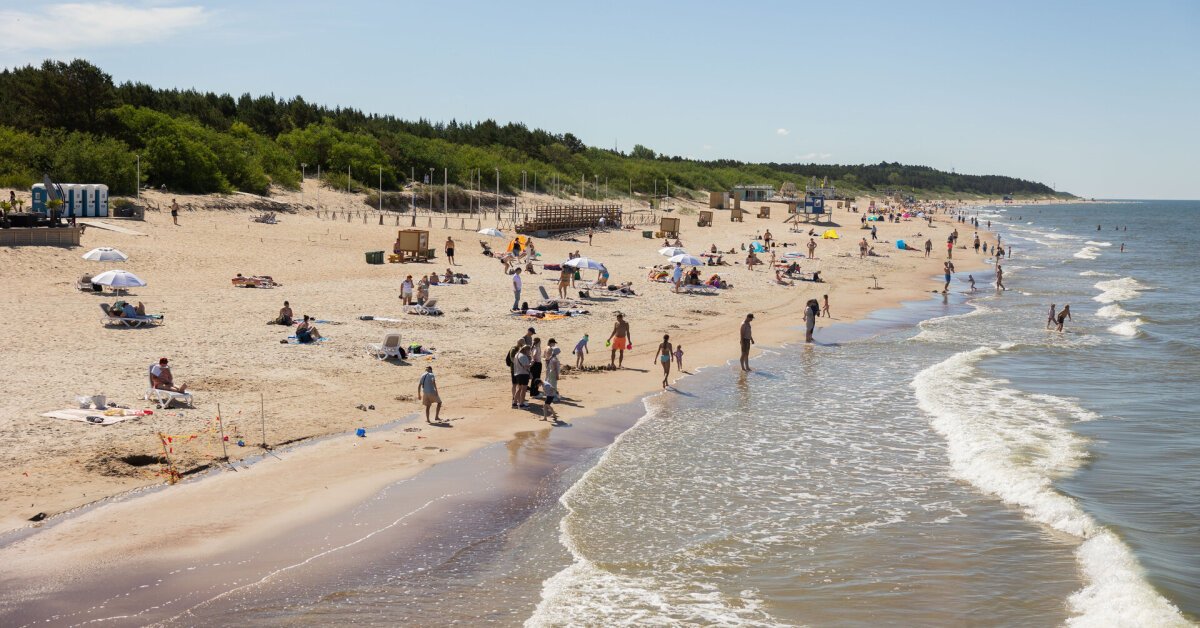
“This year’s forecasted strongest El Niño event in the Pacific Ocean will inevitably bring a hot and dry summer to us as well. Extreme heat will cause people to stay near water bodies en masse, which automatically increases the statistics of drownings”, Girmantas Neniškis, instructor of the International Surfing Association (ISA) and the International Lifesaving Federation (ILS), founder of the surfing academy “Surf Camp”, says in a press release.
Although a calm sea is forecast for the weekend, according to him, there is no need to relax. “When the sea is rough, some people feel a natural fear and swim closer to the shore or don’t go into the water at all. However, with extreme heat and a mirror-like surface of the water, the collective illusion is activated that the sea is a calm pool, which is a huge mistake. Swimming in open water is fundamentally different from a pool, so even experienced swimmers can drown without assessing all the risks,” observes G. Neniškis.

Author of the message photo/Girmantas Neniškis annually certifies lifeguards and surf coaches
One of the biggest risks this weekend is heat shock and muscle cramps. When the outdoor temperature exceeds 30 degrees, the body dehydrates quickly. An overheated person jumps into the cool sea water, the large temperature difference causes shock to the body and muscle cramps, which causes acute pain and panic in the water. That is why during the heat it is necessary to constantly consume a lot of fluids and wade slowly into the water, allowing the body to acclimate.
G. Neniškis also shares three survival rules that everyone who plans to get into the water learns at the surfing academy. They help even those who have a strong fear of water to feel safer in the water:
- Always be ready to swim. We can only move safely in water by swimming. Most of the incidents happen to “just have fun”. You cannot completely relax in the water, you must constantly assess your body position, monitor the distance to the shore.
- Breathe deeply. If you feel fatigue or panic in the water, do not hold your breath. Deep, calm breathing allows the body to float on the surface of the water and supplies the muscles with oxygen.
- Never hit rock bottom. According to G. Neniškis, this is the biggest psychological mistake. Trying to reach the bottom at any cost, a person caught in a current or a battle of waves sinks down, swallows water and begins to drown. When swimming in the water, learn to rest in a horizontal position on your back.

Author of the message photo/Extremely hot weather increases the risk of drowning and other ailments
The instructor of the International Rescue Federation reminds us that even when the waves subside completely, the currents and underwater holes of the Baltic Sea do not disappear anywhere. “We have to face situations when vacationers hang their towel on the sign “Current” or “Duobė” placed by lifeguards, go directly behind it to swim and start drowning. It is mandatory to strictly listen to the instructions of the rescuers and observe the signs even when the surface of the water is completely calm”, emphasizes G. Neniškis.
Families visiting the sea should pay special attention. According to international standards, children must be supervised at arm’s length. According to G. Neniškis, it is extremely difficult to identify a drowning child, because he drowns silently, does not shout, his airways are under water, he sinks deep, and from the side it may seem that the child is diving or playing. In addition, a small child goes underwater faster than an adult, in just 10-20 seconds, so if the parents are further away or have their eyes on the phone, tragedy can happen very easily.
G. Neniškis reminds us that the popular inflatable sleeves or wheels are just toys, not rescue tools. A wave or current can instantly turn a child upside down, and the sleeves slip off very easily from wet hands, so there must always be an adult nearby in the water who can react immediately.
“Surf Camp” is a surfing academy operating in Lithuania for almost two decades, where surfing lessons, camps for children and adults are organized and safe behavior standards are taught. The Academy constantly educates the public about safe behavior in the water, trains professional surf instructors and highly qualified lifeguards in the waves.