W800tr second chip belt planned for Honam, Chungcheong tapped as packaging hub
South Korea on Monday unveiled a blueprint for three flagship “megaprojects” centered on semiconductors, artificial intelligence data centers and physical AI, seeking to create new growth engines while promoting more balanced development beyond the capital region.
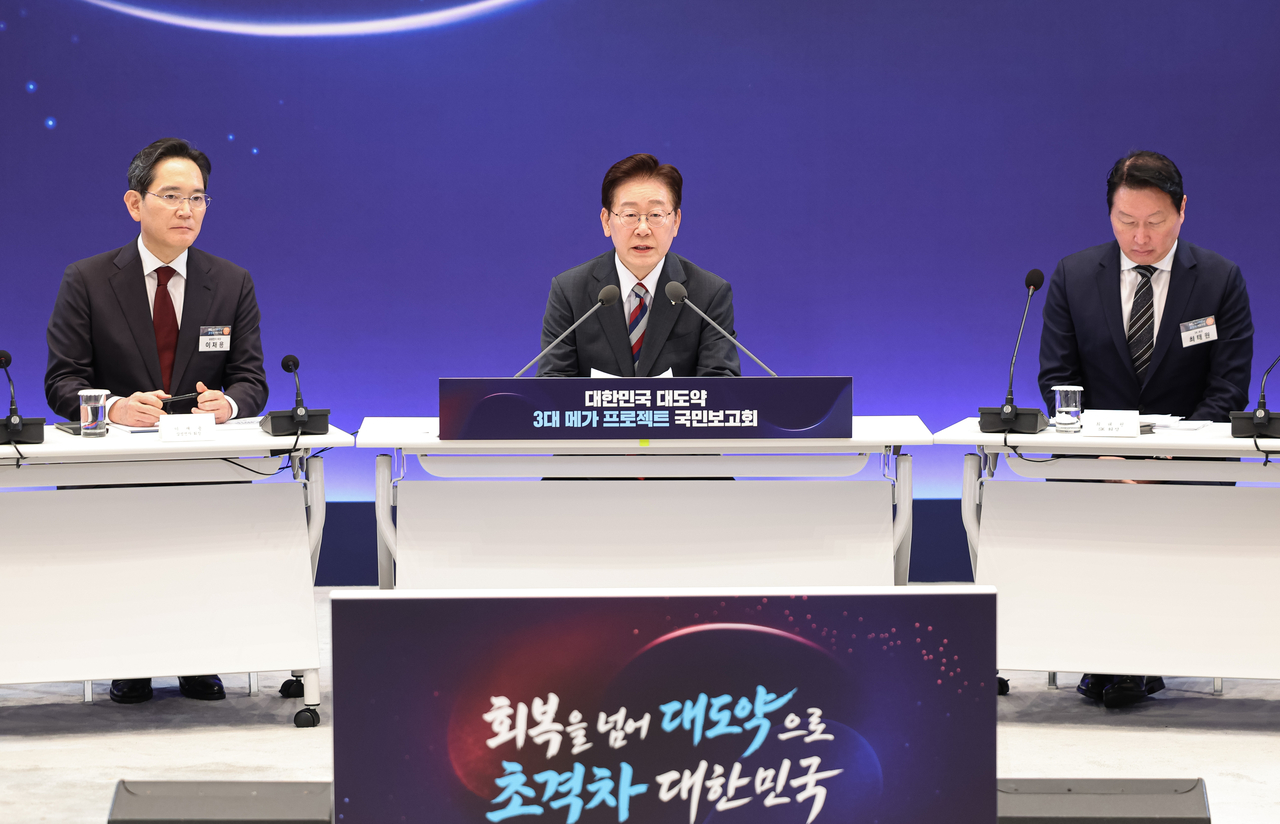
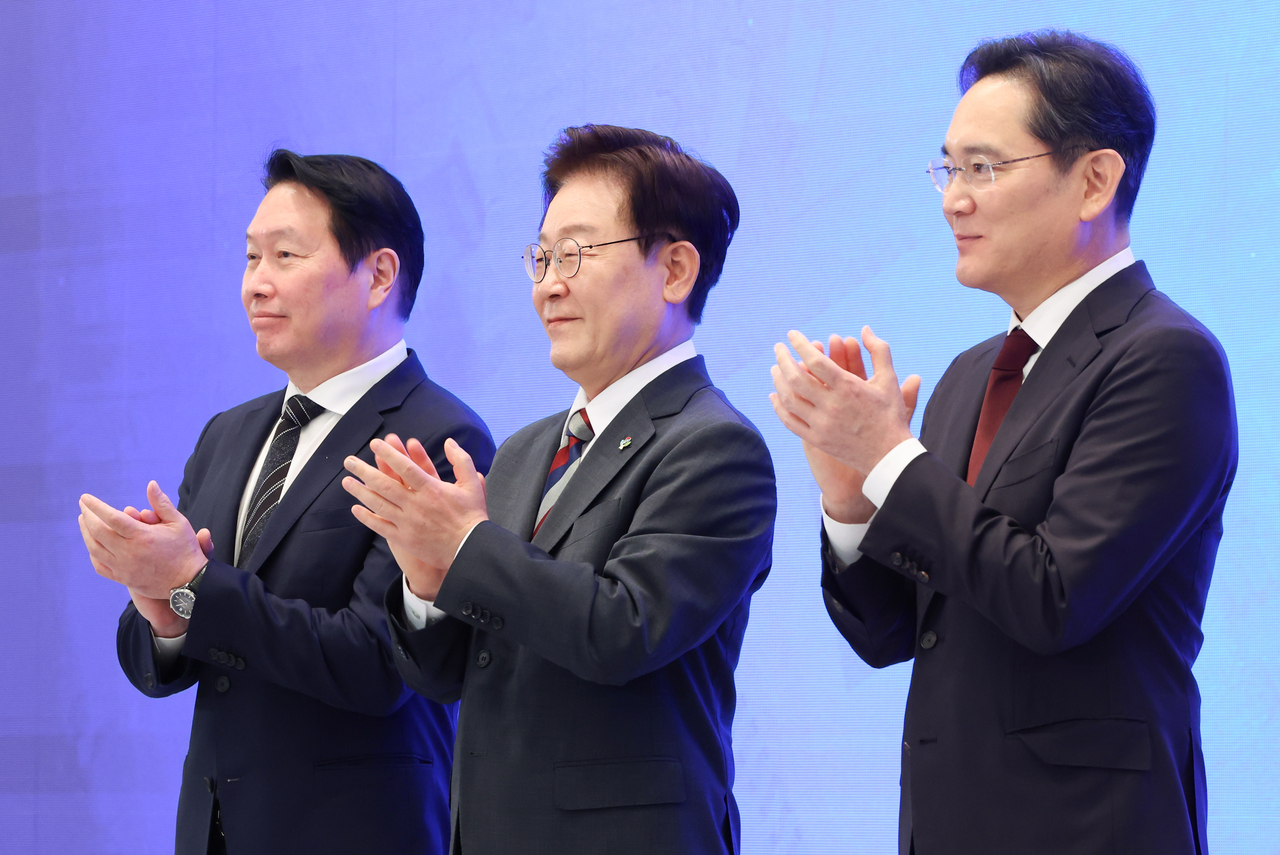
President Lee Jae Myung convened business leaders and government officials at Cheong Wa Dae in Seoul to present the projects to the public, pledging to personally oversee their implementation and ensure their swift execution.
The blueprint calls for a new semiconductor belt in the Honam region of southwestern Korea, an advanced semiconductor packaging hub in the Chungcheong region, and a nationwide expansion of AI data centers.
Samsung Electronics Chair Lee Jae-yong and SK Group Chair Chey Tae-won, whose conglomerate owns SK hynix, outlined their respective companies’ investment plans. Cabinet ministers detailed support measures ranging from power and water supplies to infrastructure development and regulatory incentives.
Lee framed the AI race as an all-out national competition, stressing that South Korea must move quickly to seize a narrowing window of opportunity, with “semiconductors, physical AI and AI data centers serving as the three pillars of the country’s next great leap forward.”
“Only a race for speed is the way to survive. We must secure the core elements of artificial intelligence faster than any other country. Semiconductors, physical AI and AI data centers are the three pillars of a great leap forward,” Lee said during the event.
“The government and the private sector must bring together all their capabilities to link these elements as one and swiftly build a Korean-style artificial intelligence ecosystem.”
Lee said Korea must build new regional bases that connect semiconductors, AI data centers and physical AI into a single industrial ecosystem. He further pointed to the need to move beyond the country’s decades-old development model centered on Seoul, saying it has reached its limits.
“There is one point I would like to emphasize in particular: a strategic approach to utilizing the regions,” Lee said. “As everyone knows, balanced national development has become a key survival strategy for South Korea.”
As one example, Lee said Korea must “secure overwhelming supply capacity in advance through large-scale new investments in regions such as the southwest,” pointing out that “existing sites centered on Yongin and Pyeongtaek (in Gyeonggi Province) have already reached their limits.”
Mapping Korea’s investment drive
Regionally, the government plans to invest 800 trillion won ($518.3 billion) in the Honam region to build four new memory chip fabrication plants for Samsung Electronics and SK hynix and establish a second semiconductor manufacturing cluster outside the Seoul metropolitan area. The project will be centered on Gwangju and South Jeolla Province, which are set to merge into a single special city on July 1.
The government also plans to invest 81 trillion won in the Chungcheong region to establish it as a key hub for advanced semiconductor packaging.
The government aims to invest 550 trillion won in AI data center capacity of 8.4 gigawatts by 2029 and expand that capacity to 18.4 GW by 2035, bringing total investment to more than 1 quadrillion won nationwide.
For physical AI, the government presented the initiative as a blueprint for fostering the sector as a national strategic industry, saying the next three years would be the “golden time” for Korea to emerge as the world’s leading physical AI powerhouse.
The investment drive is expected to be backed by unprecedented commitments from the country’s two chip giants.
At the event, SK Group pledged 1.1 quadrillion won in investments, including about 400 trillion won to develop the Honam region as a next-generation semiconductor manufacturing hub.
Samsung Group announced a 2.655 quadrillion won domestic investment plan, including 625 trillion won in regional investments, of which 425 trillion won will be directed to the Honam region.
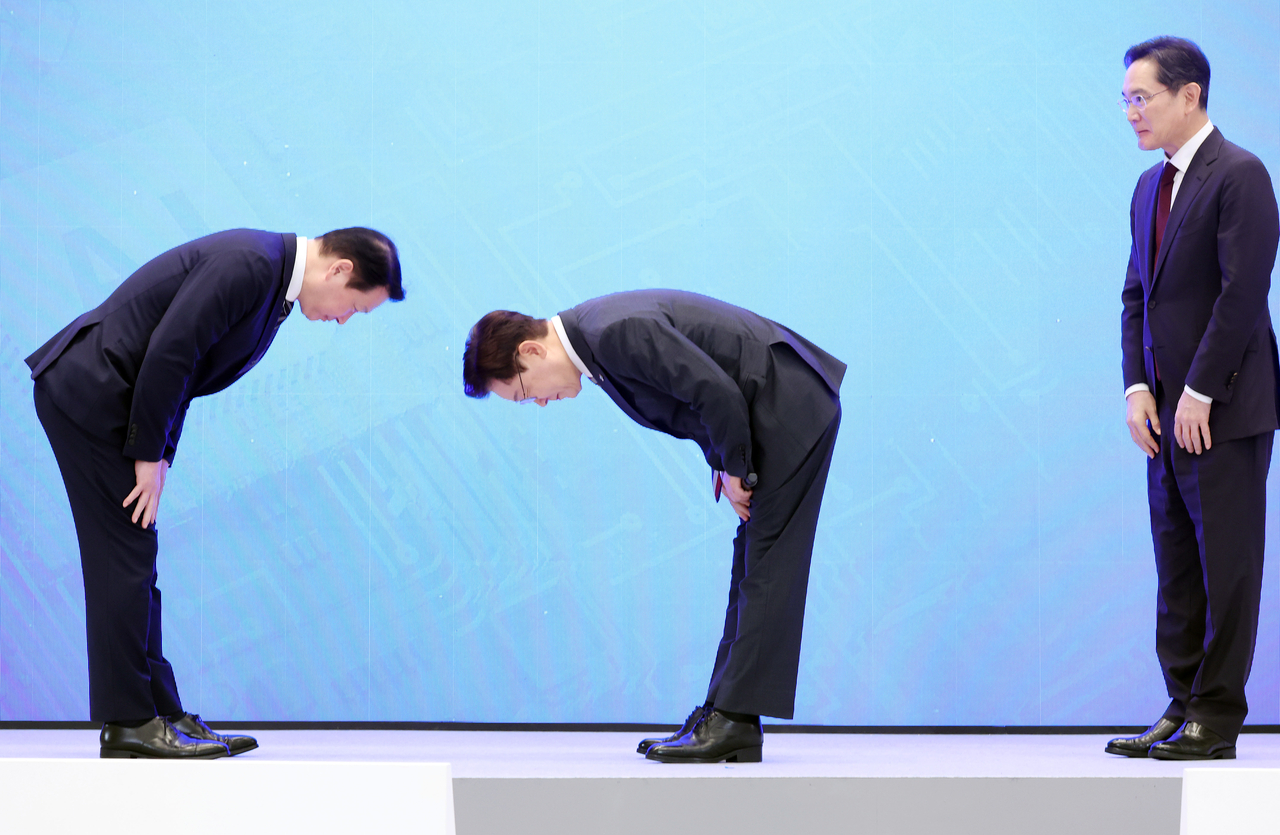
After presentations by the two chairmen, Lee praised the plans, saying, “I dare say that a new chapter in Korea’s history is beginning,” and described the occasion as “deeply moving.”
Lee added, “I would like to call the two business leaders national heroes, or heroes of the Korean people,” before bowing deeply toward them.
During the event, Lee stressed that the government is “not trying to meet national needs by forcing companies to shoulder losses and risks,” addressing concerns raised by critics over the investments.
“What the government should do is mobilize its full capacity so that companies can invest without incurring losses and with better prospects,” Lee said.
Following the event, presidential Chief of Staff Kang Hoon-sik said the government would seek to complete the second semiconductor manufacturing cluster within Lee’s five-year term in office.
“We will challenge ourselves to complete the project during this administration,” Kang said, adding that a special committee on strengthening the competitiveness of the semiconductor industry, chaired by the president, will be launched when the Semiconductor Special Act takes effect on Aug. 11.
Kang also sought to ease concerns that the massive domestic investment plans could come at the expense of overseas projects, saying, “Samsung and SK will continue with overseas investments that were already planned.”
dagyumji@heraldcorp.com