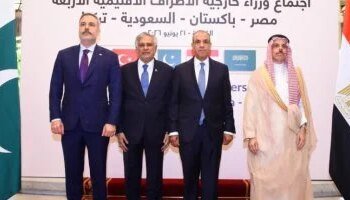
Major General Dr. Reda Farhat, Vice President of the Congress Party and Professor of Political Science, confirmed that the reception of President Abdel Fattah El-Sisi For foreign ministers Egypt, Saudi Arabia, Turkey and Pakistan, on the sidelines of the fourth meeting of the Quartet, reaffirms that Cairo has become a major center for political decision-making and regional consensus, and that Egypt continues to play its pivotal role in managing the region’s files based on its historical status and political and diplomatic weight.
Farhat explained that holding this meeting in Cairo carries important political messages, most notably international and regional confidence in the Egyptian state’s ability to lead dialogue efforts and contain crises, especially in light of the rapid developments and unprecedented challenges the Middle East is witnessing that require coordination between active regional powers to avoid sliding toward further escalation.
He pointed out that Egyptian foreign policy, led by President Abdel Fattah El-Sisi, is based on a balanced strategic vision based on respecting the sovereignty of states, supporting political solutions, and rejecting the logic of military conflicts, which gave Cairo great credibility with various parties, and made it an essential partner in various initiatives aimed at achieving security and stability in the region.
The political science professor added that President Sisi’s emphasis during the meeting on the importance of continuing the negotiating path between the United States and Iran, and supporting the implementation of understandings that contribute to reducing tension, reflects a deep Egyptian awareness that stability in the Middle East will only be achieved through dialogue and diplomacy, away from escalatory policies that threaten the security of the region and the interests of its people.
Farahat stressed that the Egyptian position remains steadfast towards the various issues of the region, foremost among which is the Palestinian issue, as it is the central issue that cannot achieve comprehensive peace or lasting stability without reaching a just solution to it in accordance with international legitimacy resolutions, and establishing an independent Palestinian state on the borders of June 4, 1967, with East Jerusalem as its capital.
Farahat pointed out that the ongoing Egyptian movements reflect a comprehensive vision aimed at re-establishing the equation of regional stability and enhancing cooperation between the countries of the region, in a way that preserves Arab national security, and confirms that Egypt, under the leadership of President Abdel Fattah El-Sisi, will remain the country most capable of building bridges of consensus, creating balances, and advancing peace and development efforts in the Middle East.