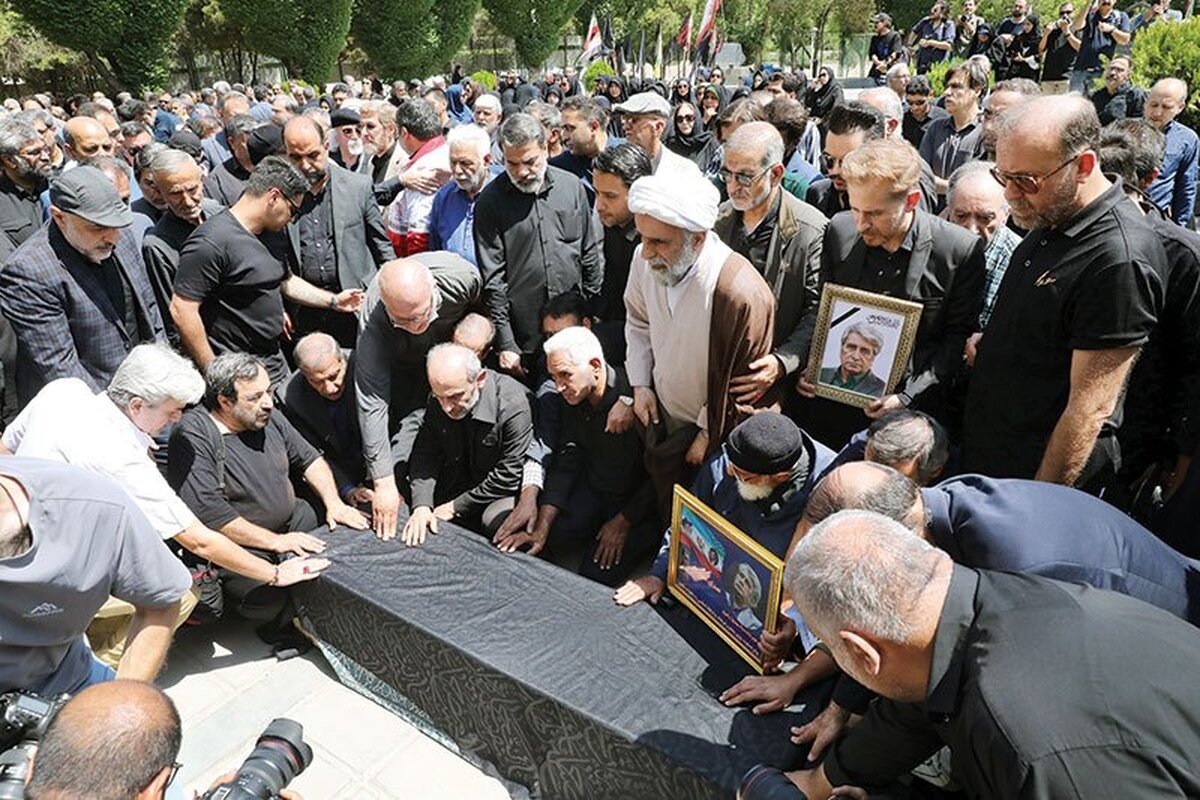
What added to the sorrow filled with respect for this ceremony was the resounding of Ustad Razavi’s pleasant voice, which filled the atmosphere of the ceremony with speeches of his devotion and love for the family of Immaculate and Purity, especially Aba Abdullah al-Hussein (a.s.) and Hazrat Ali bin Musa al-Reza (a.s.). In this ceremony, the head of National Media mentioned the place and role of Razavi in the country’s media memory.
Razavi was a part of the historical memory of the national media
Dr. Jabali, head of the Broadcasting Organization, referring to the death of this veteran radio announcer, said: “The late Razavi went to God’s mercy on the first night of the month of Muharram and on the eve of the martyrdom days of Seyyed al-Shahada (PBUH), and it is hoped that he will join the caravan of the martyrs of the Karbala plain during these days.”
He stated that in recent years, especially in the last one or two years, the national media has suffered many losses due to the death of its veterans, and added: The likes of Professor Razavi were not just colleagues or professors, but they were part of the historical memory of the national media, who are no longer among us.
Referring to the passing away of figures such as Professor Manouchehri, Professor Valizadeh and Professor Tahmasab in recent years, Dr. Jabali emphasized: The loss of the late Razavi is also a great and irreparable loss for the Broadcasting Organization. Because these elders have shaped the history of media and radio during their decades of activity and have left valuable memories and lessons for future generations.
The head of the Broadcasting Organization also emphasized the need to pay more attention to the veterans present in the national media and said: We should appreciate the veterans who are still among us and benefit from their experience, knowledge and expertise more so that the loss of these elders does not mean the loss of a school and experience. He stated that the national media does not rely only on sound and image, and stated that Sedavsima uses sound and image as a tool to convey belief, faith, belief, culture and civilization as well as love for the country and homeland. He also expressed his condolences to Behrouz Razavi’s death to his family, radio colleagues, and employees of the Broadcasting Organization, and said: Master Razavi’s voice will remain with us forever, and his memory will always be respected and cherished by us. God willing, may God make the soul of this respected master the companion of the great, the righteous, the saints and the innocent.
The enduring voice of radio culture and prestige
Ahmad Pahlavanian, deputy voice of Sada, also said on the sidelines of Behrouz Razavi’s funeral: Today, the country’s big family of media and culture is losing one of its most valuable assets. Behrouz Razavi was not only a speaker; He was the owner of a voice that remained in the minds and memories of several generations of audiences with dignity, knowledge, ethics and professional commitment. His effective presence on the radio for many years gave credibility and authenticity to this medium and registered his name in the history of Iranian broadcasting.
He continued: Professor Razavi was a noble, humble and kind person, along with his unique ability to perform and narrate, who was always considered a valuable role model for younger colleagues. His loss is a great loss for the media community and especially for the radio family, but his professional and cultural legacy will remain in the listening memory of the Iranian people. Undoubtedly, his warm and lasting voice will remain alive in the memory of the audience and his memory and name will be cherished forever.
Razavi’s knowledge and mastery of Persian literature and language
In another part of this ceremony, Farhang Joulii, a producer and a longtime friend of Behrooz Razavi, referring to more than half a century of friendship with this artist, said: We had friendship and friendship with each other for more than 50 years, and losing him is very difficult and sad for me. Many people knew Behrooz Razavi with his unique and pleasant voice, but what made this voice more lasting was his knowledge, culture and mastery of Persian language and literature. He was a capable artist, a professional person and a cultured personality. He added: Behrouz Razavi always believed that life is short and one should take advantage of its opportunity to do good, make others happy and be kind. His thought and belief was that a person should not cause harm to others and as long as he is alive, he should be kind to those around him. Although some of our joint programs did not continue, his memory and human look will always remain in the minds of his friends and lovers.
Lives forever in memories
Azra Vakili, a radio announcer, also said in this ceremony: Death is a law that is prescribed for all creatures, but some people leave such an impression that their memories remain in the minds forever. Behrouz Razavi was one of these people; Someone whose warm, friendly and pleasant voice will always remain alive in memories.
Referring to his first professional collaboration with Razavi, he added: My first close and professional acquaintance with him goes back to about 37 years ago; When I was working as a producer of Qaseh Shab radio program. His kind, warm and catchy voice gives a special effect to the program at the beginning and end of each story. I have seen many times that he guided the young speakers with patience. Fortunately, the voice of this enduring announcer will remain in the radio archive and listening memory of the Iranian people.
He was a teacher of ethics and humanity
Daoud Heydari was another speaker of this ceremony who said: We are involved in daily life and sometimes we forget what people spent their life, life and youth behind the radio microphone and camera so that we can know more, learn and reach peace. Behrouz Razavi was one of the professors from whom I learned a lot not only in the field of work and media, but also in the field of knowledge, humanity and ethics.
He continued: Behrouz Razavi was not just a voice or a radio announcer; He was a multifaceted artist, familiar with music and painting, and at the same time, he was a calm, patient and magnanimous person. He also treated his students as a friend in speech classes. I am sure that the name of Behrouz Razavi, like all those who have left a lasting impression, will remain eternal in the history of Iranian culture and media.
knowledge; The hidden identity in Razavi’s voice
Seyed Abbas Sajjadi also pointed to the cultural aspects of Behrouz Razavi’s personality and said: If we know Behrouz Razavi only as a speaker, we have done him a disservice. Although speaking has a valuable position, Razavi was more than a speaker; He was a writer, cultural researcher and an artist whose depth of knowledge and mastery of the Persian language gave his speech a unique identity.
He added: What distinguished him from others was not only limited to the beauty of the voice; Behind this deep cultural sound, there was a wide study and a detailed knowledge of the language. It was enough for him to utter a sentence for the listener to recognize that this is Behrouz Razavi’s voice. Many may not know that he was also active in the field of poetry and song, and these characteristics made him a cultural and lasting personality.
My father was the support of our life
In this ceremony, one of the most intimate parts of the program was dedicated to the words of the artist’s son; where Razavi’s family appreciated the presence of those present in this event. Raman Razavi, the living son of Behrooz Razavi, said on behalf of the family: On behalf of myself and my brothers, Roozbeh and Ravi, I sincerely thank you all for your warm and loving presence. Your companionship and sympathy in the grief of losing our beloved father is a source of encouragement and peace for our family. He added: My father was not just a father; He was a strong support, guide and role model in our lives. We learned honesty, kindness and respect for others from him and I hope we can continue his way and character.