The Democratic Party found itself in a difficult political position in the face of the citizen protest against a tourist project in the Narta lagoon in Zvrnec, behind which stands Jared Kushner, President Trump’s son-in-law.
In the first days of the start of this protest, President Sali Berisha declared that he agreed with the investment and that Albania should welcome foreign investments and attacked those who were criticizing the opposition from the protest, describing them as “the opposition against the opposition” and “the real misery of politics and Albanian citizenship”.
While a senior exponent of the DP, Flamur Noka went even further, calling on the protesters to remove the “Trojan horses”, “mercenaries” and “kamikazes” who, according to him, were trying to divert the movement.
These positions showed a distance between the largest party in the opposition and a protest that was instigated by environmental activists and ordinary citizens, immediately creating the perception that the PD was against this protest, which served to direct the anger of the protesters in addition to the government and Prime Minister Edi Rama to the head of the PD, Sali Berisha, a protagonist in Albanian politics since 1990.
Berisha came out with a public position only on June 8, putting the PD from a defensive position against the protesters’ criticism to fully supporting their five demands and the protest itself.
To show this support with actions, the democratic parliamentary group took a legal initiative demanding the repeal of some controversial laws of the “Rama” government that are directly related to investments that endanger protected areas, such as the one on ‘Strategic Investments’, the law on ‘Protected Areas’, the ‘Mountain Package’ and on ‘Cultural Heritage’.
Even on Wednesday, during the meeting of the parliamentary group, Berisha insisted that the opposition had always been against the laws that have enabled interventions in protected areas and that the protest should be supported.
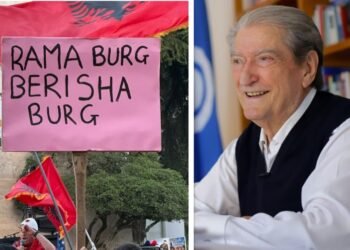
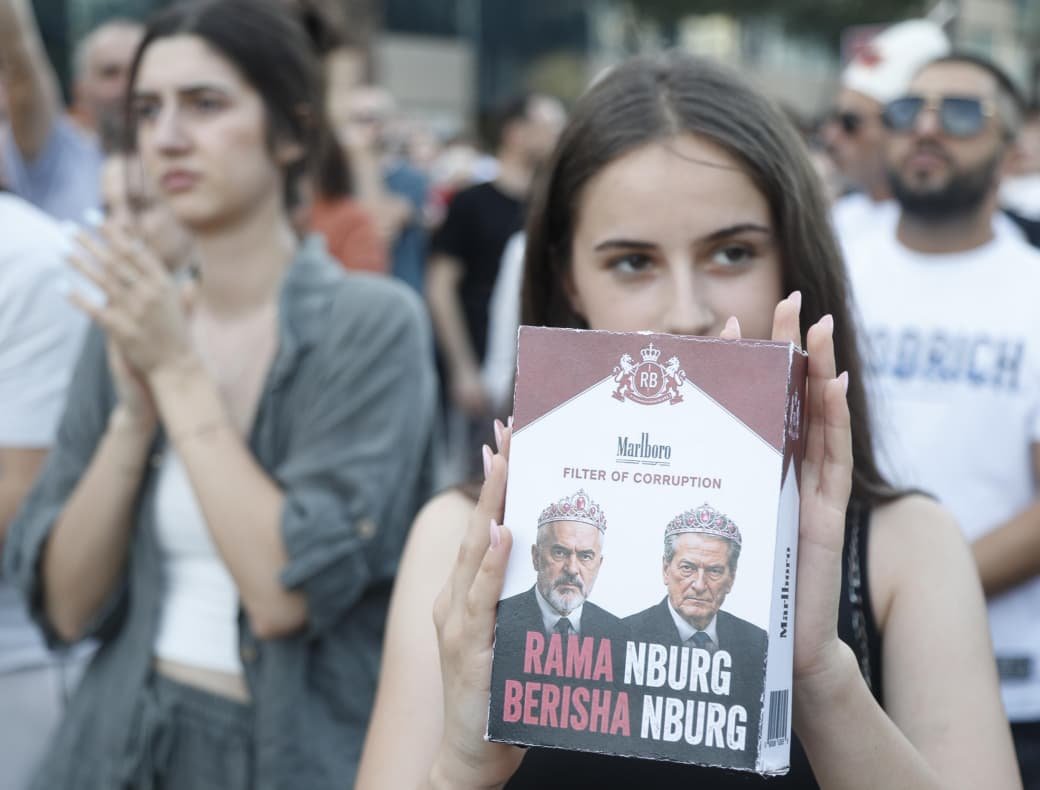
But the slogan “Rama in prison, Berisha in prison” has already become one of the main slogans of the protest and comes after the request for the Prime Minister’s resignation.
In a civil revolt that has united individuals of different political persuasions and different social groups against corruption and the current model of governance, the Democratic Party has found itself in an unusual position. For the first time in many years, the largest opposition force is not only not playing a leading role in the protest, but is being accused by some of the protesters of being part of the political establishment they seek to challenge.
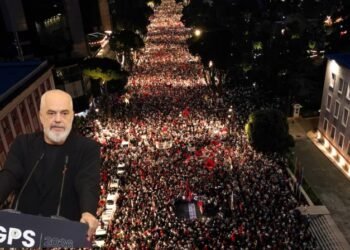
While the Democratic Party failed to position itself in time for this protest that today has received an international echo, some of its deputies were more clear in their public attitudes and many of them are these days and in the middle of the crowd of tens of thousands of protesters who march in the streets of Tirana for hours.
The deputy of Tirana, Belind Kelliçi, told BIRN that he had taken a public stance since the day the incident happened in Zvërnec during a speech in the National Assembly of the DP and then denounced in Parliament the robbery of properties in this area and in other areas of the South.
But he admitted that DP did not have an official political position at the beginning of the protest and every reaction has been on personal lines.
“My family has been protesting every day, I myself wanted to join them, but I respected the call of the protestors not to create any incident and I participated in the marches after the protest on several nights as a citizen,” said Kelliçi, adding that despite not supporting calls against the leader of the opposition, he believed that “there are more things that unite us than divide us”.
Regarding Berisha’s statement on June 3, he believes that it was misunderstood and was not an attack on the protest.
“The cause of the protest is major and the demands of the protesters are in tune with our positions that we have taken against the laws that this government has adopted for protected areas and strategic investments”– emphasized Kelliçi.
Even Jorida Tabaku, a member of parliament who has continuously opposed the law on strategic investments, the one on protected areas and other government initiatives that have opened the way for investments on the coast or protected areas, told BIRN that neither she nor PD is against the protest, but that they support it.
“Since the first day of the protest, I have seen many democrats there, members of the structures of the Democratic Party and people who make up its base. I have also met citizens with different political convictions, right-wing, environmentalists, disappointed left-wingers, including people who voted for me personally,” she said.
While she refused to comment on the different positions of her democratic colleagues, Tabaku comments on the protest as a civic spirit that does not belong to any political force but that “reflects a dissatisfaction that goes beyond party boundaries” and that unites “the opposition to the political and economic system that is impoverishing the country and excluding the majority of Albanians”.
Tabaku considers the protest as legitimate and against a system against the way Albania has been governed during these 13 years. “And when citizens demand change, the opposition cannot be against them; it must be part of this struggle to change this system”– she concluded.
For political analysts, the DP’s hesitancy to support the citizen revolt showed that the main opposition party had fluctuations and indecision, while the reversal of the course is considered delayed.
“The DP made a mistake with its initial stance towards the protest”- Ermal Hasimja, lecturer of Political Sciences, told BIRN, a position that, according to him, showed “fluctuation and indecision”.
However, he believes that Berisha’s initial stance was more misinterpreted than an attack on the protest.
“In fact, he did not oppose the protest, but he supported the American investment involvement and attacked those who put Rama and the opposition in a bag, and this was interpreted as opposition”- he added.
For Hasime, the slogan that equates Rama with Berisha does not serve the cause of the protest and seems to suit him “the strategy of Rilindash which practically has been to convince the electorate that everyone is the same”.
“People may be disappointed by the entire political elite, but at this moment the equalization of responsibilities removes the focus from the real responsibility that is socialist governance,” he emphasized.
Even Rigels Xhemollari, head of the “Civic Center” organization, considers the PD’s reflection and support for this protest to be late and connects this with Berisha’s own political interests.
“Other interests related to the Trump family and the Zvrnec project prevailed for the DP leader over the interest of the citizens,” he told BIRN.
According to Xhemollari, the protest also created divisions within the party itself, between those who wanted to be in the protest and those who opposed it, such as the general secretary, Flamur Noka. “Even the media and journalists close to the DP followed the line of mudslinging and attacking the protest,” he added about the first days of the protest.
According to Xhemollari, only when they saw that they did not succeed in undoing them, they decided to support him, but turning a blind eye to the main slogan ‘Rama n’burg Berisha n’Burg’, a slogan related to the behavior of this party towards the ruling party or its previous government.
“Citizens in protest make the DP complicit for the bargains and agreements at the expense of the national interest, they see it equally as enemies of the SPAK and the new justice and do not believe that this opposition offers you a fair political-economic system,” he concludes./BIRN