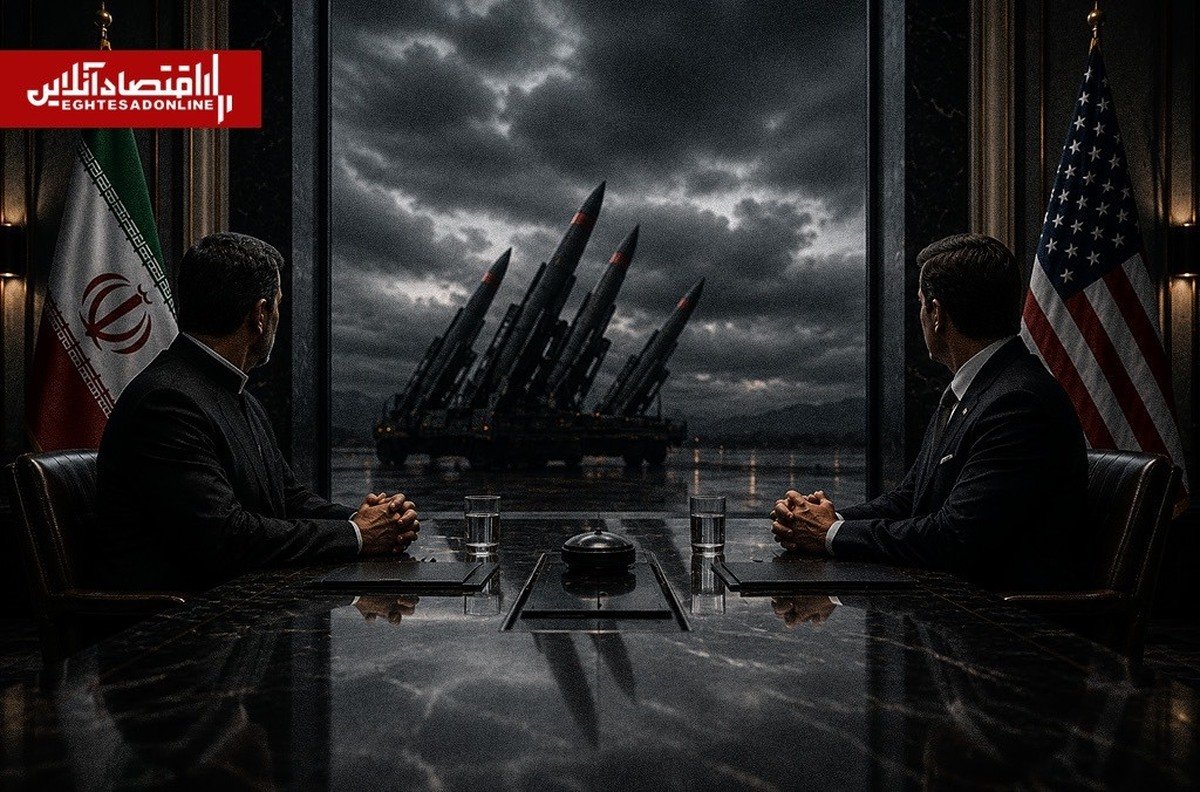
Economy Online, Amir Mohammad Hosseini: The second consecutive night of conflict, this time it was heavier; The ceasefire between Iran and the United States has become more shaky than ever, and the possibility of an agreement is fading. Iran’s Foreign Ministry says that the US attacks have made the ceasefire “practically meaningless”.
On Thursday evening, the United States Central Command (CENTCOM) announced that it had launched a new round of airstrikes against targets on Iranian soil under the direct order of Donald Trump. The attacks, which were quickly met with Iran’s missile and drone response to the US bases in Jordan, Bahrain and Kuwait, but finally ended on Thursday morning.
At the same time, there were reports of the simultaneous presence of a high-level delegation of Qatari negotiators in Tehran. According to some sources, this delegation came to Iran to convey Trump’s message to Tehran or to try to hold a tripartite meeting to resolve disputes.
Of course, before the American attacks, the American president had threatened that the bombing would be carried out and had claimed that Iran had lost the opportunity to reach an agreement and had to pay the price.
Now the question is whether Iran and the United States will hit the last wire and enter into a full-scale war again, or are these limited wars a pressure lever to reach an agreement?
From the shores of Sirik to the suburbs of Mehrabad
According to official statements and field reports, the US attacks last night targeted several key points in the geography of Iran’s drone defense and guidance. The explosion was heard in areas such as Minab, West Bandar Abbas, Sirik and Qeshm Island.
Although some reports of rockets hitting Asalouye petrochemical complexes were denied by local authorities, Trump’s confirmation of the firing of 49 Tomahawk missiles and the proximity of some of them to a radius of 40 miles from Tehran, shows that Washington has moved the previous red lines.
After these attacks, the central headquarters of Khatam al-Anbiya, as Iran’s war management headquarters, immediately ordered the complete blockade of the Strait of Hormuz for all commercial vessels and oil tankers. Minutes after this order, the IRGC Navy announced the targeting of two offending ships in this strategic waterway; The action that pumped the tension to the world markets and the price of Brent oil in the Asian markets quickly passed the mark of 95 dollars per barrel.
Low intensity war and pressure to agree
During last night’s attacks, Trump claimed that he ended the attacks due to direct calls and requests from Iranian officials. The claim, which was immediately called false by the IRGC, seems to be more of a media attempt to manage domestic public opinion than a fact.
Some observers say that Donald Trump still has no intention of entering into a full-scale war with Iran. Western media reports such as the Wall Street Journal and Axios have revealed that Trump was not seeking a full-scale war in the White House situation room, but rather “controlled military pressure” to force Tehran to accept his tough terms in the talks.
Trump even sent a message to Tehran through Qatari intermediaries that these attacks were just a reaction to the helicopter accident. However, it seems that Trump’s calculations do not fully match the realities on the ground. American officials have admitted that Trump did not foresee the truce collapsing so quickly or that Iran would launch missiles and drones without restrictions and close the world’s energy bottleneck.
This situation has put Trump in a sensitive position, especially considering the rise of inflation to the highest level in the last three years in the United States and the growth of fuel prices that threaten his economic achievements.
Differences in the positions and goals of Tehran and Washington
Intelligence reports and analyzes of regional media, including assessments of the Israeli army, which has turned its main front towards Iran, show that the main root of these conflicts is the deadlock in the negotiations.
Washington is looking for an end to this crisis that the world will recognize as an “absolute American victory”. For this reason, stopping uranium enrichment and plans such as control over a part of Iran’s oil and gas industries in exchange for reconstruction, which practically targets the country’s national independence, have been proposed in this regard.
But on the other hand, Iran has repeatedly shown that it will never abandon its nuclear program as a national achievement and a deterrent. No authority in Tehran has the potential or authority to grant such structural concessions under military pressure. This fundamental contradiction between the demands of the two sides has greatly reduced the possibility of reaching a lasting agreement and has seriously challenged the effectiveness of mediators, such as Qatar and Pakistan, who want to return to the diplomatic table.
future scenarios; From gradual erosion to a major war in the region
With the relative subsidence of the attacks on Thursday morning, the key question now is whether these conflicts will be contained or the region will move towards an all-out confrontation.
The first scenario is the continuation of the low-intensity war and the attrition siege, which is the most likely scenario. Realizing the terrible costs of an all-out war, America will try to continue the low-intensity war model. A war that is a combination of point missile attacks, naval blockade and economic pressure. Trump’s goal in this scenario is to wear down Iran’s economic structure without opening the Pandora’s box of a regional war. In this model, Tehran will turn to a proportionate and equal response strategy to maintain the balance of terror.
But at the same time, there is a possibility of a complete collapse of the ceasefire and escalation of tension. If one of the attacks miscalculates or causes heavy casualties, the situation will be out of control of the situation rooms. In this scenario, the long-term closure of the Strait of Hormuz, Iran’s extensive drone attacks on US regional bases, and the direct entry of actors such as Israel into the fray, can turn the crisis into a full-scale regional war. An option that Trump is fueling by threatening more heavy bombing in the coming nights, but the economic consequences for the world will be intolerable.
The third scenario is the forced revival of diplomacy under the pressure of war. In such a situation, both sides, realizing that the costs of war exceed its gains, retreat from the brink and agree to mediation. Of course, this agreement will probably not be a comprehensive treaty, but rather a preliminary and temporary understanding to manage the tension and reopen the Strait of Hormuz in exchange for the relative reduction of immediate pressures.