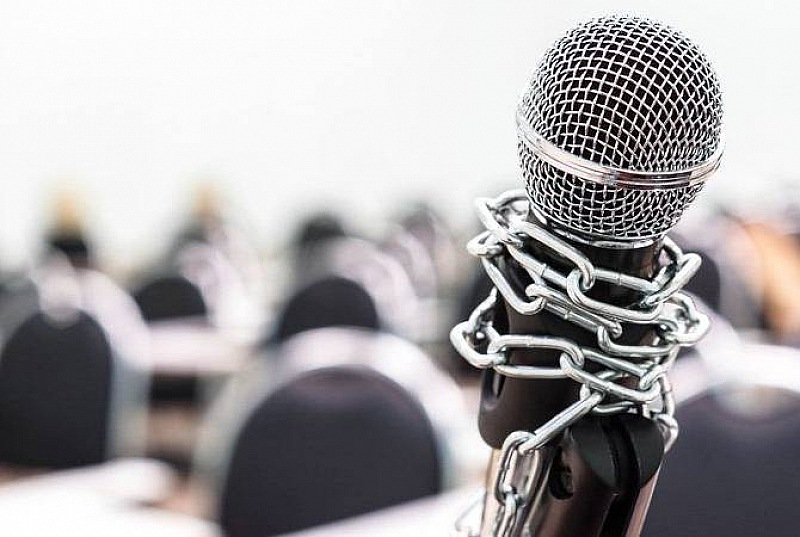
The inclusion of our country in the group of “problematic” countries is not an isolated event, but the result of chronic processes that have been systematically eroding the media environment for years. While in the northern and western parts of Europe the freedom of the press remains a pillar of stability, in our region it becomes a fragile construct subject to constant pressures that are simultaneously political, economic and institutional.
The issue has three faces that often intertwine into one, stifling independent voices. The first is the deep political influence, which is manifested already in the formation of the regulatory bodies. When the appointments in the institutions responsible for the media environment become a political bargain, the public media lose their capacity to be an objective corrective, becoming rather the mouthpieces of power.
The second person is economic possession. In a small country like Bulgaria, where the owners of large media groups rarely limit themselves to journalism, editorial policy turns out to be directly dependent on their interests in other sectors such as construction, energy or trade. This creates an environment where the truth is dosed according to the owner’s business needs rather than the public interest.
The third, and perhaps most dangerous, pillar of pressure is physical and institutional harassment. While the direct threats from the era of previous administrations have evolved, they have not disappeared, only changed form. The emergence of the so-called slap cases – strategic lawsuits designed to financially and mentally drain investigative journalists. This phenomenon creates a “chilling effect” where the fear of damaging lawsuits forces newsrooms to self-censor. In the countryside, journalists are even more isolated, often facing off against local feudal lords or corrupt structures alone, with no real protection from state institutions that demonstrate a worrying lack of will to investigate abuses.
However, it is important to understand that this is not just a “journalists’ problem”. Every time an investigative story is stopped by a court or self-censored, a citizen loses control of public funds. A lack of critical journalism means a lack of oversight of public procurement, infrastructure projects and budget blunders.
Thus, corruption, which remains hidden due to the lack of media pressure, turns into direct losses for every tax payer – from broken roads to substandard health care. A free media is the only effective mechanism for accountability, and when it is invalidated, society loses its right to demand accountability from those in power.
In the context of modern technology, the fight for freedom becomes even more complicated. In an environment where trust in the mainstream media has eroded, a dangerous vacuum opens up, which is immediately filled by misinformation and propaganda. In a world where artificial intelligence can generate fake news and deepfake videos in seconds, citizens’ critical thinking is their only defense. When journalism is weak, people stop trusting facts and start trusting algorithms that often serve fringe and radical interests. This “infodemic” makes democracy even more vulnerable because it is no longer just fighting political censorship, but a chaos of disinformation that blurs the line between truth and lies.
Despite this grim picture, there are indications of resistance. Bulgaria has seen the rise of independent platforms and niche investigative projects that survive through donations from readers, turning into a kind of “guerrilla” journalism. This model of funding, directly from citizens, is one of the few ways to ensure independence from political and corporate puppet masters. Comparing us with our neighbors from the region, it can be seen that the trends are not the same – while some countries manage to reverse the direction of regression, others stagnate. This proves that the way forward is not predetermined.
To get out of the “problem” group, concrete, systematic steps are needed. First, complete transparency of media ownership so that each user knows who is behind the particular source of information. Second, legislative reforms to criminalize and limit slapping cases, protecting the right to public debate. Third, a serious state media literacy policy to teach citizens to recognize manipulation in the age of artificial intelligence.
The fight for media freedom is not a fight for ratings or professional prestige, but a fight for trust, without which any society, no matter how technologically advanced, is doomed to collapse. Until journalism in Bulgaria becomes a shield against corruption, and not its victim or accomplice, the country will continue to wander on the periphery of European democratic standards.