Several days after the presidential election, the count is at more than 93% of the votes counted, according to the website of the Office of Electoral Processes (ONPE). First place is occupied by Keiko Fujimori (Fuerza Popular) with 17% of valid votes. He is followed by Roberto Sánchez (Together for Peru) with 12% and very close behind Rafael López Aliaga (Popular Renewal) with 11.9%. The difference between the two is around thirteen thousand votes. And there are still more than five thousand records observed or contested, whose acquittal will be decisive in defining the candidate who competes against Fujimori, who goes to the ballot for the fourth time.
As usual, the concentration of the vote is very different in the various areas of the country. In Lima there is a clear preference for the right-wing candidate López Aliaga with 21%, while in the south the left-wing candidate Sánchez has greater support, as in the case of Cusco with 23%. In Loreto, an electoral district in the east, Fujimori has 28%, as well as in districts in the north of the country such as Tumbes or Piura. While Peruvians living abroad voted 26% for the Renovación Popular candidate and 17% for Fujimori.
The polls the day before anticipated a three-way tie for second place. High vote volatility was reported in recent days, in which the publication of surveys was prohibited. Five candidates account for approximately 50% of the votes cast. The truth is that political fragmentation is once again evident as in 2021, since two candidates will compete in the second round who together do not reach 30% of valid votes, approximately 25% of votes cast.
On the other hand, the projection of electoral participation exceeded that registered in the 2021 elections during the pandemic. And the case of Peruvians abroad is significant, since an attendance of 40% has been recorded, much higher than the historical participation.
An atypical election day
Election day did not take place with the normality with which elections are usually held in Peru. There were serious logistical failures in the distribution of electoral material in Lima that affected the opening hours of voting tables, which affected the legitimacy of the process. The National Election Jury (JNE) has filed a criminal complaint, while the Comptroller’s Office and even Congress have initiated control actions by summoning the electoral authorities.
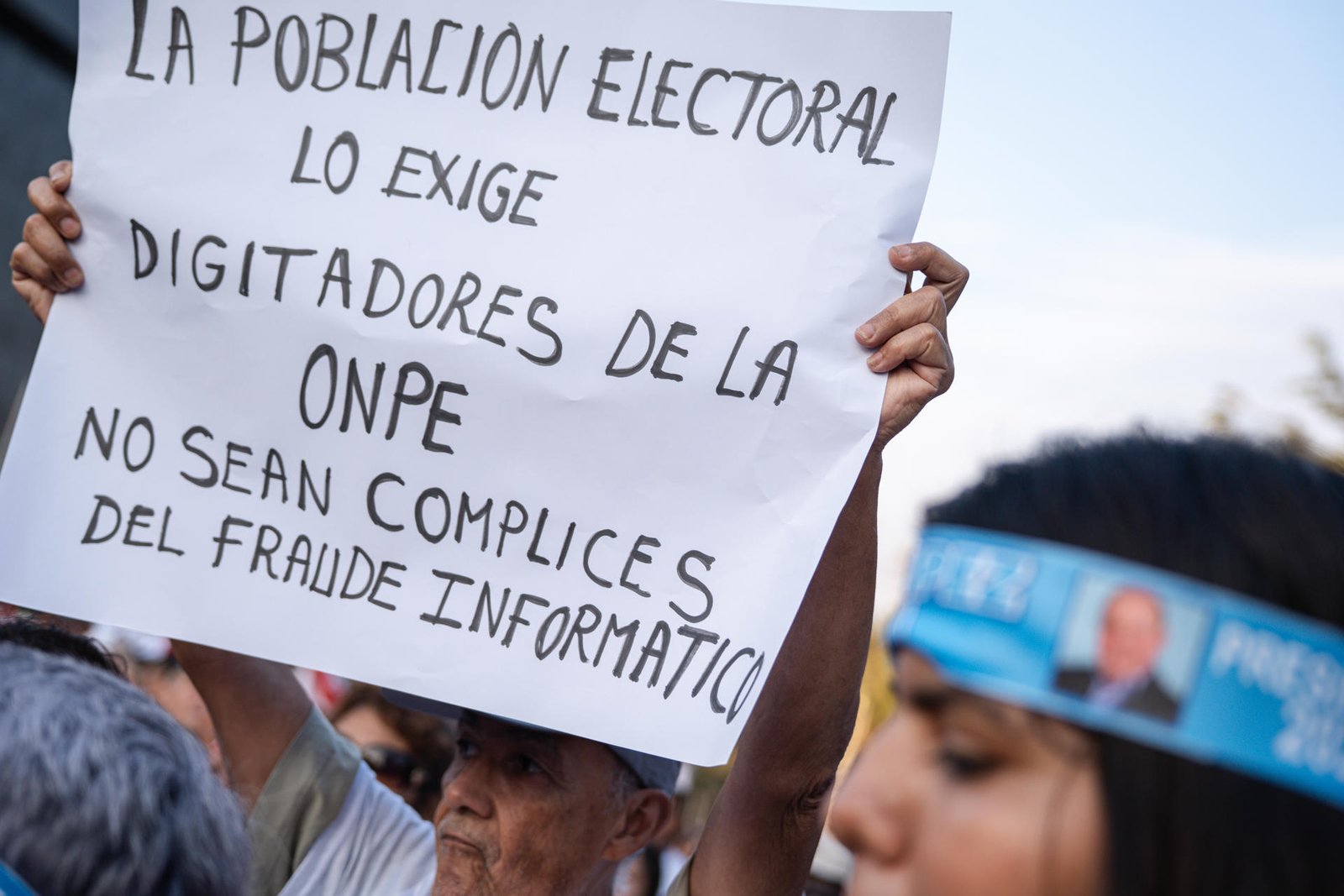
In the days following the election, López Aliaga has denounced fraud through a premeditated operation to affect a certain group of his voters in the capital. Other candidates who were postponed in the election have joined the call for a new electoral process. Sánchez has announced mobilizations if the electoral result is not respected. To date there are more than a dozen requests for annulment of elections, but this case is only foreseen when two-thirds of the votes are null or blank. The JNE must resolve these requests, as well as the challenge of minutes. Their spokespersons indicate that this process may take a few more weeks.
The investigations will determine the reasons for the irregularities, unusual in electoral processes in the country. However, from there to fraud or premeditated operations to affect a certain group of voters there is a leap for which there is no evidence.
The greatest damage generated is regarding distrust in the elections and in the electoral bodies themselves. According to the National Institute of Statistics, in 2017 distrust in the ONPE was 68.5% and 71.4% in the JNE. In 2025, this grew to 77.9% and 80% respectively. The accusation of electoral fraud in 2021 undoubtedly contributed to this, which could not be proven in the JNE bodies or in the investigative commission created for this purpose in Congress.
Second Round Scenarios
On June 7 will be the second round of elections. A first scenario is that the race pits the right-wing candidate against the left-wing candidate who claims Castilismo. This would once again polarize citizens around ideological axes and reopen territorial cleavages between Lima and the Andean north and south. In that case, the challenge will be to attract the moderate electorate that does not identify with any of the extremes.
A second scenario is a second round between two right-wing candidates. This would confront two different profiles: a more popular right versus a more conservative one. In that case, the anti-vote will play a central role and the campaign strategies will be decisive. Deepening the confrontation can affect the future parliamentary coalitions necessary to govern in a Congress without a majority of any party.
The new Senate
On the other hand, as of July Congress will once again be bicameral. Who wins the presidential elections will be decisive for the parliamentary dynamics. In recent years, the constant changes in the presidency of the republic have distorted the classic relationship between government and opposition. In fact, even though the official results are pending, with the information available it can be stated that in no scenario will the executive have its own majority.
A Senate is projected to be made up of six political parties, three of which are new and to the extent that they would be the same in both chambers, party coordination of the legislative agenda is expected. This fact is not minor since the senators do not have a legislative initiative and could reach a consensus with the deputies of their party.
In Peru, the Senate has great veto power. Fuerza Popular would obtain 22 of the 60 seats, so it could control that veto for decisions that require a two-thirds vote, such as a presidential vacancy due to permanent moral incapacity. Furthermore, the possibilities of assembling coalitions do not depend only on the political parties but on the articulation they achieve within their benches, since the link between politicians and their parties is very weak, as shown by the numerous cases of transfuguismo.
In short, the electoral process has not closed the cycle of political instability in Peru and institutions remain weakened. The scenarios that open up depend on how much the political system can absorb the discontent derived from the result of this first presidential election. Meanwhile, some regions and parties are already in another campaign, that of the subnational elections that will be held in October.
*This article was originally published in Latin America 21.