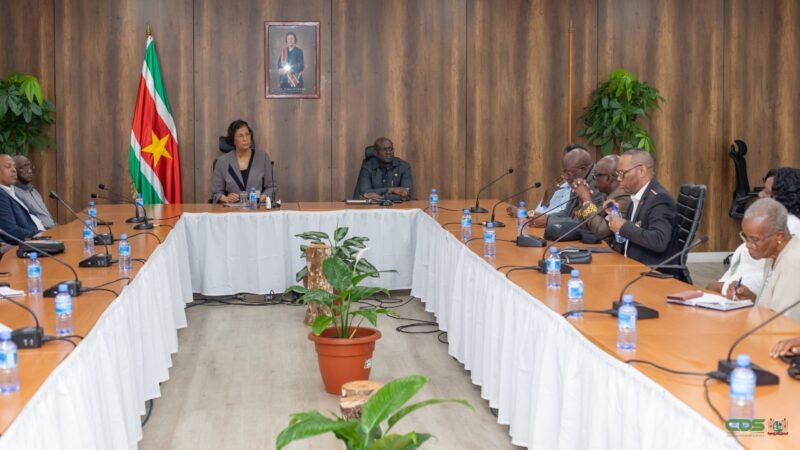
PARAMARIBO — In preparation for a national day of prayer scheduled for Friday, President Jennifer Simons had a consultation with a team of Christian spiritual leaders. The meeting took place on Monday at the Office of the President. The head of state noted during the meeting that religious organizations play an important role in social recovery and moral support of society.
Apostle Steven Reyme, pastor of Logos International, indicates that the day of prayer is an initiative of Surinamese bishops to dedicate the country to God. He says the president has embraced this initiative and elevated it to a national moment. Reyme explains that extensive discussions were held with the head of state about the spiritual state of Suriname and the way forward, specifically discussing the future after developments in the oil and gas sector.
“President Simons called on spiritual leaders to adopt an advisory attitude and record their proposals in writing”
The aim is to raise the mental well-being of the population to a level where social values and norms are again central. According to the apostle, this day is special because the Bible teaches to pray for governments and the people, “so that Suriname can lead a peaceful life in the midst of socio-economic challenges.” The theme of the day of prayer is based on the Bible passage Malachi 4 verse 6, in which the restored relationship between fathers and children serves as the foundation for authority and respect within society.
“Spiritually you would say that the people who are in certain positions must have a heart for that population, must have a heart for those children, must have a heart for the wanderers,” said Apostle Reyme. In line with this, the minister discussed the approach to youth crime. He states that education and upbringing, starting with the family as the first environment, are the key to curbing crime.
Religious organizations can support this by guiding young people in making the right choices between good and evil. President Simons called on spiritual leaders to adopt an advisory attitude and record their proposals in writing. This forms the basis for a follow-up discussion to further concretize the cooperation between the government and the religious sector.