By PACNEWS
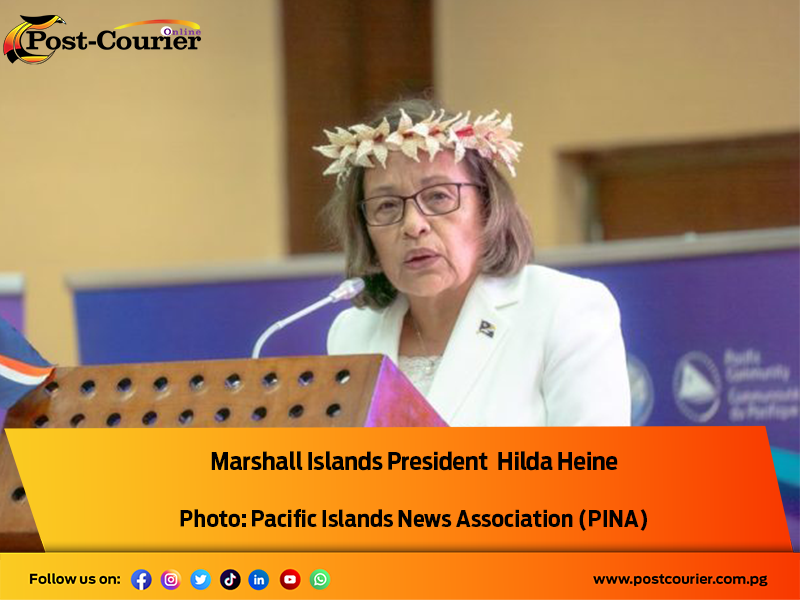
Marshall Islands President Hilda Heine has warned against seabed mining and called for the United Nations to acknowledge the harm caused by nuclear weapons testing in the Marshall Islands.
Addressing the UN General Assembly, Heine said decisions on seabed mining must be based on science and adequate safeguards, warning that the consequences of getting ocean governance wrong could not be reversed.
“Responsible and science driven regulations need to be in place. Going on guesswork for global oceans is beyond dangerous
“There are no do overs,” Heine said.
Heine said the Marshall Islands had joined 45 nations seeking a moratorium on seabed mining and expressed concern about actions where decisions were being made before the environmental impacts were fully understood and safeguards were in place.
The president said the Marshall Islands, together with Guam, Northern Mariana Islands, the Federated States of Micronesia and Palau, had expressed alarm over seabed mining activities.
“Collectively, the people and voices of Micronesia must be heard,” she said.
Heine also called on the United Nations to deliver an apology and acknowledgement for the harm caused by the 67 nuclear weapons tests conducted in the Marshall Islands between 1946 and 1958, when the country was a UN Strategic Trust Territory.
“The United Nations is long overdue to reflect and renew the same spirit with which our Marshallese people first came to the United Nations by delivering an apology and acknowledgement of the harm caused by impacts from the 67 nuclear weapons tested on our islands,” she said.
Heine said the UN trusteeship system had been intended to safeguard the wellbeing of the Marshallese people, but the nuclear tests caused lasting harm.
“For generations, our families have testified to displacement, illness, contamination and loss,” she said.
Heine said an apology from the United Nations would provide an opportunity for healing and closure for Marshallese communities.
“This apology is an opportunity to reflect, reflect upon the past, to bring healing and closure to the Marshallese,” she said.
Heine also warned that climate change was placing growing pressure on low-lying island states, with the Marshall Islands already experiencing the impacts of rising seas.
“It is the seas that are rising around us and not our islands, which are sinking,” she said.
She called for sufficient, timely and accessible finance for adaptation and loss and damage.
“The Marshall Islands and vulnerable people everywhere need sufficient, timely and accessible finance for adaptation and loss and damage,” Heine said.
“Those who have profited to the detriment of the many must pay.”
Heine highlighted the completion of a 1.8-kilometre seawall and footpath on Ebi, built with support from the World Bank, the Green Climate Fund and Marshall Islands resources.
She said the project protects about 8,400 people and critical energy infrastructure while reducing coastal flooding losses.
Heine said the project took more than a decade to complete and represented only one island in a country facing widespread exposure to sea-level rise.
“We are taking action and we urgently need strengthened partnership to better protect our islands before sea level rise overtakes us,” she said.
On climate action, Heine said the world must act to limit any overshoot of the 1.5°C temperature threshold.
“We all need to wake up and act,” she said.
She said the Marshall Islands was using renewable energy to reduce fossil fuel use in its remote outer islands, with renewable energy expected to cut fossil fuel use by 88 percent over the next 18 months.
Heine also reaffirmed the importance of the law of the sea and said the Marshall Islands would continue to advocate for Pacific interests in international ocean governance.
She said small island states must have a stronger voice in decisions affecting their security, economies and future.
“The international community is not listening closely to small island developing states, and it is not responding fast enough,” Heine said.
“Too often, the purported solutions for island nations don’t seem to know the problem.”
Heine said the Marshall Islands remained committed to the multilateral system despite its frustrations and failures.
“The United Nations must continue to serve as our primary weapon to ensure that no one is left behind,” she said