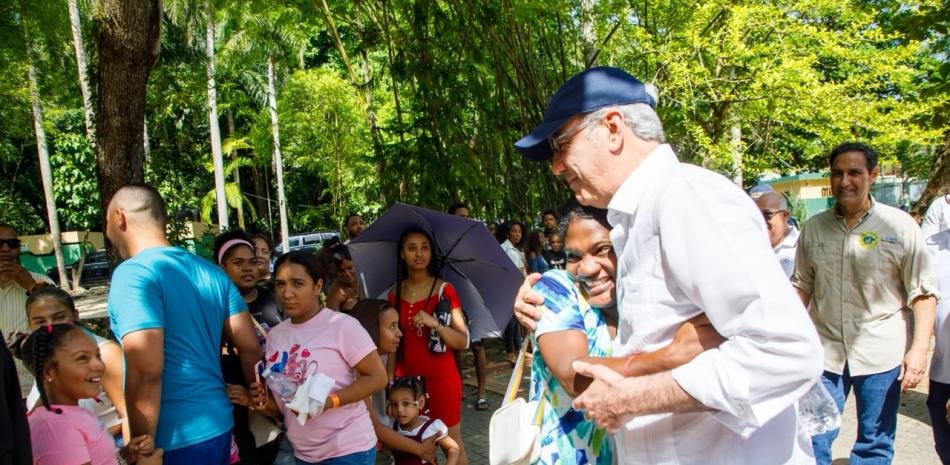
President Luis Abinader visited the National Zoo this Sunday, becoming the first president to tour its facilities in more than 20 years, a few days before the institution commemorates its 51st anniversary.
During the tour, the head of state, accompanied by the director of the Zoo, Nayib Aude, learned about the main development projects planned for the zoo in the short, medium and long term, aimed at strengthening its mission of biodiversity conservation, environmental education, scientific research and family recreation.
President Abinader proposed expanding the collection of species with the incorporation of emblematic specimens, including elephants, giraffes and chimpanzees, with the purpose of enriching the visitor experience and strengthening conservation programs.
Likewise, he proposed the rehabilitation of the aviary, known as the aviary, a structure that has remained out of operation for more than two decades, as well as the strengthening of the research areas, food science, conservation, preservation and assisted reproduction, with the aim of contributing to the recovery of endemic species in danger of extinction.
The president also considered the modernization of the infrastructure, as well as readjusting the spaces that will receive new species, including the hippopotamus area, and the modernization of a new signage with QR codes that will allow visitors to access, through mobile devices, information and audiovisual content about each species.
Likewise, Abinader evaluated the possibility of developing a theme park within the complex, as an initiative to expand the recreation options of Dominican families, strengthen the tourist offer of Santo Domingo and consolidate the National Zoo as a modern, educational and reference space in the region.
Dr. Rafael María Moscoso National Botanical Garden
The head of state also supervised the inaugurated works of the first phase and the progress of the second stage of renovation of the Dr. Rafael María Moscoso National Botanical Garden.
Upon arrival, the president was received by the director of the National Botanical Garden, Pedro Suárez, later, he boarded the park’s internal train to visit the Seed Bank, the Japanese Garden and the Department of Botany next to the National Herbarium, where he learned first-hand about the research, conservation and preservation of flora carried out by the institution.
The works carried out in this first phase, as part of the modernization plan promoted by the Ministry of Environment and Natural Resources, include the construction of a medical dispensary, the remodeling of the main façade, the rehabilitation of the bathrooms at the entrance, as well as the creation of a security office and a modern video surveillance monitoring center.
Likewise, the domes intended for holding institutional, business and social activities were intervened, in addition to the Tea House, located in the Japanese Garden, one of the most emblematic and visited spaces in the park.
As part of a second stage, as reported by the Presidency, new interventions will be carried out to complete the modernization process of the National Botanical Garden, with the purpose of continuing to strengthen its infrastructure and the services it offers to citizens.