It wasn’t that long ago that the name Polestar stood for a classic niche product. Anyone who wore a blue square on the radiator grille of their Volvo signaled to connoisseurs: This is solid Swedish mass-produced technology with an extra portion of performance from the in-house tuning company. An emotional complement to the safety image of the parent brand.
Turning this optimized performance appendage into an independent, purely electric premium manufacturer was a bold experiment. Under the umbrella of the Chinese car giant Geely A radical metamorphosis took place from 2017 onwards.

The Polestar 2 Fabry
The all-electric one laid the foundation for the new brand Polestar 2which was presented in 2019 and is visually clear as a sedan Volvo-Origin shows (the Polestar 1 was still an imitation hybrid model). It is based on the platform on which Volvo made the XC40. Technically it offered something new: The Polestar 2 was the first series vehicle in the world to use Google’s Android Automotive as the operating system.
The 4.6 meter long Polestar 2 established the brand in the collective memory of leasing fleets and initial adapters. It is the reliable volume model that made the Swedish-Chinese balancing act suitable for everyday use. With over 190,000 units sold, this vehicle carried the entire economic burden of the young brand for years and proved that reduced Scandinavian minimalism finds buyers even without a combustion engine.

A lot of things in the Polestar 2 are reminiscent of Volvo Clemens Fabry
Even today, the Polestar 2 is still a solid electric car that is easier to use than modern offerings thanks to the switches and buttons that were common at the time. You just have to make concessions when it comes to range. When fully charged, the 79 kWh battery showed 530 kilometers; in our test we achieved 376 km (consumption of 21 kWh/100 km). Because a successor is coming in 2027, now is a good time to buy a Polestar 2: promotional prices start at 42,990 euros.
We skip the Polestar 3, which is on the same platform as the Volvo EX90, and come to the visually and technically completely independent model, the Polestar 4. It marks a conscious break with conventional automotive forms – and brings a piece of radical design anarchy to the road: the crossover coupe is missing the rear window!

No rear window on the Polestar 4 Clemens Fabry
Designers and technicians explain this with constructive advantages. By eliminating the rear window, the upper crossbar beam moves further back, giving the rear passengers unexpected headroom despite the sloping roofline.
The interior mirror becomes a small video screen, which, thanks to the higher-mounted camera on the back, shows more of what’s happening behind the car than a normal mirror. In our test, however, we found it difficult to correctly estimate the distances of following cars. It also takes a short moment for the eye to adjust to the video image.

Interior of the Polestar 4 Clemens Fabry
Another video feature is nice, however: when you blink, a video image of the side of the vehicle is played, so you can see immediately whether you are taking the curve a little too closely and are in danger of hitting somewhere.
The Polestar 4 cannot be described as underpowered. Even the basic version (currently from 51,990 euros) offers 272 hp, the all-wheel drive version with two motors (from 54,990 euros) has 544 hp. From a standstill you can get to 100 km/h in 3.8 seconds, you’re already in the dimensions of that Porsche Taycan.
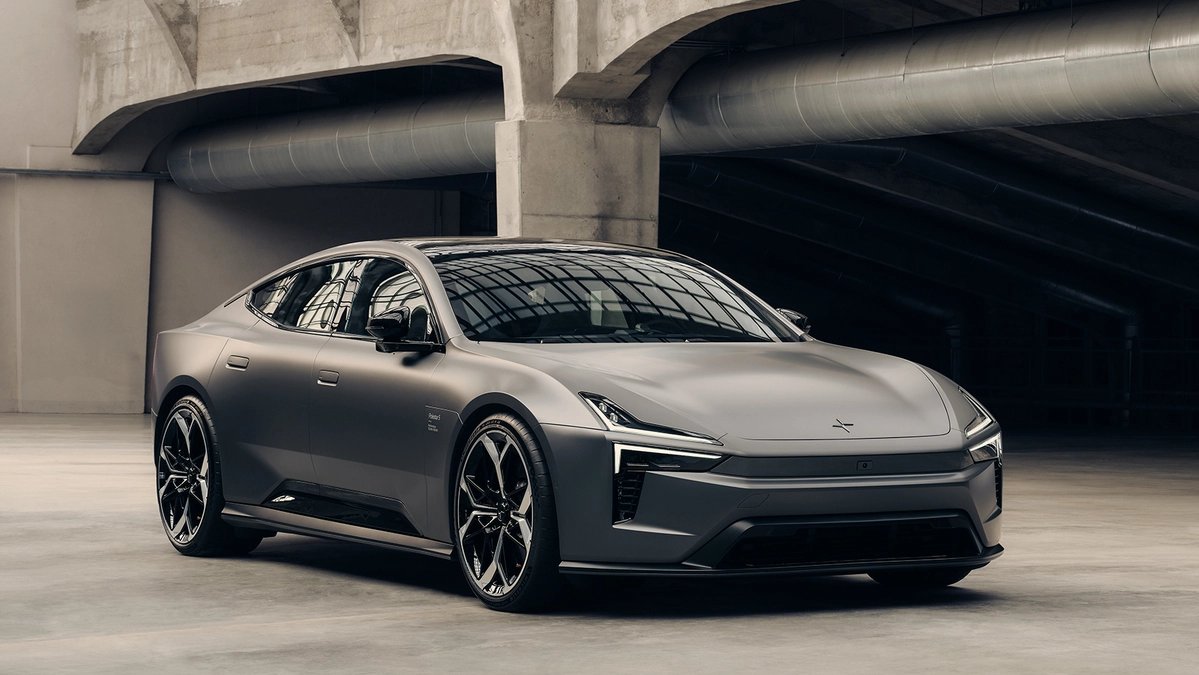
That’s the keyword for the current one Polestar 5which the manufacturer positions as a clear competitor to the Porsche Taycan. With this four-door Grand Tourer, the company is leaving the bourgeois premium class and finally moving into the luxury class segment.

Polestar 5 Factory
Polestar is completely separating itself technologically from the Geely Group’s common platforms. The luxury sedan is based on a specially developed, ultra-light structure made of glued aluminum – a manufacturing process that is usually found in super sports car construction.

Interior of the Polestar 5 Factory
With a system output of up to 884 hp and a modern 800-volt architecture for extremely short charging times, the Polestar 5 acts as a technological flagship. It is intended to demonstrate what the brand is capable of achieving in the high-end sector. This is also reflected in the price: starting price is 118,900 euros, for the performance model with 1015 Newton meters of torque (0 to 100 km/h: 3.2 seconds) you pay from 140,900 euros.
The difference is remarkable: the performance version can be driven like a sports car (only the brakes don’t work as aggressively) or like a comfortable limousine. The rear window is also missing here, but the designers have moved the interior mirror a little forward, making it easier for the eyes to switch between far and near.
From the conventional Polestar 2 to the unconventional design experiment Polestar 4 to the technological manifesto of the Polestar 5: the evolution of the brand has been visually and technically successful. It remains to be seen whether the ambitious tech venture will also pay off for investors in Gothenburg and Hangzhou in the long term. Despite record sales of more than 60,000 vehicles, the company posted significant operational losses last year.