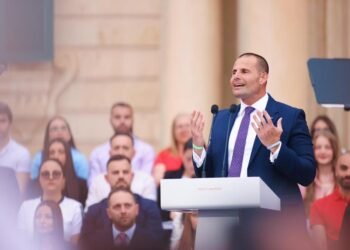
Nationalist Party leader Alex Borg wheeled out two more electoral pledges on Friday during the party’s first campaign mass meeting: a €5,000 Child Trust Fund and no taxes on the first €10,000 earned from overtime and part-time work.
Borg addressed the party’s first mass rally of the electoral campaign on Worker’s Day, as a throngs of supporters gathered in Lija for the event.
The two pledges are not necessarily new: Borg made the pledge for a Child Trust Fund in his Budget reply last year, and the PN’s pledge on tax-free income for part-time and overtime work was first made by Borg’s predecessor Bernard Grech.
This is the first time, however, that Borg has mentioned them since the general election was called last Monday.
Borg also placed heavily emphasis on the proposals that the party has launched thus far over the course of the past week: proposals which have been heavily focused around the healthcare sector.
He mentioned a €120 million investment in Mater Dei Hospital aimed at further modernisation and expansion of services, and he mentioned the construction of a new 250-bed hospital in the north of Malta, with a budget of €160 million.
Another major project was the transformation of the Paola health hub into a 250-bed hospital costing €80 million, as well as the construction of a new 400-bed hospital in Gozo with an investment of €350 million.
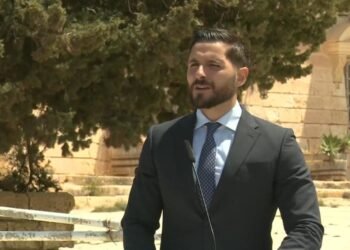
He also put forward the creation of a National Health Park in Selmun – details of which were announced in a press conference earlier in the day – which would include 60 beds and require a €20 million investment. These projects were presented as a comprehensive restructuring of Malta’s healthcare infrastructure.
In addition to infrastructure, Borg spoke of the workforce-related measures that the party had come up with for the health sector.
He reiterated the pledge of a monthly stipend equivalent to the minimum wage – close to €1,000 – for students studying to become nurses, midwives, doctors, and other healthcare professionals, with the aim of encouraging more young people to enter the sector.
He also pledged that Maltese healthcare professionals who return from working abroad would benefit from a five-year exemption from income tax, designed to attract skilled workers back to Malta.
Borg also addressed family policy and long-term financial support. He pledged the introduction of a Child Trust Fund, under which every child born would receive a €5,000 government-backed investment. This fund would not be immediately accessible but would grow over time and become available when the individual reaches the age of 20, serving as a long-term savings mechanism for future generations.
On workers’ income, Borg proposed that no tax would be applied on the first €10,000 earned from overtime and part-time work. He presented this measure as a direct financial benefit for employees, particularly young couples and workers who rely on additional hours to meet rising living costs.
Mental health and workplace wellbeing also featured in his proposals. Borg announced that businesses which introduce Employee Assistance Programmes focused on mental health would benefit from a 150% tax deduction on related expenses. This measure was intended to encourage employers to invest in psychological support systems for their employees.
He further pledged a reduction in bureaucracy affecting businesses, arguing that excessive administrative processes hinder efficiency and growth. While he did not go into detailed legislative mechanisms, he committed to simplifying procedures and reducing unnecessary red tape in order to create a more efficient business environment.
Transport and mobility formed another key part of his speech. Borg announced the introduction of a mass transport system, with work to begin within the first 100 days of a Nationalist government. He stated that the first operational line would be completed within five years. This project was presented as a solution to Malta’s traffic problems and as a means of improving quality of life by reducing commuting times.
Borg also linked his proposals to broader social issues, particularly stress and work-life balance. He referred to higher-than-average workplace stress levels in Malta compared to European countries and argued that his policy proposals—especially those related to transport, mental health, and taxation—would help improve daily life for workers.
He also addressed the cost of living, acknowledging the financial pressure faced by families, young couples, and pensioners, particularly in relation to housing, food, and healthcare costs.
PN Deputy Leader Alex Perici Calascione also addressed the mass meeting, emphasising on the importance of accountability in public administration and arguing that Malta required leadership that prioritises citizens over partisan interests.
University student Trisianne Attard meanwhile emphasised on the importance of recognising workers’ contributions and ensuring that their challenges are acknowledged. She also referred to issues affecting everyday life, particularly the pressures linked to cost of living and maintaining a healthy work-life balance.