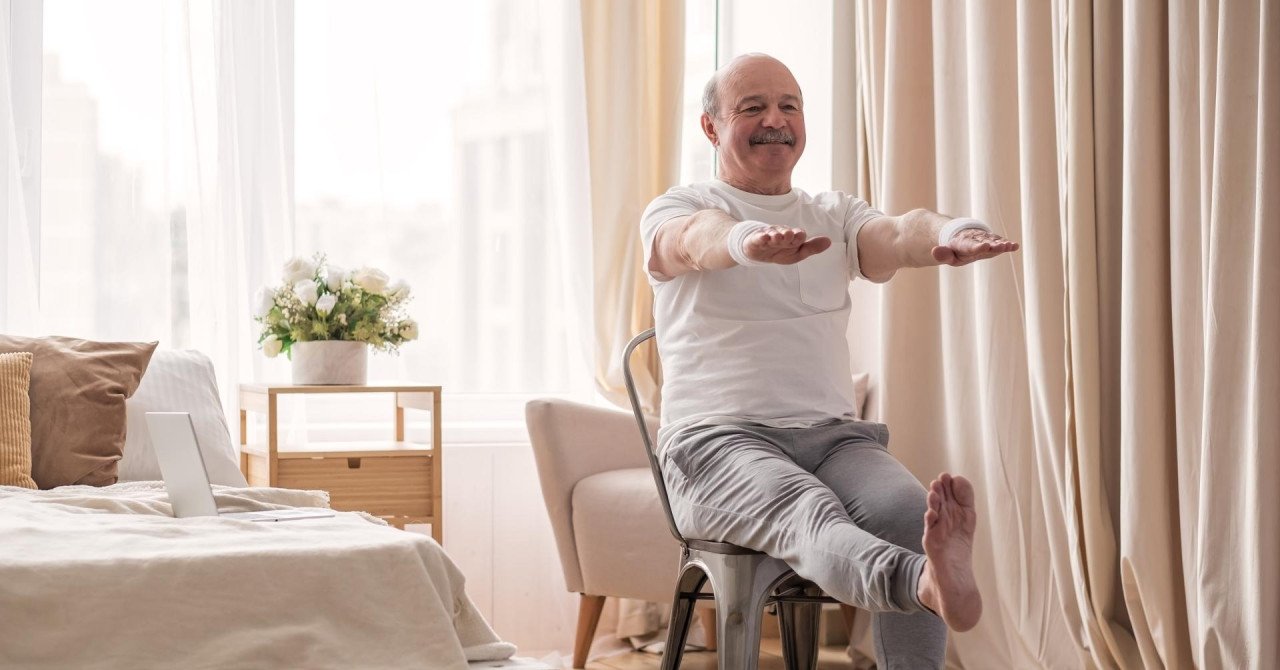
Many believe that sit-ups are an effective way to burn stubborn belly fat. While this classic abs exercise can be a solid addition to an all-around workout, it’s not the best way to tackle this body part. Tightening and toning the lower abdomen requires establishing a caloric deficit, adopting healthy lifestyle habits and adhering to appropriate training. The good news is that if getting down and up from the ground seems challenging at this stage in life, all you really need is a sturdy chair to start a productive and sustainable fitness routine. dr. Andrew Gorecki, a physical therapist who regularly works with seniors on trunk function, balance and prevention, reveals five excellent chair exercises that can help strengthen your lower abdomen.
Before you get started, it’s important to remember that you can’t reduce fat on the spot. When you burn fat, you lose it all over your body, not just in one specific area.
– What chair exercises can do, and which is much more important after the age of 60, is to restore deep abdominal muscle control, lumbopelvic stability and trunk function that protects the lower back, improves posture and reduces the risk of falling. The firmer midsection that people see is usually the result of better postural control and activation of the deep abdominal muscles, not fat loss, explains Dr. Gorecki.
Sit-ups activate the surface muscles of the abdomen, while the lower part of the abdomen is controlled by the transversus abdominis, otherwise known as the “corset muscle”. According to Dr. Gorecki, you train the transversus abdominis by deliberately breathing and strengthening the trunk, not by simply bending over on the mat. And that’s why these chair exercises are so important and effective.
– After the age of 60, the best exercise for the trunk is the one that you will actually do every day. A routine on a chair that you can perform during a TV commercial beats a perfect training program in the gym or on the floor of the room, which you will probably often skip – points out Dr. Gorecki.
1. Sitting march
– This exercise targets the transverse abdominal muscles and hip flexors, the foundation of lower body control – says Dr. Gorecki.
- Start by sitting on a chair with your feet hip-width apart.
- Gently pull your lower abdomen inward.
- Slowly raise one knee to hip height and the opposite arm into the air.
- Switch legs and arms and keep alternating sides.
2. Seated skating
– This exercise trains the lower abdominal muscles to stabilize the pelvis while the limb moves, which is exactly the pattern that protects the lower back in everyday life – explains Dr. Gorecki.
- Start by sitting on a chair with your feet hip-width apart on the floor.
- Gently pull your lower abdomen inward.
- Move one heel forward on the ground until your leg is almost flat.
- Return to the starting position and repeat with the other leg.
- Alternate sides.
3. Sitting position with exhalation
– Complete exhalation is crucial because it activates the transverse abdominal muscles and pelvic floor much more than holding the breath – says Dr. Gorecki.
- Start by sitting on a chair with your feet hip-width apart on the floor.
- Gently pull your lower abdomen inward.
- While tightening your abdominal muscles, exhale completely and pull one knee towards your chest.
- Return to the starting position.
- Repeat on the other side and keep alternating sides.
4. Trunk rotations in a sitting position
– This exercise targets the oblique abdominal muscles that form the “corset” of the waist and are dramatically underused after the age of 60 – points out Dr. Gorecki.
- Start by sitting on a chair with your feet hip-width apart on the floor.
- Lightly place one hand on the opposite knee or the back of the chair.
- Slowly rotate your torso to the side where your hand rests on your knee.
- Return the trunk to the starting position.
- Repeat the rotation on the other side and continue alternating sides.
5. Seated inclines
– This exercise activates the deep stabilizers and restores the lumbopelvic rhythm that most adults lose by the age of 60 – says Dr. Gorecki.
- Start by sitting on a chair with your feet hip-width apart on the floor.
- Gently pull your lower abdomen inward.
- Rock your pelvis back and forth with small, controlled movements (from a relaxed back and pelvis resting completely on the chair to a straight back and slightly raised pelvis).