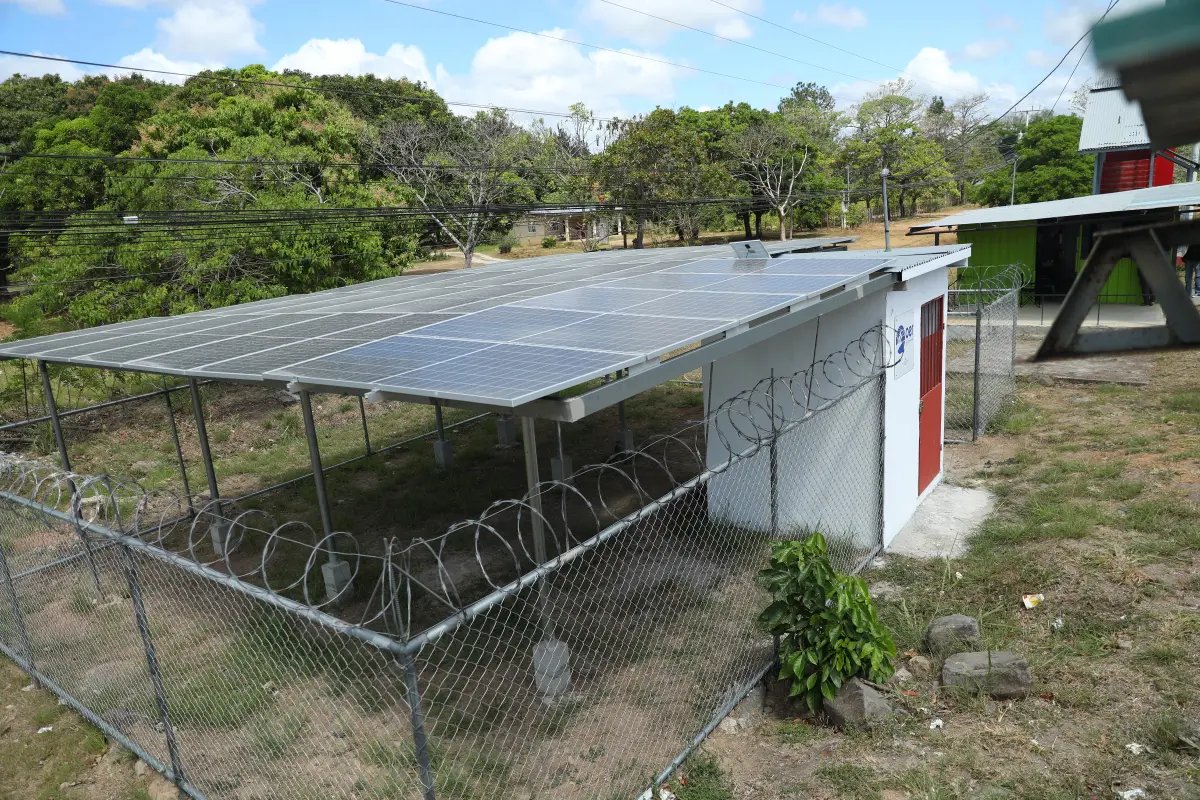
A few meters from the Inter-American highway, near the Technological University, headquarters of Penonomé, a metal structure that supports 35 solar panels blends into the landscape. This is the first photovoltaic project that aims to reduce the electricity costs of rural aqueducts.
The project has begun in the province of Coclé, in the communities of Llano Marín and Aguas Blancas, district of El Coco. A third facility is located in El Salado, Juan Díaz district, Antón district.
“It is a program that we have jointly with the Ministry of Energy, directed, in principle, in two aspects: schools that do not have electricity and aqueducts, because the donated equipment depends on panels and inverters that only work interconnected to the network,” explains engineer Félix Castillo, coordinator of the province of Coclé of the Office of Rural Electrification (OER), attached to the Ministry of the Presidency. The Ministry of Energy received a donation of photovoltaic solar equipment from the Chinese Embassy. These equipment were transferred to the OER so that it could dispose of them.
“It is a system that works to reduce costs, take advantage of solar energy and consume it and sell the surplus. This has been addressed to rural aqueducts interconnected to the network,” explains Castillo. These community organizations usually have many difficulties with paying for the electricity used in their processes, which is why the support of the community boards was sought to get the projects started.
“The OER provided both the solar panels and the inverters and the technical team that provides support, but we know that a project also requires security, surveillance, installation, and we do not specifically have installers, we have engineers who can follow up on the execution of the projects. That is where our partners come in,” says the engineer.
The Community Board of El Coco through HR Manuel Rodríguez offered to take charge of the installation, the meter change and the security of the properties. And the third participant in this society is the Rural Aqueduct Board. “Although the representative tells us that he is going to provide the resources, we must confirm if the Aqueduct Board is interested, because in the end they are the ones who must ensure the maintenance, surveillance and security of this equipment,” says Castillo.
As this is a limited amount of equipment available, the OER requires the community board that wishes to carry out the project in their communities to have the immediate financial availability. “We have few pieces of equipment and they are being selected based on the capacity of the community boards and the acceptance by the aqueduct boards,” he warns.
For the procedures to begin “there must be a request from the Aqueduct Board, there must be a request from the township representative plus a commitment from both parties. We normally provide 10 420 W panels and two 2,000 kW inverters to the turbines or pumps that are connected to the grid,” reports the engineer.
An exception was made for the Llano Marín aqueduct, since it is a central space that provides services to the extension of the Technological University, the extension of the University of Panama, the extension of the Latin University, the warehouses of the Agricultural Marketing Institute and the Women’s Penitentiary Center, in addition to about 400 houses. For this reason, 35 panels of 420 watts, seven inverters of 2,000 kW each and a luminaire to illuminate the area have been supplied, in addition to advice on installation and maintenance issues.
“The issue of water is very sensitive, our township has many rural aqueduct management boards and during the dry season it becomes a little more complex because there is greater consumption and the situation of some families is very difficult to pay this monthly payment. There are sick people, people without jobs. And this helps the aqueducts to at least be a little more up to date with the payment of electricity,” explains representative Rodríguez. Therefore, he contacted the OER to start the project.
With the equipment installed, during the day, the electricity that is consumed is generated and the surplus goes to the network. At night, grid power is used. Between 6 and 7 hours of sun are used, but the turbine works 24 hours a day to supply water to the entire area.
From almost $900.00 in the average bill last year, by the end of the year the amount was lowered to $512.26. The January invoice, with the work still unfinished, came for $460.88. For February the bill was $230.90. “This is clear evidence that the system has produced results,” says the representative with receipts in hand.
For Zoraida Valdés, president of the Llano Marín Rural Aqueduct Board, the implementation of this system has been of great benefit, since “the rapid reduction in energy costs has been seen in the bill. Energy is one of the highest costs that aqueducts face and it costs a little to collect payment from the community,” she says in a positive tone.
In Aguas Blancas, the Aqueduct Board itself covered the costs of the structure and installation of the photovoltaic equipment that will power one of the two pumps that the community has. In this case, it is the basic equipment of 10 solar panels and two inverters. The honorable Rodríguez supported them with the transfer of some materials and plans improvements in the area.
“If we refer to historical consumption, in January 2026 we were at 1,487 kW and in February we are at 871. So this is evidence that the installed system, although it has a lower capacity in the community of Aguas Blancas, is giving results,” says HR Rodríguez.
Wilfredo Cedeño, president of the Agua Blancas Rural Aqueduct Board, reports that there are around 500 users covered by the aqueduct. “With the bill that we just received, we see that we have received a cut of approximately 50%. From an account of $450-460 that we paid, we have dropped to $200. It is a very significant saving for an aqueduct like ours and this allows us to have a degree of investment for other areas in which we lack. It has been very good, we trust a lot in that technology and we are very grateful,” he says.
“We like that the administrators of the rural aqueducts are dynamic and that they have initiative like these two aqueducts that we have supported have had, in addition to the support of the representative. We want to urge the other representatives to take this example of work to be able to strengthen and mitigate this water problem that affects the province of Coclé so much,” says Castillo.
“Not all representatives have the same level of effectiveness. There are the fewest that I have encountered, but I have found them to be very good and work for their community, as is the case with El Coco. So we feel happy when we find people like him with whom we can work as a team,” says Antonio Clement, director of the OER.
The project is already being replicated in other provinces. “We maintain a donation in the municipality of Renacimiento, Chiriquí; Isla Caña and Valle Rico in Los Santos; Las Cabras in Herrera and soon we will be sending to Caimito de Capira and Calidonia de Soná.”
The OER emphasizes the care that must be taken of this equipment, since on many occasions the community thinks that it is something cheap because it is donated and they downplay its maintenance. The OER’s investment for the Llano Marín aqueduct amounts to about $45,000 in equipment, while the Community Board had to disburse about $15,000. “This Aqueduct Board has an approximate investment of $60,000.”
The institution also does a type of induction so that those responsible get to know the team and “lose their fear” of it. “It is not a new technology, it has existed for a long time, but there are many myths about photovoltaic energy: that if you touch it, the energy can pass to you, that you cannot clean it with a cloth of water… they are all myths, although of course you have to have some type of protection, respect because we are working with direct current.
With the support of local authorities and the work of the community, solutions arrive.