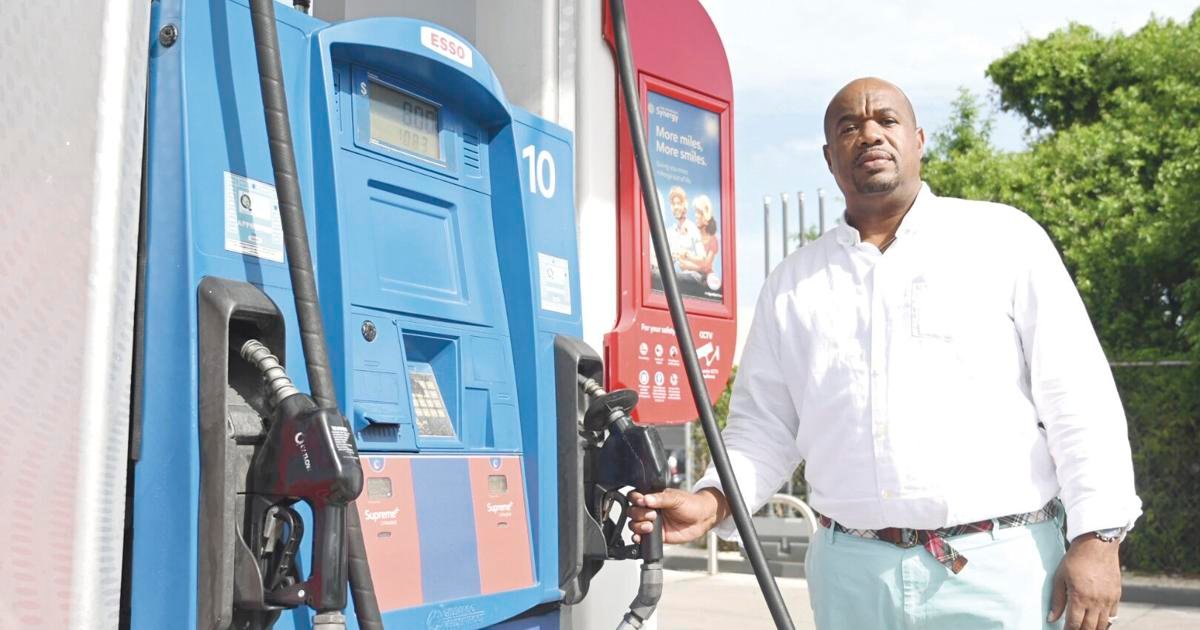
Bahamas Petroleum Retailers Association Vice President Vasco Bastian said yesterday that the price of oil per barrel may hit $110, but the $0.25 margin increase approved by the government in October 2024 buffers the industry from any fallout.
Analysts at the US Energy Information Administration (EIA) and global investment banking firm Goldman Sachs anticipate prices could average $105–$111 per barrel in the near term, depending on the status of shipping traffic through the Strait of Hormuz.
“I thank God that nearly two years now – I think it was October 1, 2024 – we got our margin increase, and I can tell you, if we hadn’t gotten that margin increase to hold us in times like this, I would think probably about 75 percent to 80 percent of the gas stations probably would have shut down,” said Bastian.
He continued: “That’s why I can never stop thanking the government. Philip Brave Davis, Simon Wilson, Michael Halkitis, and all those persons who played their role behind the scenes, who offered to give us a margin increase.”
The government of The Bahamas approved a $0.25 increase per gallon of gasoline, and a $0.16 increase per gallon of diesel (inclusive of value-added tax) for petroleum retailers. These adjusted retail margins officially took effect on October 1, 2024, providing much-needed relief to operators who had not received a margin adjustment since 2011.
Crude oil is currently trading in the $89 to $92 per barrel range, with Brent crude hovering around $92.50, and West Texas Intermediate (WTI) around $89.50.
Some gas stations in New Providence have already started selling gasoline at $7 per gallon.
“Prior to this whole Iran, United States and Israel conflict, oil was trading at around $60 per barrel a couple of months ago. This is a direct correlation because of what’s going on in the Middle East, and the markets continue to react to this war. Even when the war started between Ukraine and Russia, oil prices spiked,” said Bastian.
Just before Russia’s full-scale invasion of Ukraine in February 2022, global oil prices were already surging due to tightening supplies and rising geopolitical tensions. In late January and February 2022, Brent crude (the global benchmark) hovered between $90 and $97 per barrel, while US West Texas Intermediate (WTI) traded around $88 to $92 per barrel.
Following the invasion on February 24, 2022, fears of supply disruptions and embargoes caused prices to instantly spike above $100 per barrel, eventually peaking at around $126 to $127 per barrel in early March 2022.
Conversely, prior to the outbreak of the US-Israel war on Iran, the global benchmark Brent crude oil price was trading at about $65 per barrel. Following the onset of the conflict, prices surged significantly, climbing well over $100 per barrel at various points and experiencing volatile swings.
“I don’t know how long this war is going to last, and I don’t know how long these prices are going to escalate, but they will eventually level off at some point,” said Bastian.