Julie Parsons made her name with a series of successful novels built around mysteries. With People Like Us she has moved for the first time to nonfiction, but again a mystery in the form of a disappearance is central. This time, it is deeply personal.
When she was four and her family lived in New Zealand, her 41-year-old father, Andy, an Irish doctor and decorated war hero, travelled from Samoa on the MV Joyvita towards the Tokelau Islands. The boat never arrived:
“A couple of days to operate on the man with the gangrenous arm and make sure he’s recovering properly. Three more days on the boat, back across the Pacific Ocean to Samoa. Back to Biddy [his wife] and to us. Back to me. It wasn’t supposed to change our lives. To hurt us. To damage us. It wasn’t supposed to be anything other than fun. But out there in the vast expanse of the ocean, something was waiting, waiting, waiting.”

Julie Parsons herself is still waiting, decades later, but knows there will never be an answer to the unsolved mystery that has shaped her life. Hauntingly, the Joyvita was found adrift in the ocean near the island of Futuna. All 25 people onboard had vanished. Years later Andy Parsons was officially declared dead.
That haunting event drives this book. At some level our parents are always mysteries to us, their children: they led full lives before we came along. But Julie Parsons was never able to talk to her father as an adult, and never knew what had happened to him. So she set off on a journey to learn as much as possible about her origins, particularly about her grandparents’ families, the Purefoys, Chamberlains, McClenaghans and Parsons.
A few years after her father’s death, her mother brought the children back to Ireland, and the tightly interconnected milieu of the south Dublin Protestant. The Parsons branch of the family actually started in Athlone as shopkeepers, but the turmoil from the Easter Rising had, as Yeats famously wrote, changed everything utterly. Nationalist Athlone started to look unsettled and even threatening, and so there was a move to more comforting Greystones, which in 1911 had three times as many Protestants as Catholics.
Demographic changes in the next few years were dramatic: by the 1926 census, now available online, the Church of Ireland population in the Irish Free State was down to 5.5 per cent, by 2022 just 2.4 per cent. This is the “small and intimate world, the world of people like us” that the book is set in, a web of interconnected schools, hospitals, businesses, rectories and churches, starting with the Mariners’ Church in Kingstown, now the National Maritime Museum in Dún Laoghaire, where Julie Parsons’s mother grew up, the child of parents who themselves were the children of clergymen. From the start she was close to the sea, in which much later she lost both of her first two husbands, neither body ever being recovered.
[ The lost Protestants of ‘Kingstown’Opens in new window ]
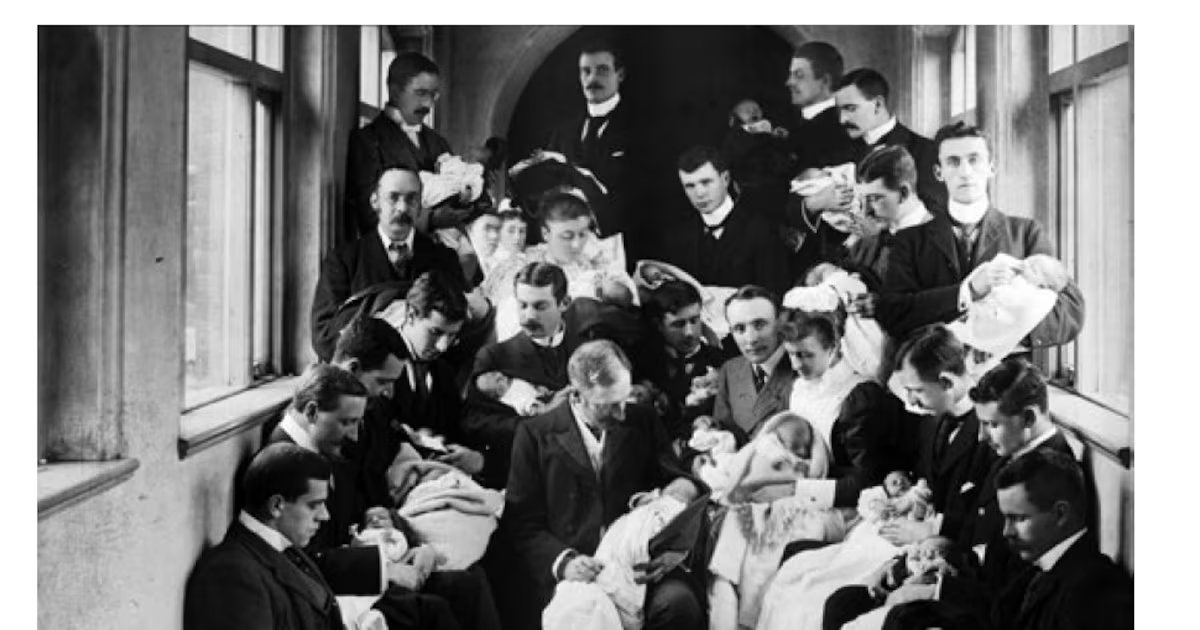
One of the strongest features of the book is the quality of the plentiful and evocative photographs which Parsons has assembled. In one, Richard Dancer Purefoy, master of the Rotunda is surrounded by 18 young men, four nurses and 20 babies. In another, the author’s mother stands beside her, radiant on the ship homeward-bound from New Zealand. Elizabeth’s memorable personality comes across strongly in the often rawly emotional writing of her daughter, still in her 70s directly addressing “Mummy” and “Daddy”. That is the distinguishing feature of the style, along with the description of a world that has largely faded. Occasionally some of the very intensive research might have been left out of the final writing (and an index would have been welcome).
While the world of the “people like us” was indeed “small and intimate”, it had so many connections well beyond South Dublin. This account extends its reach to Donegal and Sligo, Dunkirk and Anzio, Libya and the Pacific. Its historical reach is also tremendous.
One of the few colour photographs in the book is of the “Crazy Quilt” bequeathed to the author by her loving New Zealander godmother, Aileen, each piece in the patchwork coming from someone she knew. After her death Julie discovered that Aileen had given up her own baby for adoption. Every dress she made for Julie, and every rendition of “Happy Birthday” for her, must have made her think of the loss of her girl. A response to loss, People Like Us is also a richly coloured patchwork.
Julian Girdham teaches English at St Columba’s College in Dublin