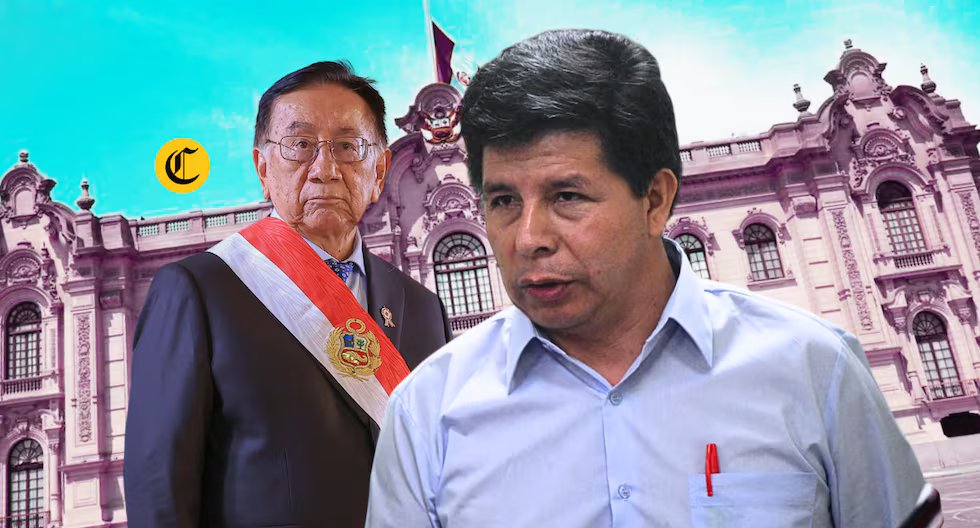
Pedro Castillo He will continue serving his sentence for the coup d’état in the Barbadillo Prison (Ate). His request for presidential pardon through which he sought to be released during the government of the outgoing president José María Balcázarwas rejected and archived unanimously.
This was confirmed by the attorney general, Luis Jimenezwho maintained that the Presidential Thank You Commission met this Friday and declared “inadmissible” the last request presented by Castillo Terrones that was pending resolution.
With this, the interim president Balcázar Zelada will not be able to grant a presidential grace – common or any other type – to his former political ally, as he does not have the legal support as required by the Constitution.
LOOK: Only 15 parties have guaranteed registration after the 2026 electoral processes: What will happen to the other 42?
As El Comercio had anticipated, the Presidential Grace Commission issued a technical report indicating that the former president did not meet the requirements to be the subject of a “common grace.”
On July 10, Castillo Terrones presented a request to be granted a “common grace” with the purpose of annulling the sentence for the Coup d’état and also for the preventive detention that was imposed on him in the Puente Tarata Case and others.
The Internal Regulations of the Presidential Grace Commission required that, in order to grant “common grace,” she must have exceeded twice the period of the preparatory investigation stage plus half, without her situation having been resolved.
However, as this newspaper had explained in previous editions, the former president already has a sentence of 11 years, 5 months and 15 days for the crime of conspiracy to rebel due to the Coup d’état, and in the process for the Tarata Case and others, Castillo Terrones is being prosecuted for serious crimes as a criminal organization whose terms still do not exceed what is required by law.

PEDRO CASTILLO
In statements to the press, the head of Justice, Luis Jiménez, indicated that the decision on the situation of the sentenced ex-president was the last issue addressed by the pardon commission in this government and therefore, the case is already “closed.”
Jiménez Borra said that the decision was already notified to the petitioner as far as the Barbadillo Prison, and concluded by indicating that he felt “proud” of his management.
“The one that was pending is the one that was evaluated today (Friday), and that has been declared inadmissible, therefore, the Ministry of Justice has already ruled on the merits, there is nothing more to talk about on the subject, there is no grace, no pardon and we continue working as always on the tasks to bring justice closer to all Peruvians.”

On the other hand, through a statement, the Ministry of Justice confirmed that the request for the Coup d’état case, the preparatory investigation process “has already concluded and the applicant has a ruling in the first instance”, the same one that is on appeal.
Regarding the process of alleged criminal organization, the Minjus noted, the case is within the legal deadlines and does not present excess time as required by law.
The Minjus indicated that there were 17 requests for presidential pardon that were presented in favor of Castillo Terrones over time. Of the total, 14 were presented by third parties and ended up being rejected. Another 3 were signed by Castillo Terrones, two of them were archived for not being corrected.
And, after the last request of the convicted man was filed, the Presidential Pardon Commission no longer has in its hands any other request for presidential pardon in his favor, the Minjus assured.

Luis Enrique Jiménez, Minister of Justice and Human Rights. Photo: Presidency.
In statements to Canal N, lawyer Walter Ayala, Castillo Terrones’ lawyer, rejected the Minjus decision and maintained that the legal report issued by the Presidential Thanks Commission had no legal basis.
He assured that it was a decision that “they saw coming” and that they do not “lose hope” of seeing the sentenced ex-president free. He announced that they will go to the UN General Assembly and will resort to the new political jurisdiction of the Bicameral Congress.
“In the parliamentary jurisdiction, bills or motions will be promoted to clarify the defects that existed in that vacancy and that lifted the jurisdiction without the right to defense,” he said.
Balcázar must respect the Constitution
The constitutionalist Aníbal Quiroga, maintained that with the pronouncement of the Ministry of Justice and the Presidential Grace Commission, which rejected all requests for presidential pardon for Pedro Castillo, the interim president José María Balcázar has nothing left but to respect the Constitution.
“If the pardon or presidential pardon were to proceed in a bad way, changing ministers, or issuing a direct resolution, which Balcázar can no longer do, whatever it may be, that would generate severe responsibility for the president and the minister who endorses him in the new Congress. He must respect the Constitution,” he indicated.
He argued that the idea of granting any benefits should be rejected, alleging “supposed pacification” or claiming the existence of “political prisoners.” On the contrary, he stated, in Peru there are no political prisoners and “those who are detained or convicted are done so by order of the Judiciary” which is independent and with motivated arguments.
“In some way, Balcázar has wanted to fulfill that promise he made to sit in the presidency, but the system itself has not let him and here it is worth highlighting the courage of Dr. (Luis) Jiménez (Minister of Justice) and Dr. (Abraham) García Chávarry (president of the Commission of Thanks), who have stood firm and have not given in to the ideological and political issue,” he noted.
Along these lines, he highlighted that attempts to benefit Castillo Terrones have not been addressed, through requests without legal basis or by trying to “false medical health documents” in order to obtain a humanitarian pardon.
“I believe that law, justice and democracy have triumphed and the demonstration that, to the extent possible, we are all equal before the law and that people have to answer for their illegal acts; because if today Mr. Castillo is pardoned or we ignore a coup d’état, tomorrow a drug trafficker, an extortionist or another crook in the country will also ask for a pardon or pardon, and that is not correct.”

Natale Amprimo, constitutional lawyer, explained that with the decision of the Minjus to declare “inadmissible” the last request for presidential pardon of the sentenced former president, there would no longer be any capacity for action on the part of the interim president José María Balcázar, since “the Constitution is developed through rules, regulations and laws, and where it is established that presidential acts have no value if they do not bear the signature of the ministers.”
“The Castillo issue is closed and concluded. Do not forget that presidential acts have no value if they are not endorsed by the respective minister, so in that sense, the issue is already quite clear. The minister would have to be changed, but that would already be a scandal, a few days before (Balcázar) leaves office.”

He pointed out that Castillo Terrones can insist with his requests in the incoming government of Keiko Fujimori, however, he specified, a pardon or grace “does not respond only to a question of will,” but to certain requirements that must be met to enable the head of state to grant said benefit.
Along these lines, he warned that no authority should look for ways or training to violate the law and allow what is not allowed, ignoring the requirements required to grant a presidential grace, since this would not be legally viable.
“And those requirements are not met by Mr. Castillo, it is not about ‘finding the formula’ as someone said out there, to pacify. No, the formula cannot be sought outside the law, the authority that does not comply or does not adapt its behavior to the legal and constitutional framework is not a democrat. And the authorities are not there to look for formulas and see how they get in through the window if they are prohibited from entering through the door, the authorities are there to comply with the Constitution and if you do not understand that, it is not a Democrat,” he noted.