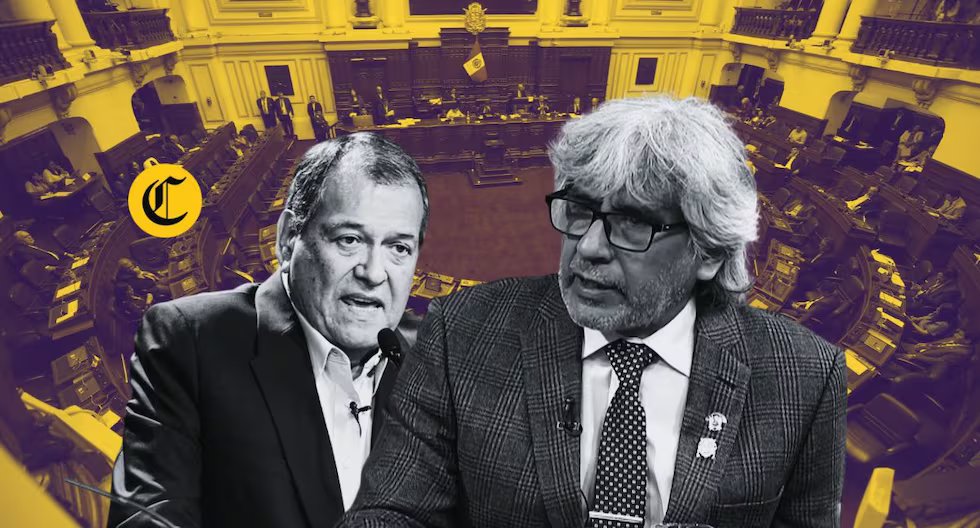

Jorge Gavidia became the first congressman to resign from a bench of the new bicameral Congress. The senator announced his departure from the Good Government Party after Jorge Nieto, leader of the group, brought forward the start of a disciplinary process against him for having voted in favor of granting legislative powers to the Executive.
In dialogue with We Have to Talk, the El Comercio video podcast, Gavidia explained that he decided to distance himself from the group because he preferred “not to continue harming” the party by maintaining positions different from those of his bench. One of the main discrepancies occurred during the vote on the request for legislative powers, which he supported, while the Good Government opted to abstain. In his opinion, there was “pettiness” in the Senate when analyzing the Executive’s request.
The parliamentarian explained that his discomfort began when he did not receive the support of the bench for a bill and was accentuated after he was not appointed as a member of the Special Multiparty Commission on Technology Transfer and Rural Innovation.
“I did perceive that a position was already being marked that was no longer so central. (…) If you want to be the center, then at least you let us have freedom when exercising the vote, right?” he exclaimed.
“This,” he said, “could even be used better than ever politically: to say, well, I have two senators here who voted in favor; we abstained, precisely because we are a center party that can build a bridge.”
Along these lines, he questioned the use of abstention as a way out of political disagreements. “Abstention is a terrible form of absolute hypocrisy,” he said.
Gavidia announced that he will remain without party militancy, although he assured that he retains affinity with the Good Government and wishes to maintain ties with its members.
“I will remain solitary, I prefer not to harm another party, we have to be honest,” he declared.
“I’m going to be free, but I still feel that affinity for a party that gave me the opportunity to be a senator. I would like to maintain the relationship because they are honorable people,” he added.
On the other hand, he rejected that his resignation could be interpreted as a betrayal of the party and recalled that, since his incorporation, he had warned that he held different positions from those of other members of the group.
“I am not a traitor, because since I joined I said: ‘Just in case, I think differently’, and (Nieto) told me: ‘Perfect, Jorge, this is an open party,’” he recalled about the conversation he had with the Good Government leader when he joined the organization.
“One is not a traitor when within the group you say: ‘You know what? I better leave before doing more damage to the party.’
When asked about the benches he would turn to to seek support for his initiatives, he responded: “Fuerza Popular for me is also going to be important because it is a government party (…) And on the other hand, I am going to be honest, Together for Peru seems like very honest people to me.”
Likewise, he acknowledged that he did not formally communicate his decision about his vote to the group, but maintained that he had publicly expressed his disagreements weeks before. As he explained, the debate on the interpretation of the Senate regulations, the Constitution and the relationship with the Chamber of Deputies was generating a trap that delayed a decision that he considered urgent for the country.
“I saw a trap and an approach that is perceived as obstruction, which is not exactly, but it seeks to solve a problem that is not a priority, considering that they are very divergent points where the legal interpretation of the Senate regulations compared to the Constitution and the relationship with Deputies requires much more time and Peru urgently required those powers,” he noted.
In that context, he questioned that the discussion focused on a legal controversy that, from his perspective, should not postpone attention to the issues that motivated the Executive’s request.
“I saw that this was going to get stuck. What is a senator doing walking around, thinking that we are going to solve an almost academic issue?” he expressed.
Meanwhile, Senator Nora Bonifaz, of the Good Government, urged Gavidia to explain the doctrinal differences that motivated his resignation from the group.
“Evidently, there is no transparency in that mental darkness, even though he calls himself a scientist. I want Jorge Gavidia to say scientifically, one by one, those differences in Good Government, and explain them. We will listen,” he told the media.
This newspaper sought to contact the other members of the Good Government, but at the close of this report they did not respond.
For his part, Senator Alfonso López Chau ( Ahora Nación ) regretted the resignation and expressed his wish that he reflect and return to the Good Government bench. “As far as I understand, you can do it (join another bench), but I hope you don’t do it, I hope you reflect and return to your bench. I recommend that,” he said.
“It is a shame and I cannot be happy about a situation like that. On the contrary, I wish the Good Government to soon overcome its problems and establish itself as a party, that is what I can wish for,” he added.
Likewise, he ruled out that his group seeks to recruit Gavidia. “No, we do not open the door to anyone. Out of manners, we cannot encourage that to exist in another party and we are not happy,” he declared.
Daniel Barragán, from the Civic Obras Party, had a different position. He stated that his group does not rule out the eventual incorporation of Gavidia, who resigned from the Good Government Party after expressing disagreements with its members.
“The doors of Obras are always open, but it depends on the circumstances, an evaluation must be made just like any party,” he indicated.
Senators and deputies who no longer belong to the party for which they were elected will have two options: join the Mixed Group or move, for the only time during the parliamentary period, to another existing group.
To benefit from any of these alternatives, they must renounce the political party of origin, according to the information released by the Congress of the Republic.
The Mixed Group brings together senators and deputies who no longer belong to the bench for which they were elected and who do not make up another parliamentary group.
However, its members have limitations with respect to the constituted benches, since they are not part of the Board of Spokespersons nor do they have their own staff or office.
Besides…
What do articles 40 and 41 of the Congress Regulations establish?
Article 40 points out that new parliamentary groups cannot be formed during the legislative period. Representatives who resign or are expelled from their groups are part of the mixed group or may join, for only one time in the parliamentary period, another existing parliamentary group depending on the electoral result.
Representatives who join a previously constituted parliamentary group cannot nominate or join the board of directors of the chambers or commissions until the end of the next annual period of sessions after the date of their incorporation.
Article 41 indicates that the mixed group functions as a parliamentary group only for the purposes of presenting legislative proposals, as well as to integrate commissions. He cannot be a member of any board of directors, nor the Board of Spokespersons. It does not have staff or office as a parliamentary group.
In dialogue with El Comercio, the specialist in parliamentary issues Alejandro Rospigliosi warned that the resignation of Jorge Gavidia from the Good Government Party bench could constitute a case of transfuguism.
He recalled that there were attempts to tighten the provisions of the parliamentary regulations in the face of this type of situation, but the Constitutional Court declared them unconstitutional.
“I think the man will go over to the ruling party. He has many questions and it is easier to lean into the protection of the ruling party than to be in the opposition. He needs it to finish this five-year period,” he stated.
Rospigliosi explained that Gavidia must formalize his resignation before the Chief Congress Officer. However, he considered that the Good Government bench should open a disciplinary process and expel him, with the aim of establishing obstacles to his eventual incorporation into another parliamentary group.
“He would have more barriers. If he is not punished and expelled, he would leave freely, without any difficulty,” he said.