Of Beatrice Guarrera
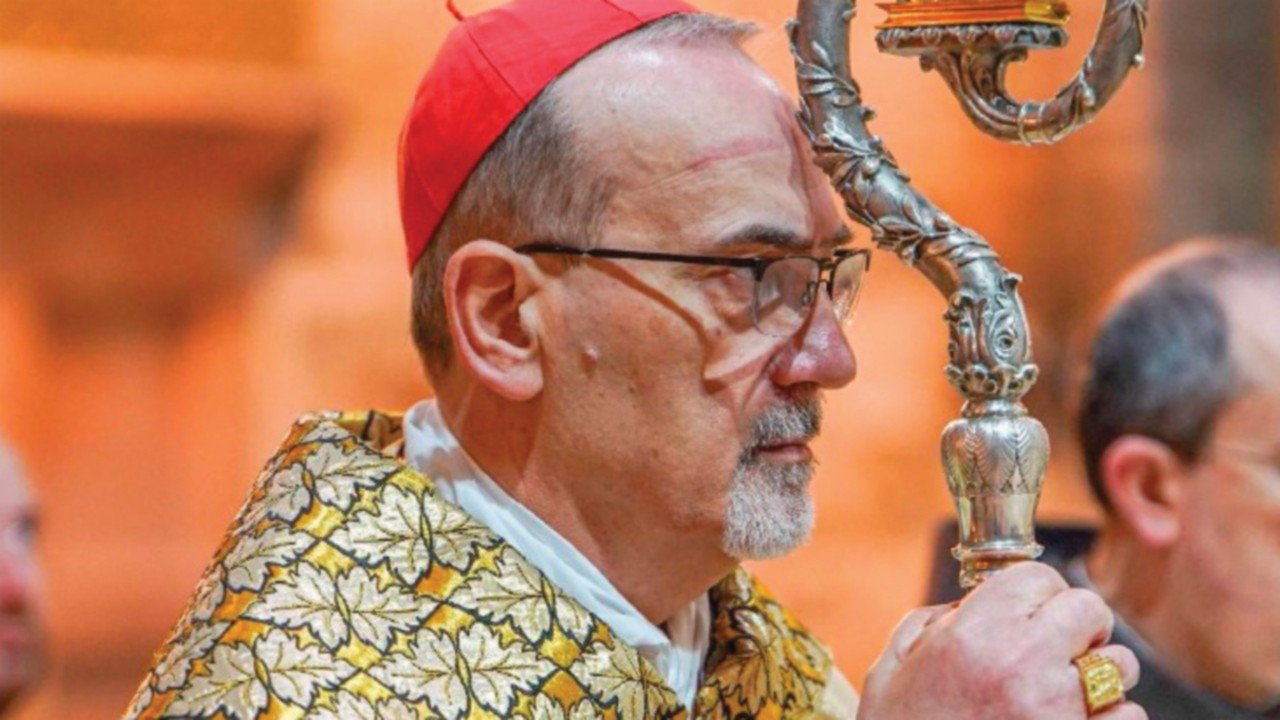
How to live as Christians in the conflict situation that the Holy Land is facing? This is the question that the letter addressed to the diocese signed by the Patriarch of Jerusalem of the Latins, Cardinal Pierbattista Pizzaballa, which was released today, Monday 27 April, with the title They returned to Jerusalem with great joy. A proposal to live the vocation of the Church in the Holy Land.
«The vocation of Jerusalem – observes the cardinal in the text – is to heal the world from its wounds. Healing wounds with meekness and the courage of forgiveness: this is the sublime mission of Jerusalem, where Christians are salt, light and leaven within the societies to which they fully belong.” Pizzaballa’s words are contained in the long document which represents “an initial proposal for reflection”, to be matured “through discussion”, “provided that we are nevertheless moved by the sincere desire to try to understand God’s will for each of us”. The text will also arrive in bookstores from Monday 11 May in a volume, published by Libreria Editrice Vaticana, in Italian and the possibility of publications in other languages is being studied.
The Letter is structured in three parts: in the first we start with “the evaluation of the current state of disorder”, to “anchor ourselves firmly to reality as it is, while recognizing in it the active presence of God”; in the second the patriarch shares “a vision for the community, inspired and anchored in Scripture, with a precise connection to Jerusalem”; in the third, the pastoral implications of these reflections are analyzed, to be applied to parishes, families, schools and institutions. Pizzaballa underlines that the letter does not contain considerations and analyzes of a purely political nature: «it is “political” only in a broader sense, as it concerns our remaining, as Christians, in polisthat is, in our real world and in our city of Jerusalem, although always oriented towards the true and definitive Polisthe heavenly Jerusalem.” The biblical icon around which the patriarch’s reflection revolves is, in fact, the city of Jerusalem, which “indicates coexistence, civil and religious relationships”. «We – states Pizzaballa – are the Church of Jerusalem, and the Holy City is not only the geographical but also the spiritual heart of our ecclesial community». A Church with a multifaceted face, “by its essence, plural, given that Jerusalem is the mother of all peoples”, but which “for many centuries has been immersed mainly in an Arab context”. From this precise framework the gaze on the present begins, a gaze that “aspires to embrace and include all its inhabitants”.
It is therefore impossible not to start from 7 October and the war in Gaza, “watershed events which, in the worst possible way, closed an era and opened another”. “What we are experiencing – observes the patriarch – does not only represent a local conflict, but is the symptom of a paradigm shift at a global level”. For decades the international community believed in an international order based on rules, treaties and multilateralism, while today everyone “seems to have opened their eyes to their weakness”. «We are witnessing the return of force as a decisive tool to resolve every dispute – adds the cardinal -. War has become the object of an idolatrous cult.” Civilians are no longer considered collateral victims, but become damages to be attributed to the enemy’s failure to surrender or functional tools to achieve their own goals, while some world powers choose a side not on the basis of justice, but on the basis of their own strategic and economic interests. «It is a war that is also waged with words and images – the patriarch points out -. It is increasingly difficult to distinguish news from propaganda, while we wonder how many people in these latest wars have died due to an “algorithm’s decision”. The daily life of the diocese has suffered “the consequences of this chaos”, such as the dissolution of relationships poisoned by hatred and mistrust, the fragmentation into enclaves and identity bubbles, amplified by social media algorithms, the loss of meaning and the wear and tear of the words “coexistence”, “dialogue”, “justice”, “common good”. Among the negative effects is also the crisis of interreligious dialogue, “hit by conflicting memories and identity exploitations”. «The Holy Places, which should be spaces of prayer – states Pizzaballa – become identity battlegrounds and sacred texts are used to justify violence, occupation and terrorism. This abuse of the name of God is the most serious sin of our time.”
In this scenario, the local Church is called to respond differently in heterogeneous realities, starting from Gaza, where Christians “are immersed in a condition of extreme tribulation, but the Parish of the Holy Family and Caritas remain the Face of Christ in the midst of the horror”. In Palestine, the future of the Israeli-Palestinian conflict is being decided in a silent and structural way. “If the drift of aggression caused by the occupation and the absence of the rule of law is not stopped, we risk the crystallization of a situation of permanent occupation that erodes any possibility of a just and shared solution”, warns the patriarch. In Israel «social discrimination, economic inequalities and growing insecurity are increasing, due to crime which reinforces the temptation to emigrate. The Catholic community of Jewish expression – continues the cardinal – in such a polarizing dispute has not always felt listened to”. Within this desolation, the Christian communities “remain a tangible sign of hope and courageous experiences of vitality and brotherhood, thanks also to the constant spiritual and active closeness of the universal Church – from Pope Francis and Pope Leo XIV to the smallest and poorest dioceses”.
The Church of Jerusalem “made its voice heard by trying to pronounce a word of truth even within this disorder, often at the cost of misunderstandings, but – asks Pizzaballa – was it enough? Or, in this difficult period, have we at times favored prudence and sought institutional survival, sacrificing our prophetic testimony? It’s a question that accompanies me every day, which is never easy to answer.” We also have to ask ourselves what God’s will for Jerusalem is and, to answer, “we need to scrutinize the image of the Holy City” that God offers in the Scriptures. Jerusalem is not just a question of political borders or technical agreements, its main identity is being the place of God’s Revelation, a house of prayer for all peoples. “Ignoring this vertical dimension, the primacy of God, expressed in the sensitivity of the different faith communities, has led and will lead to the failure of every coexistence agreement”, warns the patriarch.
This is a crucial warning for the religious institutions of Jerusalem: “Without allowing themselves to be constantly enlightened by the relationship with God, they atrophy, becoming impregnable fortresses closed to the world.” Pizzaballa also states that “the obsession with the occupation of spaces and property has become one of the main criteria for relationships between the religious communities of Jerusalem, generating division and violence”, but instead “we need the courage to build new models of relationships where the common faith in God becomes an opportunity for encounter and not exclusion”. Ultimately, we need “a new way of seeing in the light of the Paschal Lamb”, which materializes in “a lifestyle of the ‘city with open doors’ and a purified memory”, “rethinking the categories of history and therefore of guilt, justice and forgiveness”. We must then work to ensure that Jerusalem is accessible to all, because “it does not belong to anyone exclusively, but is the heritage of humanity”.
At the pastoral level, the primacy of liturgy and prayer must be kept in mind first and foremost. The role of families as laboratories of education in coexistence and respect is also fundamental, where the past can be narrated to children with pain and truth, but without transmitting feelings of hatred and revenge. Furthermore, Christian schools must be understood as “workshops of a new humanity, in which Christian conscience is transmitted and people are taught to reread history with eyes free from rancor”. Hospitals and social works – places where hospitality and dialogue are already lived realities – must be supported. An important role also belongs to the elderly, who are the living memory, to the young – the prophecy – and to priests and religious, a faithful point of reference for the community and models of possible coexistence. In reference to relationships with other Christians, adds Pizzaballa, “it is important to encourage concrete opportunities for mutual understanding and to speak with one voice, because the first testimony is the unity between communities”. Interreligious dialogue also remains “a vital necessity”. Finally, it is fundamental that “no complicity with the culture of violence” is never tolerated, while space must be given to trust.
«How is it possible to do all this?». The patriarch’s response is simple: «Alone we cannot. But we are not alone. Jesus awaits us in our parishes, in our communities of faith, in our ecclesial groups and movements.” «Let us carry God’s dream for his city in our hearts – concludes Pizzaballa – and let that dream become, step by step, day after day, our very life».