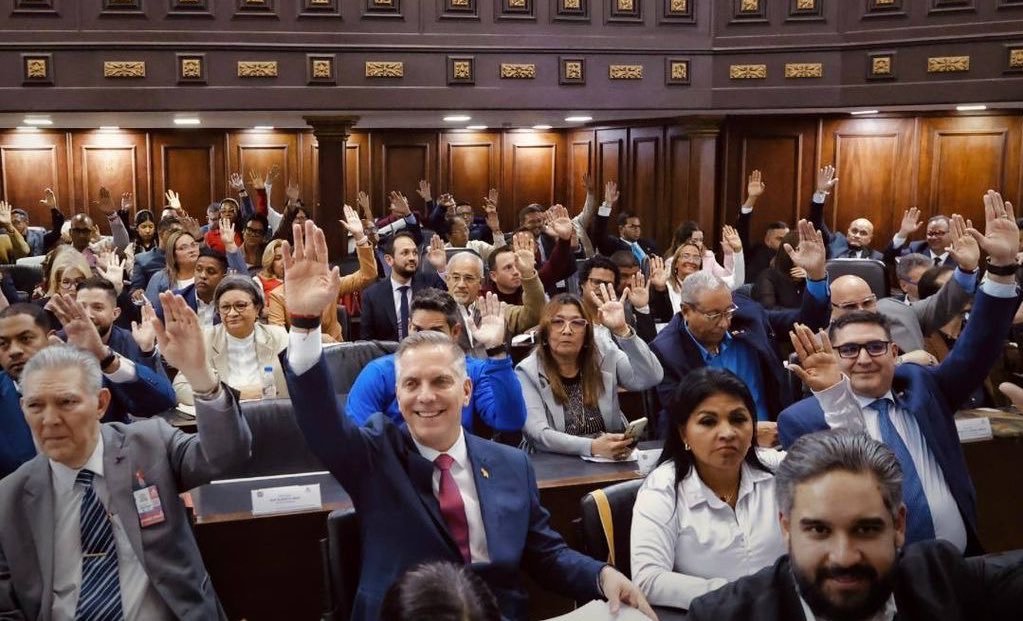
Finally the National Assembly concluded the second discussion of the Organic Law of Mineswhich took exactly one month, to declare sanctioned the regulations that repeal the decree issued by then-president Hugo Chávez in 1999.
The remaining articles from 115 to 131 refer to the sanctioning regime of the legal instrument that was presented by the government in charge of Delcy Rodriguez to the AN, after the visit to the country of the Secretary of the Interior of the United States, Doug Burgum (March 4), to seal cooperation agreements on mining matters.
The new law establishes fines for those who incur delay or omission in the presentation of mining activity reports to the competent body (500 times the equivalent of the official exchange rate of the highest value currency, published by the Central Bank of Venezuela, in force); due to lack of notification of minerals other than those authorized (1,000 times the official exchange rate); for transport without the guide (1,000 times) and for lack of registration in the mining registry (500 times the exchange rate).
Likewise, anyone who does not collaborate, hinder or manipulate the inspections will be fined (5,000 times the official exchange rate); who uses substances that degrade and disturb the environment (1,000 to 100,000 times); who incurs in invasion of another’s concession (1,000 times the exchange rate), among others.
In accordance with article 123, the fines established in the regulations are doubled in case of: exploitation in an area under a special environmental protection administration regime; concurrence of two or more causes and recidivism in the commission of the offenses.
Jail for illegal exercise
The prison sentences were established in article 124 of the law: Natural persons, as well as partners and directors of legal entities, whether public or private, national or foreign, who, by themselves or through an intermediary, promote, incite and carry out primary activities without having permits will be punished with prison. six months to 10 years.
“In the event that the activities indicated in this Law are carried out in an area under the special administration regime for environmental protection, the applicable penalty will be imprisonment for 10 to 15 years”adds the article.
Article 130 contemplates the suspension of all or some mining activities authorized, in case of violation of the law, for a period of 6 months. The original project did not contemplate deadlines.
The law contemplates six transitional provisions. One of them is that the governorates and mayors must adapt their plans, programs and laws on the matter within a period of one year. A period of 180 days is also granted for the publication of the regulations of the regulations.
The suppression of the National Mining Inspection and Supervision Service is also ordered, in addition to the aforementioned decree of the 1999 Mines Law.
“Historical moment”
The PSUV deputies stood up to applaud at the end of the second discussion, while the head of Parliament, Jorge Rodríguez, declared the law passed “unanimously.” Likewise, he ordered the referral of the legal text to the Supreme Court of Justice (TSJ) to rule on constitutionality.
Rodríguez praised the “profuse” consultation process of the law that, he assured, will contribute to the “construction of prosperity and the future.” He said that small miners will have an instrument “that protects them” and thanked the deputies for their work and “real perception of the historical moment that we are living.”
The Mining Law becomes the third legal instrument sanctioned by the AN with a majority of Chavismo. Before, the law to accelerate procedures and the partial reform of the Organic Hydrocarbon Laws, in the context of economic cooperation with the United States, which has exercised guardianship over Miraflores since January 3, when Nicolás Maduro and Cilia Flores were detained.