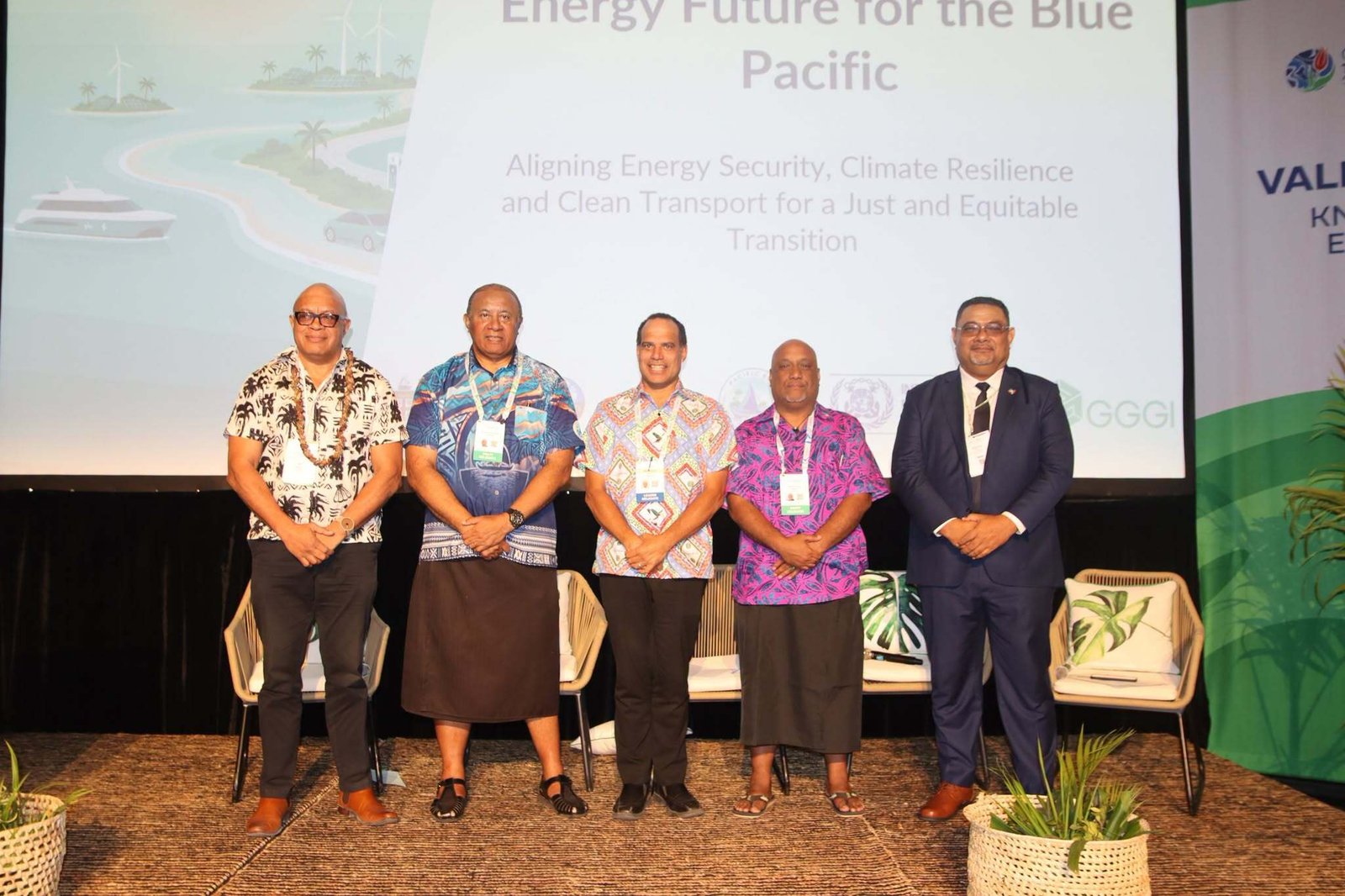
Nadi, Fiji – 20 November 2026 – Pacific leaders, regional and international organizations, development partners and participants from the pacific ecosystem were convened today by the Ministry of Public Works, Meteorological Services and Transport (MPWMST) at the Pre-COP31 Fiji side event, “Towards a 100% Renewable Energy Future for the Blue Pacific: Aligning Energy Security, Climate Resilience and Clean Transport for a Just and Equitable Transition”, to highlight the fact that the Pacific energy transition and transport transition are one connected agenda.
Hosted by the MPWMST and supported by the Global Green Growth Institute (GGGI), the event brought together perspectives from the government of Vanuatu, the Pacific Blue Shipping Partnership Chair from the Republic of Marshall Islands and the International Maritime Organization (IMO).
Moderated by Regional Director for the Pacific Ratu Sakiusa Tuisolia, the panellists highlighted the need that renewable energy and transport transitions must be pursued together. Discussions underscored that clean electricity, sustainable mobility solutions and maritime decarbonization are essential components of a resilient and fossil-fuel-free Pacific future, reaffirming the voices from the Manubada Call to Action 2026 and the Pacific Blue Shipping Partnership Charter signed 12 June in Majuro, as important frameworks guiding Pacific climate and development ambitions.

Opening the session, Hon. Ro Filipe Tuisawau, Minister for Public Works, Meteorological Services and Transport of Fiji, highlighted the importance of integrated approaches that simultaneously strengthen energy security, reduce dependence on imported fossil fuels and improve national resilience. Drawing on Fiji’s rich maritime heritage, the Minister emphasized that the connection between transport, energy and the ocean is not new for Pacific peoples. He reflected on the historic role of the drua, Fiji’s double-hulled voyaging canoe, which harnessed wind power and embodied generations of Pacific innovation, sustainable resource use and navigational expertise.
“Fiji stands ready to work with our Pacific neighbours to pioneer Pacific-led solutions and with international partners to develop transport systems that reduce dependence on imported fuel, improve mobility and connectivity, and strengthen the resilience of our communities.”
The Minister noted that the drua should not simply be viewed as a relic of the past, but as a symbol of enduring principles that remain relevant today: innovation adapted to Pacific conditions, renewable-powered mobility, efficient design, skilled craftsmanship and respect for the ocean that sustains island communities. He stressed that transport decarbonization represents the next major frontier in climate action and should be viewed as a modern continuation of the Pacific tradition of using local knowledge, renewable resources and home-grown ingenuity to connect islands and strengthen resilience. As a sector critical to trade, tourism, access to health and education services, and inter-island connectivity, he underscored that the choices made today will determine whether Pacific nations remain dependent on fossil fuels or transition towards cleaner, more affordable and resilient

Talking about the solutions developed in Vanuatu to enable the transition, Minister for Climate Change, Hon. Ralph Regenvanu, underscored the importance of energy sovereignty and reducing vulnerability to global fuel price shocks through domestic renewable energy solutions, national financing vehicles and sustainable transport investments.
“Energy sovereignty does not mean acting alone. It means working together so that Vanuatu can increasingly power its communities, connect its islands and shape its future using resources and systems that are resilient, sustainable and within our control.”
Panellists agreed that Pacific island nations are already laying important foundations for the transition through nationally and regionally developed policy frameworks, technical standards, sustainable mobility plans, renewable energy investment plans, pilot initiatives and regional maritime cooperation.
Highlighting the role of the Pacific Blue Shipping Partnership, the chair representative, Presidential Special Envoy on Maritime Decarbonization for the Republic of Marshall Islands, Ambassador Albon Ishoda, called for a country-led, regionally coordinated transition to a sustainable, resilient and decarbonized Pacific maritime sector by 2050 urging strong international shipping action grounded in a just and equitable transition, the polluter-pays principle and the 1.5°C limit.
“This shift we are trying to achieve is not just about our responsibility to the environment; it is also about energy security for our island nations. We need to look to solutions closer to home and find inspiration in our rich maritime heritage for a sustainable maritime future” emphasized Ambassador Albon.
The discussion them moved from the Pacific’s regional delivery platform to the global regulatory process with Mr. Sitalingi Payne, Regional Coordinator for the International Maritime Organization Regional Presence Office for the Pacific sharing updates on ongoing global discussions relating to shipping decarbonization and the emerging Net-Zero Framework.
“Pacific SIDS should be able to contribute to adopting global rules at IMO, which will facilitate access to finance, technology and capacity needed to transition without compromising food security or connectivity.” Said Mr. Payne.
Together, in a room packed with government officials, development partners, members of civil society, and the private sector representative, the speakers stressed that implementation at scale will require greater access to climate finance, technology transfer, technical assistance, workforce development and long-term investment partnerships.
As preparations continue toward COP31 and ongoing discussions within the International Maritime Organization, the panel called for stronger international support to transform Pacific ambitions into implementation-ready investments that deliver tangible benefits for communities, economies and future generations.
The event concluded with a shared commitment to continue working together to advance Pacific-led solutions that support climate resilience, decarbonization of land and maritime transport and a 100 percent renewable energy future for the Blue Pacific.
Follow us on X | Facebook | LinkedIn | YouTube | Instagram
For more information, visit: https://gggi.org
GGGI Pacific (Regional Office)
Anant Jha
Senior Officer, Pacific Transport and Sustainable Mobility, Pacific
anant.jha@gggi.org
Kelly Vacala, Regional Communications & Knowledge Sharing Lead