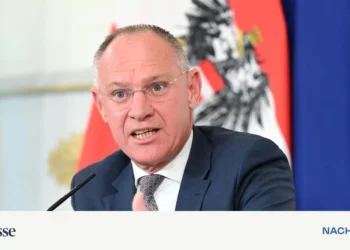
While the ORF will decide on Thursday who will lead the station until the end of the year, the fronts remain hardened in the case of the former station boss Roland Weißmann. Even though, according to the compliance check, there was no “sexual harassment in the legal sense,” Weißmann was terminated by ORF. Because “any appearance of behavior that is inappropriate for a manager” should be avoided. Weißmann wants to contest the termination. On the other hand, lawyer Roland Gerlach, who is advising the head of the ORF Foundation Board in the case, told the “Presse” that he still considers Weißmann’s behavior to be sexual harassment within the meaning of the Equal Treatment Act. But this question would no longer play a role in the dispute over Weißmann, says another labor law expert.
Regardless of whether there was sexual harassment or not: any claims for damages against Weißmann are statute-barred anyway. The ORF employee’s allegations against Weißmann date back to 2022, and under equal treatment law, claims for damages must be made three years after knowledge of the damage and the perpetrator.
The termination
In terms of labor law, things are more exciting. The ORF did not fire Weißmann, which can be done with immediate effect in the event of misconduct. He terminated his employment within the legal deadlines and also said that there was no sexual harassment. Therefore, it no longer plays a role in this termination whether there was harassment, says labor law lawyer Katharina Körber-Risak (who is not involved in the current legal dispute) to the “Presse”. Gert-Peter Reissner, head of the Institute for Labor Law and Social Law at the University of Graz, also explains that it is now irrelevant for the termination by ORF whether there was sexual harassment. “Dismissal is not a case of justification,” he says.
The broadcast
A third issue is the question of whether the top of the ORF Foundation Board (Heinz Lederer and Gregor Schütze) violated Weißmann’s rights because they made public in a broadcast on March 9th that “an ORF employee had made allegations of sexual harassment against the general director.”
Weißmann had previously resigned for an important reason, from his point of view not voluntarily, but because the ORF did not treat him fairly after the allegations emerged. As a result, he ended the ORF management contract on March 8th from his side, but the contract as a regular ORF employee that was revived was terminated by the broadcaster. If Weißmann was really allowed to terminate the boss’s contract for an important reason, he can still assert claims from this employment relationship.
If Körber-Risak has his way, it is also irrelevant to the dispute over the broadcast whether sexual harassment actually occurred. Because the allegations depend on the time at which they were broadcast and “it was certainly not clear at the time.”
Fellow lawyer Gerlach had defended the OTS: At the time, he had pointed out that the public could not be left in the dark about what was going on, it would come out anyway. And since there was no agreement between Weißmann and the woman, the risk of the accusation becoming public seemed too great. Weißmann’s lawyer Oliver Scherbaum, however, criticized the fact that the broadcast, including the accusation, was made against Weißmann’s will.
Termination challenge
Back to Weißmann’s employment as a regular ORF employee, which was terminated by the broadcaster. Weißmann wants to challenge this dismissal because it is a dismissal based on a frowned upon motive. The employer did not fulfill its duty of care towards Weißmann. In principle, such a challenge is possible for employees; this can result in the dismissal being revoked and the employee having to be employed again.
However, the possibility of challenging the company constitution law does not exist in top positions, says Professor Reissner. And Weißmann’s ORF chief contract and his regular one cannot simply be separated from each other in this regard.
Even apart from the question of sexual harassment, the case remains exciting. In the event of non-agreement, the labor court would have to resolve the issues. Eleven people applied for the position of ORF general director until the end of 2026, which will be awarded on Thursday. The appointment of the position for the regular five-year period from the beginning of 2027 is planned for August.