President Trump announced on Sunday that the United States and Iran had agreed on a memorandum to end hostilities. But many crucial details remain unclear or unresolved. Stephen Stromberg, an editor in Opinion, gathered the Opinion columnists David French and Nicholas Kristof and the Opinion contributing writer Megan K. Stack to discuss what the deal means for the United States, for Iran and for the global order.
The text has been edited for clarity.
Stephen Stromberg: The United States and Iran have observed a shaky cease-fire since April. The text of the new deal might not emerge until Friday, and we are seeing different accounts of what’s in it. But — from what we do know — what’s significant about it?
Megan K. Stack: This is actually, finally, the cease-fire that has eluded us.
The outline apparently includes an end to the fighting between Israel and Hezbollah in Lebanon.
Judging from what Iranian officials and Vice President JD Vance have said, it appears that Iran might get some financial concessions, including “access to” a $300 billion reconstruction fund, which Vance said would come from Gulf countries.
Also, an Iranian official told Reuters that Iran will agree not to produce or acquire nuclear weapons, will refrain from further uranium enrichment and will dilute its stockpile of enriched uranium. If true, that is a concession from Iran.
These could be the beginnings of a long-term deal. But closing it won’t be easy.
Nicholas Kristof: The good news is that the fighting may end or slow down across the region and that the Strait of Hormuz may open. But the memorandum hasn’t resolved the fundamental issues, from Iran’s nuclear program to sanctions relief on the country. I’m skeptical that a nuclear deal will actually emerge from this. And the fact that the Trump administration hasn’t released the text suggests that it prefers that people don’t see what it conceded.
David French: It’s a relief to see an end to an illegal and unwise military conflict (for now). To the extent that there is anything new, it seems that Iran and the U.S. have solved the problem of both wanting to declare victory — by simply refusing to release the agreement. Both Iran and the Trump administration can fill the gaps in public knowledge with their own propaganda.
In the meantime, the public is left in the dark, with the sense that the warring parties reached a cease-fire deal that seems like little more than an agreement to agree on something, at some point in the future, and no one yet knows what that something will be.
Stromberg: Let’s recall Trump’s stated war aims: regime change, weakening of the Iranian military, preventing Iran from getting a nuclear weapon. To what extent is he on track to achieve any of these?
Kristof: Trump has failed to achieve his war aims. No disguising that. We’re hoping to reopen the strait as it was before Trump began the war, albeit with Iran talking about imposing fees on traffic. Inside Iran, we’ve increased the power of the Islamic Revolutionary Guards Corps hard-liners and replaced a somewhat cautious Supreme Leader Khamenei (Ali) with a possibly more aggressive Supreme Leader Khamenei (Mojtaba). Instead of helping the Iranian people, I fear we’ve abandoned them to suffer under an even more hard-line regime.
Stack: Trump has gravely miscalculated and is cutting his losses.
The short-term damage to Iran’s economy, military and infrastructure is real, not to mention the many civilians who’ve died in the bombings. But Iran did more damage to our military infrastructure than most people thought was possible and fought us to a negotiated truce.
The major fighting might now end. But the International Atomic Energy Agency recently reported that Iran is now more likely to acquire a nuclear weapon than it was before the war. The people did not rise up. Enriched uranium is still in Iranian hands, albeit most likely buried under rubble.
French: There is no question that the United States and Israel inflicted considerable damage on Iran’s military, and it’s almost certain that they further degraded Iran’s nuclear program. But that damage can be repaired. Given the damage Iran inflicted in return, I wonder if Iran emerges from this conflict with a greater ability to deter the United States than we have to deter Iran.
This is one consequence of waging war without public support. We could have answered Iranian attacks, but that answer would have required far greater expenditures of blood and treasure than the American people would tolerate — especially since the Trump administration did virtually nothing to prepare the American people for war and for the sacrifices that war requires.
Stromberg: David, you seem to be saying that, had Trump made the case for war to the public, he might have been able to do more. What would a well-planned and well-executed Iran operation have required and, perhaps, achieved?
French: I don’t want to mislead anyone — even the best-planned military operation to destroy Iran’s nuclear program and secure control of the strait would have been difficult and costly.
A well-planned and well-executed operation would have looked like Operation Desert Storm in 1991 — ramping up diplomatic pressure with clear and unambiguous demands, securing allied assistance to share the military burden and maintain a united front against Iran and then using sufficient, overwhelming force (including, if necessary, ground troops) to secure victory only when diplomacy absolutely and unequivocally failed.
The impossibility of imagining public support for such a campaign shows that the president shouldn’t have dreamed of greenlighting the operation.
Kristof: I don’t think there was a path to war with Iran that would have succeeded or that would have won popular support. But Trump’s threats of war did seem to frighten Iranian leaders into offering meaningful concessions on the nuclear issue at the beginning of the year. That would have been the moment to strike a deal. Sometimes military force works best as a threat.
Stromberg: What are the prospects for Iran’s nuclear program — the ostensible motivation for beginning the war? The agreement appears to call for neutralizing — in some way, at some time — Iran’s stockpile of nuclear material.
Kristof: My biggest fear is that the Iran war will accelerate Iran’s nuclear program rather than end it. The previous supreme leader pushed to develop the capacity to build nuclear weapons but not the weapons themselves — and the Revolutionary Guards Corps probably thinks that approach provoked the United States and Israel without providing a deterrent. The Iranians see that nobody messes with a nuclear-armed North Korea, and my fear is that the new supreme leader will pursue the North Korean path and rush for nuclear weapons at some point in the coming years.
I worry that the nuclear negotiations will stall in the coming months — partly because Trump won’t want to agree to any deal that doesn’t look better than President Barack Obama’s 2015 Iran nuclear deal, which Trump scrapped — and that Trump will lose interest just as he lost interest in Gaza, that we won’t get inspectors on the ground in Iran and that the Revolutionary Guards will make a big push for a few nuclear warheads, even rudimentary ones. This scenario would be a disaster, not least because it could lead Saudi Arabia, Turkey, Egypt and other countries to seek their own nuclear weapons.
French: I share Nick’s fears. We cannot trust any Iranian promises, and if the Trump administration relies on Iranian promises in any substantial way, then we’ll know the deal is inconsequential.
We’re in a much worse position than we were vis-à-vis Iraq after the first gulf war, when we were able to secure an agreement that required Saddam Hussein to dismantle his weapons of mass destruction programs and to open his country to rigorous inspections, even if these inspections were later obstructed. I’ve seen no indications that Iran will agree to anything close to that.
Stack: I can’t imagine why Iran wouldn’t want a nuclear weapon at this point. Iran has learned that treaties with the United States do not provide protection, because someone like Trump can be elected and scrap them. Iran offered historic concessions on its nuclear program in the days leading up to the start of this war, and even that didn’t prevent the country from suffering devastating bombardment. As Nick suggests, Iran can see what happened to itself, Libya and Iraq — and what has not happened to nuclear-armed North Korea. The record shows that obtaining a nuclear weapon provides the only meaningful protection. If the United States wants to discourage nuclear proliferation, we need to rethink our pattern of behavior.
Stromberg: Is Sunday’s agreement stable? Israel was not party to the talks, and it could stress or break the deal by striking Hezbollah in Lebanon.
Stack: I desperately want to believe this war is ending. But Israel is now occupying a large portion of southern Lebanon. Hezbollah — originally formed in the early 1980s in response to an Israeli invasion of southern Lebanon — will not accept that. Trump hasn’t been willing or able to maintain sustained pressure on Israel. Reaching a true cease-fire is no small thing, but we’re still a long, precarious way from a lasting deal.
Kristof: Ending the war in Lebanon is very important to the Iranians, while Israel insists on remaining in southern Lebanon and preserving some freedom of action there. It’s hard for me to see the fighting in Lebanon ending fully — so there will be hard-liners in Iran who will push for backing out of the agreement. So much can go wrong, and that’s without even counting how difficult it would be to strike a deal on nuclear weapons in coming weeks.
French: I’ll be looking closely at American deployments. If we see the Navy redeploying and American planes heading home, then we’ll know (at least for the short term) that the Trump administration is expecting stability. If, instead, the United States keeps a large force aimed at Iran, then I’d expect more exchanges of fire.
Trump is mercurial. We might cycle through several more stages of almost-war and almost-peace.
Stromberg: So if the deal falls apart … then what happens?
Kristof: I don’t think we’d go back to full-scale fighting between the United States and Iran, at least before the midterm elections. But we might see more military action of some kind. Both Iran and the United States would probably like to keep the strait open, so the hot war might dissolve into an ongoing cold war in which Iran tries to leverage its geography to impose fees on shipping, the United States protests that this is illegal, shipowners are perpetually fearful and nothing serious gets done on a nuclear deal.
French: I agree with Nick. It’s obvious that Trump has a particular formula for military conflict — hit hard and fast with the expectation that the other side will yield rather than face the pain of American punishment. But the Iranian regime’s pain tolerance is extraordinarily high. It will expend the lives of its soldiers and civilians.
Trump was flummoxed when Plan A didn’t work, and his Plan B seems to be pretending that Plan A worked anyway.
Stack: Both Iran and the United States have reasons to get out of this war. But with global economic pressure rising and the midterms nearing, Trump’s situation is more desperate. The entire world has been waiting — and, if this deal collapses, will have to wait some more — for Trump to accept that he needs to take the L. Iranian officials understand Trump’s position, and they understand the advantage they have at the moment. I don’t see the United States extricating itself without making concessions — financial, concerning control of the strait or on nuclear weapons — that will hurt Trump politically.
Stromberg: Can anyone plausibly claim to have won this conflict?
Kristof: In any meaningful sense, everybody lost in this war — so many lives lost and so much unnecessary destruction.
We’re also in a worse position than when we had the Obama-era Iran nuclear deal and worse even than we were early this year, when Iran was offering serious nuclear concessions.
Iran acquired some important leverage — its ability to close the Strait of Hormuz and possibly to monetize the strait in the future. Everyone knew that was a possibility, but Iran showed that with drones and even the threat of mines, it can scare ships into staying away and raise global oil prices.
There’s an analogy with the trade war that Trump started with China last year: China responded by ramping up controls on access to rare earth metals, and suddenly everyone realized how vulnerable they were and became less willing to challenge China. I think in the same way, the United States and Gulf countries alike will be less inclined to pick fights with Iran in the future, knowing that Tehran can shut down a good deal of shipping through the strait if it wants to. So from this war, Iran emerges with a powerful weapon and tool for deterrence, and in that sense it has come out ahead.
French: Based on what we know so far, there is one and only one way that Trump can plausibly declare any sort of partial victory in the war — if Iran actually does agree to the concrete, verifiable and permanent demolition of its nuclear program. Even then, Trump will have accomplished only one of his announced war aims.
In the absence of that, Iran will have prevailed. All of the considerable damage we inflicted on Iran during the war can be repaired. It can replenish and even expand its missile stocks, it can continue to support its terrorist proxy armies, and it can continue to repress its citizens. It can buy new ships or build a new navy that features swarms of drones.
And, at the same time, it will have established that it can close the strait, and it will have shown that our military — as professional and powerful as it is — is more vulnerable than we might have believed. We are still learning about the damage to American bases and the true extent of our losses in the air.
Think of it another way — war is often a contest of wills, and as Trump stopped his war before he achieved his objectives, we all know whose will prevailed.
Stack: Trump has shown the limits of American military power and proved that security guarantees and alliances with the United States are not worth much. He has punctured the idea of the United States as the one unassailable superpower.
But the war has been pretty good for Russia, which saw sanctions on its oil lifted and profited from sky-high energy prices while, at the same time, watching the United States run down its military supplies and undermine its international standing by waging a war of choice. It’s also been good for China geopolitically. As for Iran and the United States, both lost — but Iran lost less.
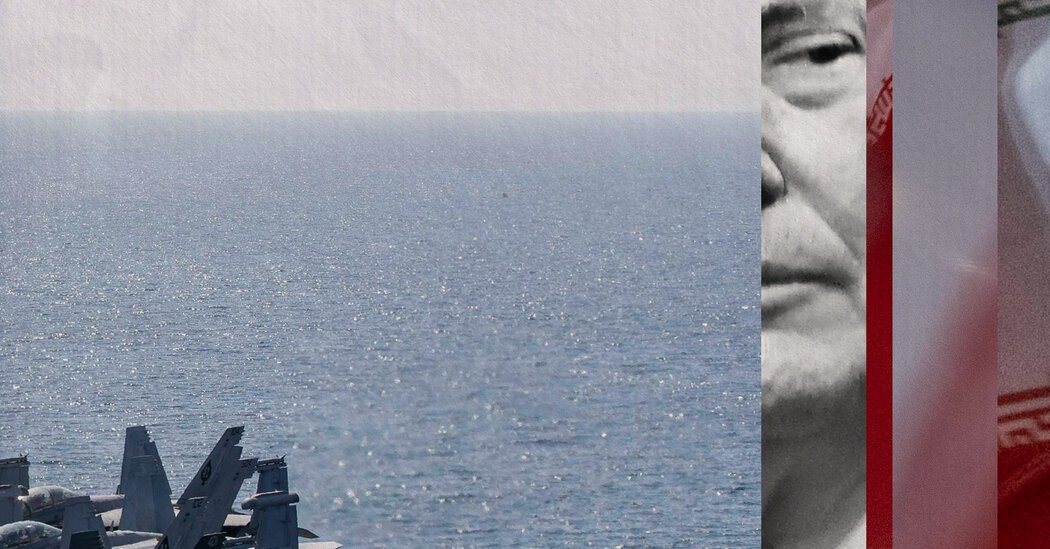
Source photographs by Chris Graythen, NurPhoto and U.S. Navy, via Getty Images.
The Times is committed to publishing a diversity of letters to the editor. We’d like to hear what you think about this or any of our articles. Here are some tips. And here’s our email: letters@nytimes.com.
Follow the New York Times Opinion section on Facebook, Instagram, TikTok, Bluesky, WhatsApp and Threads.