Grasset was just a tiny corner of the Bolloré financial empire. But losing Mr. Nora’s leadership is a sign of disdain among the powerful for a world of the recent past, one in which the public still accepted and cultivated contradictions, political complications, even conflict. It was not necessarily an enormously profitable world, but one where political opposites respected those who did not think alike, where knowledge itself garnered respect.
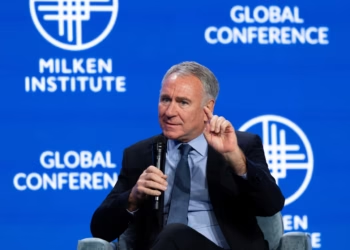
Mr. Nora, like the institution he led, was open and attentive to other people’s ideas. His weakness, if there was one, was immutable: his pedigree, which made him an easy target for the far right. Indeed, Mr. Nora is almost a caricature of the Parisian intellectual elite — his father was a political adviser to several major figures in French politics, and his uncle, Pierre Nora, was a longtime editor at another publishing house, Gallimard. Under Mr. Nora, Grasset maintained a pluralistic editorial policy.
Mr. Bolloré, by contrast, is the owner of a vast industrial conglomerate that has interests ranging from oil pipelines and energy storage to electric buses. Over the past several years, he has also been building a cultural empire, buying newspapers, radio stations, television channels and publishing houses. He acquired Grasset three years ago. As he picked up these levers of cultural power, he became editor, producer and distributor all at once. He is also, not incidentally, an extremely conservative Catholic. He has not only repeatedly brought outlets he has bought to heel by pushing the departure of people in important positions, replacing them with leaders apparently more loyal to him and his values. He has also leveraged his outlets to propagate fear and disseminate conspiracy theories about a decayed and decadent West, a Europe under threat from foreigners and egocentric old elites.
But Mr. Bolloré is, above all, a businessman: His cultural crusade is a very efficient moneymaker. His 24-hour news channel CNews — a kind of French Fox News — is the most popular news channel in France. Over the last two years, Mr. Bolloré also transformed Fayard, another historic French publishing house, into a largely far-right propaganda machine. Some of the most prominent figures of the French far right are now published by Fayard, including Jordan Bardella, the leader of the Rassemblement National, formerly the Front National. The party is leading the polls for next year’s presidential elections.
We are opening our eyes rather late in France to the efforts of the right to assume cultural control, to determine the words we consume, the discourse in which we partake. The message of authoritarians everywhere is the same: Whoever isn’t with me is against me, and whoever won’t follow me will get the boot. The boss is always right, so he steamrolls his way through and imposes his worldview. He exerts his power. He demands absolute loyalty from his subordinates. The plutocrats have become oligarchs.