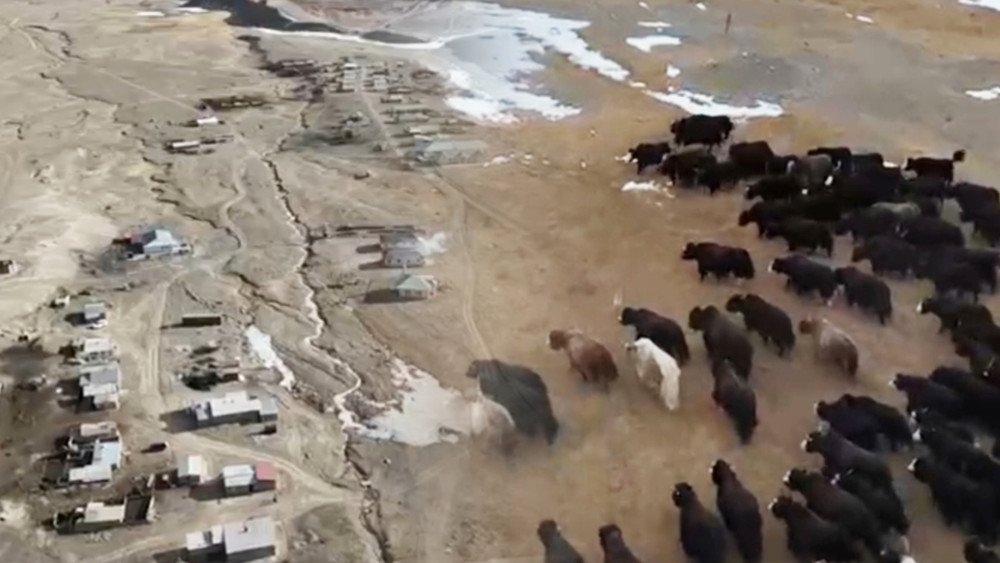
Turmush — In the remote mountain border village of Ak-Shyirak, people live at an altitude of 3800-4000 meters above sea level.
The village of Ak-Shyirak is located in the mountains of the Issyk-Kul region, near the border of Kyrgyzstan and China. It was founded during the period of active development of the highlands of Kyrgyzstan during the Soviet period, when a base camp for geological expeditions was organized here. Over time, a geological settlement grew on this site, which flourished until the collapse of the Soviet Union.
Local residents consider this place their home; they have lived there for generations, despite the remoteness of the territories from the administrative and regional centers.
Regional correspondent Turmush visited this village and got acquainted with the living conditions of the local residents. The village elder, 87-year-old Turum Kokocho kyzy, shared the history of the village. “Our village is called Ak-Shyirak because it is associated with the stallion (“kuluk at”). According to the stories of the elders, one boy from a poor family tended the cattle of the rich, and one day he was given a young horse for his work. The boy accepted the horse as a gift, but soon he began to destroy everything in his path, and this event became famous in the area. Soon the boy left these places with his horse, crossed the pass and settled in the village of Ak-Shyirak. Since then, the village received its name in honor of the Ak-Shyirak stallion. Local residents moved here in 1928-1930, when they came from Enilchek (Ak-Suu district) – representatives of the Konurat and Monoldor tribes. The Pervomaisky collective farm was formed in this area.
This is a place with a rich history. Geological mining work was carried out here, but later the mine closed and the school was also closed. In 1988, together with her husband, they wrote a letter to Apas Zhumagulov (who served as Chairman of the Council of Ministers of the Kyrgyz SSR), a statesman. Then the Ak-Shyyrak boarding school was reopened. Thanks to his support, the village was preserved and people did not leave. Everything was closed and transport links were interrupted. Since then I have not been able to thank Apas Zhumagulov. I always ask you to convey my gratitude to him,” says the oldest resident of the high-mountain settlement.
According to Turum Kokocho kyzy, now they live normally. “We are engaged in cattle breeding, spend our days happily, the children help with the housework. If I go somewhere, for example, to visit children who live near the coast of Lake Issyk-Kul, then after 15 days I return to Ak-Shyirak again because I miss it,” she says.
Recently, residents rejoiced when they received “red books” (state acts) for their homes. About 300 people live in the village, located on the border of Kyrgyzstan and China, 240 kilometers from the administrative center of the Jeti-Oguz region.
They say they store food for the whole winter and don’t leave the village until summer. In the summer, most go on vacation, and only a few stay in the village.
To get to Ak-Shyirak, you need to overcome the Sary-Moinok and Sook passes, and drive 32 serpentines. The main occupation of the village residents is animal husbandry. There is a school in the village where more than ten teachers work.
Residents of Ak-Shyyrak continue the traditional Kyrgyz way of life – they heat the stove with dung, cook food in a cauldron, brew tea in a samovar. They do not want to go to other places and live in this remote area for years.