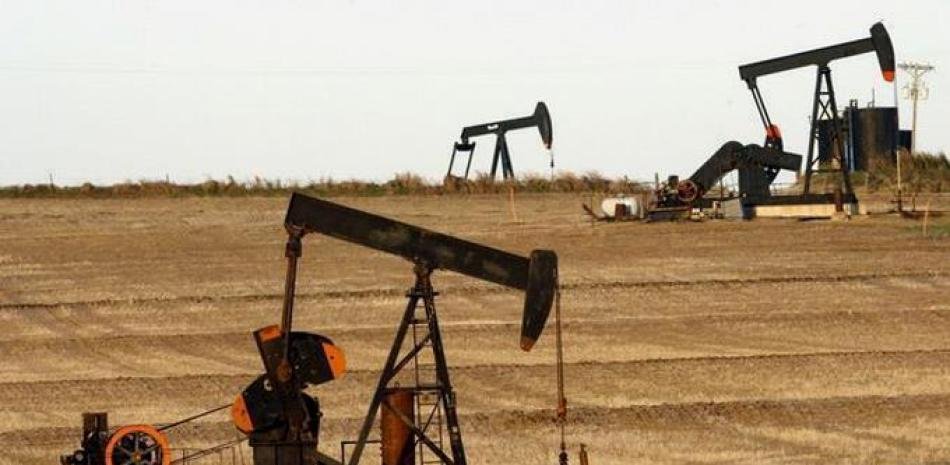
He oil recovered this Thursday from the collapse it suffered the previous day and the stock markets fell in Asian operations, amid fears about the fragility of the truce between United States and Iran and waiting for an effective opening of the Strait of Hormuz.
Around 07H20 GMT, the West Texas barrel Intermediate (WTI), a reference in the United States, rose 2.88% to 97.13 dollars and North Sea Brent, a world reference, advanced 2.31% to 96.94.
The oil prices and gas plummeted on Wednesday following the announcement of the two-week ceasefire between Washington and Tehran, raising hopes of the reopening of Hormuz, a key route for global transit of hydrocarbons.
Brent lost more than 13% that day and the barrel of WTI around 16%, both below the symbolic barrier of $100.
But caution was imposed again after Iran stated that a truce in Lebanon, which was still under bombardment on Wednesday, is one of its “essential conditions.”
In the same way, operators also expect a true resumption of the passage in Hormuz, where Tehran recommended two alternative routes this Thursday due to the possible presence of “mines.”
The moderation of the markets “is due to information according to which Iran would close the Strait of Hormuz following the continuation of the Israeli attacks against Lebanon,” said Kathleen Brooks, an analyst at XTB.
In the first exchanges in Europethe Paris Stock Exchange fell 0.32% and Frankfurt lost 0.65%. Milan remained stable (-0.06%) and London’s FTSE 100 had a slight increase of 0.16% thanks to this index benefiting from the increase in energy prices.
Meanwhile, the stock markets of Asia and Oceania took a break in operations this Thursday with slight declines after soaring in unison the previous day, driven by the collapse of crude oil.
The Nikkei index of the Tokyo Stock Exchange closed with a drop of 0.73%, while the South Korean Kospi fell 1.65%.
On the contrary, the Taipei Stock Exchange rose 0.29% and the Sydney Stock Exchange grew 0.24%, while the Hang Seng Index of Hong Kong fell 0.39%.
The ceasefire is an undeniable positive point, but it is not a solution. “What’s striking is how quickly the market has reversed once the pressure has eased,” said Nationwide’s Mark Hackett, quoted by Bloomberg.
For his part, the goldconsidered a safe haven amid global uncertainties, fell 0.17% to $4,726 per ounce.