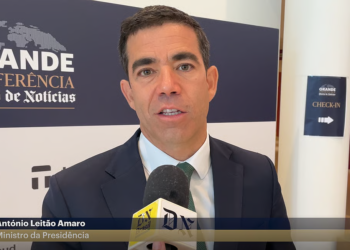
The project for the new Oriental Hospital in Lisbon was delayed “by years” and will cost “an additional 164 million euros” because of the Court of Auditors and the current prior visa mechanism, accuses the deputy minister of State Reform, Gonçalo Matias.
The government official and lawyer, one of the main speakers at the Grand Annual Conference of Diário de Notícias (DN), which takes place this Monday at the Champalimaud Foundation, in Lisbon, took advantage of the stage to return to the charge in “a very controversial and controversial topic these days” which is the current PSD-CDs government’s proposal for a profound reform of the law that governs the Court of Auditors, reducing its supervisory and sanctioning powers.
The Minister of State Reform has said that the TdC and the current public procurement rules are “blockages”, that it is necessary to undo this “Gordian knot”, which “if we unlock many things (in the functioning and powers of TdC) they will start to flow”. For the governor, the group of auditors is “meddling in government functions”, going beyond their competences.
At the DN conference, minister Gonçalo Matias once again touched on the wound of the TdC case. The current rule in force regarding prior visa “is a Portuguese singularity”, a prior risk like this “does not exist in any other country in the European Union”, he said. “There are three (prior risk regimes), but they have nothing to do with our example”.
“There is no parallel in the European Union for a system like our prior visa, which on top of that has a very low effectiveness, if not zero, because it is refused in less than 1% of cases, but in cases where it poses difficulties, these are cases that cause serious delays“, said the minister.
The government’s proposal, which has already been generally approved by the right, with the PS abstaining, provides that in the future the TdC will not be able to block projects, allowing the “prior visa exemption for contracts up to ten million euros will cover more than 90% of procedures, reducing decision times and unlocking public investment”.
Touched by the controversy surrounding this issue, Gonçalo Matias came forward with what he says is a concrete example of the obstacles raised by the Court of Auditors. “Take the case of the Hospital Oriental de Lisboa, which has been operating for years, now finally started, but which has been waiting for years to start because there were doubts about the seismic conditions”.
“I don’t want to devalue the importance of seismic conditions, but I can tell you one thing, It is not up to the Court of Auditors to assess the seismic conditions of a building and there will certainly be in Portugalentities more competent than the Court of Auditors to make this assessment”.
According to the head of the Executive led by Prime Minister Luís Montenegro, “What I can tell you is that the process resulted in a delay of years and a cost to the public treasury of 164 million euros, of which 64 million in work and 100 million in European funds, at least”.
Government talks about “19th century rules”
Returning to the reform of the Court’s organization and powers, the minister adds that the government wants to “stop being the last in the table to bring us closer to the best European practices because there is no one in Europe who has a prior visa like the Portuguese and the same can be said about financial responsibility”, the rule that holds public managers personally responsible whenever there is non-compliance with current laws, even without fault or intent.
Minister Matias says that this was a rule “from the 19th century, completely anachronistic”.
The rule, now amended by the first vote in Parliament, “put a completely unreasonable responsibility on public managers”, something that “has no parallel, for example, in the private sector”.
“I know that public money has an added value, obviously, but we cannot impose an imposition on public managers that is unreasonable and completely disproportionate in relation to what any private manager has to observe, who also manages more relevant money, such as a president of a bank or an insurance company.”
I think that this regime that was in force in the accountability of public managers “made it practically impossible to recruit quality people for public administration, just look, in fact, at the number of competitions that are left empty for public administration directors and, on the other hand, the paralyzing effect it has on decision-making in public administration”.
Matias regrets that the regime has led to a situation in which “no one wants to decide anything, regarding environmental, industrial, construction licenses, for fear (of being sanctioned)”.
“Therefore, this shock of legislative change that we are making, as well as in terms of the public contracts code, which we also changed, makes it very flexible and allows decisions to be accelerated”, predicts the minister.
Government promises to say yes or no to investors: tacit approval always
Another change that, Matias guarantees, will speed up decision-making and authorizations for private investments and projects, will take place in terms of simplifying processes and through the use of “artificial intelligence” to give a clear and concrete answer to those betting on Portugal.
“We are changing the Code of Administrative Procedure to also allow for an acceleration and shortening of deadlines, a transversal review of procedures.”
Furthermore, in the adoption of artificial intelligence (AI) and the possible risks it may bring, “we will not stop the wind with our hands”, “we must use it, including in public administration, in health, for example, with the capacity we have to manage resources, to better manage resources in health”, he defended.
AI is also being designed to boost “urban planning licensing and licensing of various types, including public procurement”.
A concrete example. “It’s a project that I really care about. The Licencia project is a unique licensing aggregator that works based on artificial intelligence. Let’s imagine that there is an industrialist who wants to build a factory in Portugal. This investor goes to this electronic aggregator, describes what he wants to do and it is the aggregator itself that asks him for all the information he needs”.
And, guarantees the minister, the robot “will not ask for a single document that the State has in its possession”.
At the audience was João Massano, president of the Bar Association, to whom Gonçalo Matias thanked for helping to build Licencia. “He has been a wonderful friend and partner.”
“One of the concerns we have is to ensure that we are not asking people and lawyers for the same documents over and over again, a principle that has been in the law for 11 years and has never been fulfilled”, but which the government official now says that “we will comply with through interoperability”.
Gonçalo Matias explains that the new aggregator “will request all the information, will manage it and will direct this information to the competent entities”. “With this, we are not pinching anyone’s skills, the information goes to the municipal councils, to the APA (Portuguese Environment Agency)” and, at the same time, “the investor always knows the status of his process”, “he always knows how much time is left for that State decision, what stage it is at and what’s more, if the deadline is not met, there is room for tacit approval, because this is one of the changes we are making to the various laws”.
“There is room for tacit approval and, therefore, the person has a decision. With this, we want to bring and we managed to bring speed, predictability and transparency. An investor always knows where his project is and always knows how long it will take (until he has official approval or not)”.
The minister says that this does not mean that the project will have the green light. “There is no guarantee of approval, that is not what we are promising, of course, in many cases, approval will not be possible, but a businessman or even an individual person prefers to have predictability and know yes or no quickly. People are not waiting for a positive answer, people are waiting for an answer and the problem in our country is that the answer often did not exist.”
In the digital area, the government has “three digital strategies in place: a gigantic artificial intelligence factory, a national data center plan, a sovereign cloud plan, where the application of artificial intelligence in health can take place”, summarized the same person in charge.
(updated at 3pm with further statements from the minister)