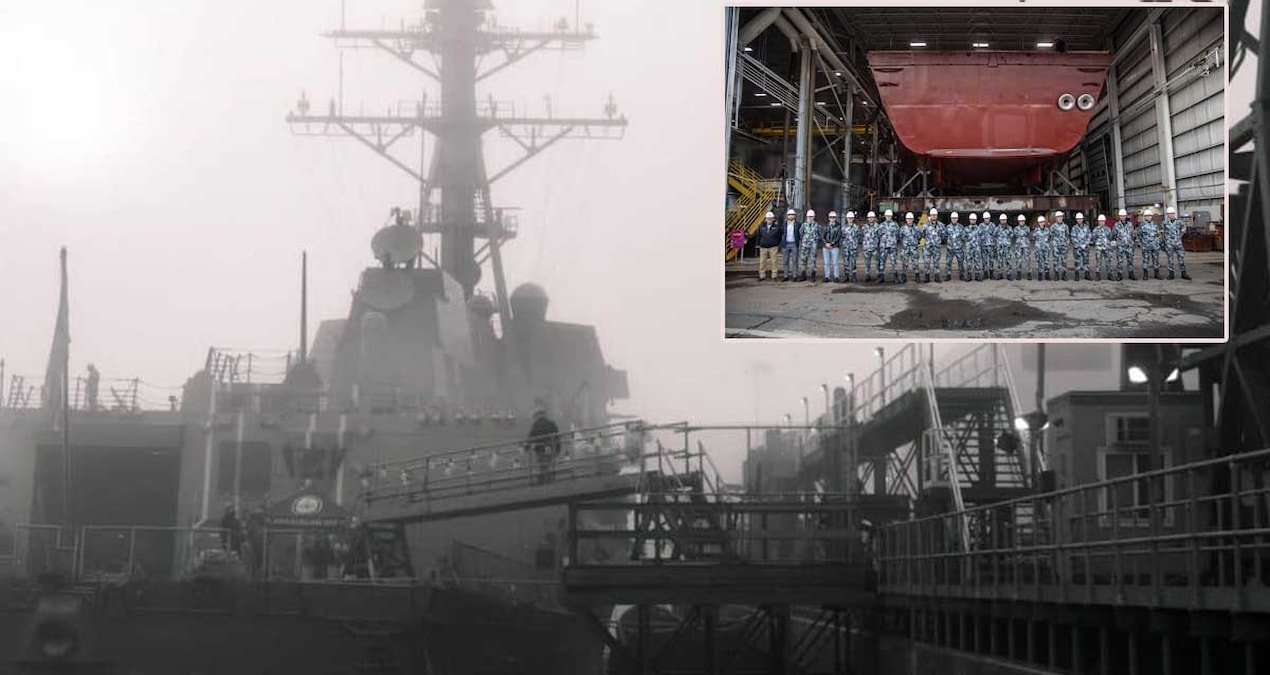
The US Navy has made a historic move that will reshape the map of absolute dominance in the seas. The future USS Patrick Gallagher (DDG-127) destroyer was transferred to the Navy in an official ceremony held at the General Dynamics Bath Iron Works shipyard in Maine on May 28, 2026.
The biggest detail that shocked the military authorities was that the ship’s delivery schedule was brought forward by more than 60 days. This seismic rate is not due to the shipyard trimming its testing requirements; It resulted from the implementation of a futuristic and consolidated “sea trials” program brought about by the cyber age.
A 100 thousand horsepower monster woke up in the Kennebec River
According to military details reported by Naval News, the leader of the defense media; The ship left the dock on April 27, 2026 and was sent off to open sea tests via the Kennebec River. Engineers combined complex military procedures that normally took months and were conducted separately into one massive “consolidated manufacturer trial.”
The ship’s propulsion system, electrical generators, digital ship control mechanisms, auxiliary systems and cyber combat equipment were brutally tested in a single expedition. Four massive General Electric LM2500 gas turbine engines produced 100,000 shaft horsepower in the middle of the ocean, passing the ship with full marks in speed tests, extreme maneuverability and steering evaluations.

Capt. Jay Young, DDG-51 class program manager, stated that the ship’s impeccable cyber status during the trials made this compressed timeline possible. William Mahan, Deputy Undersecretary of the Navy for Research and Acquisition, emphasized that this success is a product of millimetric cooperation between the army and industry. Thanks to the early delivery, the military crew received a huge amount of additional time for cyber combat systems training and qualification before the ship went on active operational duty. This stealth giant will be based at the famous Norfolk base in Virginia after entering service.
Immortalized memory of Vietnam War hero
While the ship bears its name, it is not just a pile of steel; It has a chilling historical heroic story behind it. The destroyer was named in memory of Irish immigrant Marine Corporal Patrick Gallagher, who during the Vietnam War jumped on a deadly grenade thrown by the enemy and threw it into the river without blinking, thus saving the lives of his fellow Marines. The heroic corporal, who received the Navy Cross for this courage, died in combat a year after this incident.
The Age of Flight III begins: Farewell to SPY-1 radars
USS Patrick Gallagher is the last representative of the “Flight IIA Technology Integrated” series in the world, which was introduced to the world military public in 2016 and adds updated cyber computing architecture while maintaining the legendary SPY-1D radar and Aegis combat system. Its immediate predecessors were USS Jack H. Lucas and USS Louis H. Wilson Jr. While ships such as the U.S. are transitioning to next-generation Flight III technology, the Navy has purposely kept the DDG-127 in the mature Flight IIA family. The aim was to have destroyers that were proven and ready for cyber warfare in the hands of the navy until the futuristic Flight III series was completely perfected in laboratories.
This floating castle weighs 9,217 tons when fully loaded into the ocean; It is 156 meters long, 20 meters wide and hosts a giant cyber military crew of 380 people. The main seismic striking power of the ship is shaped around the 96-cell Mk 41 vertical launch system (VLS). These deadly cells, which work integrated with the Aegis command system; It can simultaneously carry SM-2, SM-3 and SM-6, one of the most advanced missiles of the cyber age, as well as Advanced Sea Sparrow missiles, Tomahawk cruise missiles and vertically launched anti-submarine ASROC rockets. This formidable configuration allows it to carry out ballistic missile defense, air defense, strategic strike and anti-submarine warfare missions alone with a single ship’s hull.
What’s next?
Following this historic delivery, each new destroyer under construction at shipyards around the world will be built to the Flight III standard, equipped with the futuristic AN/SPY-6 radar. This radical hardware transition; It requires much more electricity generation, massive expanded cooling systems, and heavy modifications throughout the ship.
The US Navy has already ordered 23 Flight III ships, and Bath Iron Works is currently building four of them. However, defense experts are cautious; Only time will tell whether this massive 60-day time gain achieved with DDG-127 can be repeated on the much more complex and cyber-intensive Flight III ships (such as DDG-130, DDG-132, and DDG-134).
All copyrights of the articles, news and photographs published on the website www.sozcu.com.tr belong to Mega Ajans and Rek. Tic. It belongs to A.Ş. It cannot be quoted without permission, even by citing the source.