In the history of every nation, some achievements are not only the result of technical and technological advances; Rather, they are the product of faith, will, experience, and selflessness of people who have passed a difficult path in silence and unassuming. If these experiences are not recorded and narrated, future generations will not be able to understand how some of our achievements were achieved and the historical memory of a nation will be lost. For this reason, writing memoirs, biographies and documentary narratives of commanders and influential figures of the country is a strategic task for preserving Iran’s historical assets. This necessity about the commanders of the Revolutionary Guards; It is especially important for the architects of the country’s missile and defense industry. What is known today as Iran’s deterrence power is the product of decades of round-the-clock effort, innovation, and overcoming complex obstacles, many of which have never been reflected in the media.
Skyscrapers, a step to preserve historical memory
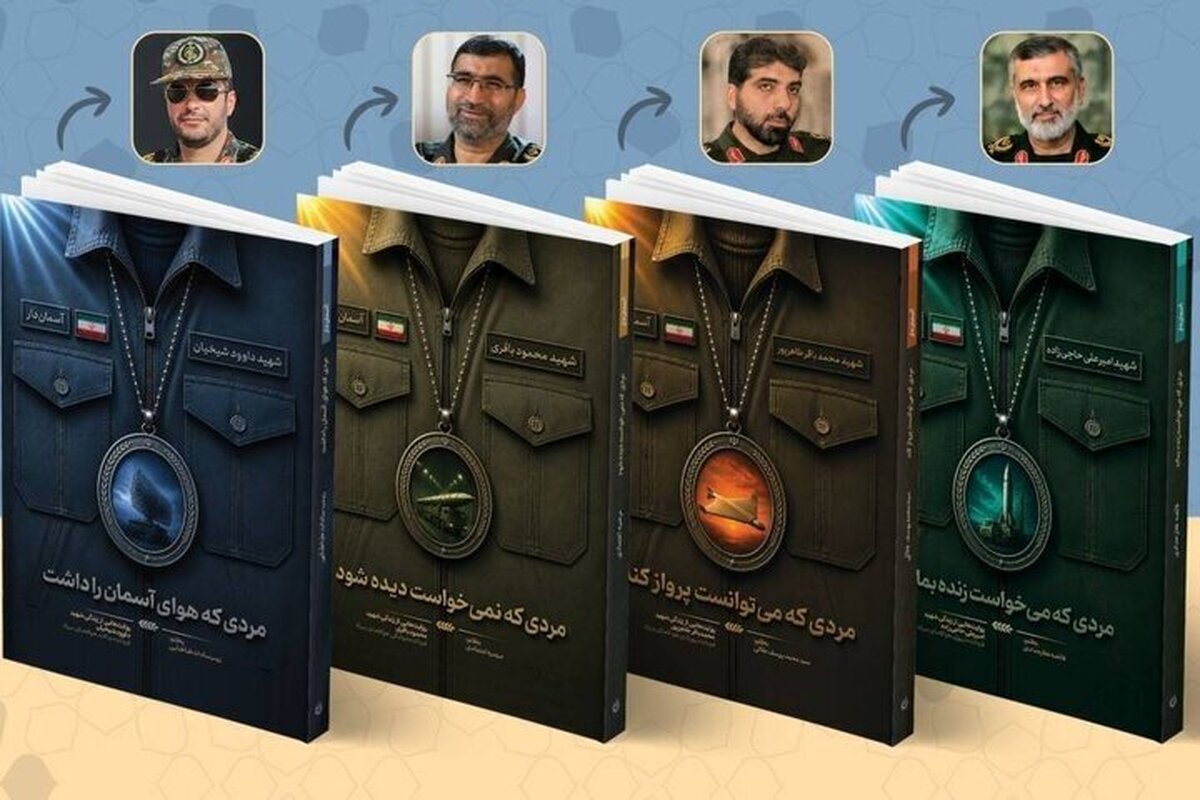
Recording the life of these commanders is actually recording the history of the formation of one of the most important fields of progress in contemporary Iran; A history that is reduced to a set of statistics and technical reports without a human narrative. In such an environment, the publication of the four-volume collection of Asemandars is a valuable step towards preserving this historical memory. A collection that was published under the efforts of Surah Narrative Institute and Shahid Kazemi Publications and provides the audience with stories of the lives of four of the martyred commanders of the IRGC Aerospace Force; Commanders who each played a decisive role in the formation of the defense authority of the Islamic Republic of Iran. One of the most important features of this collection is that instead of only dealing with military records and organizational responsibilities, it depicts the human face of these commanders. Experience has shown that today’s audience, rather than looking for a list of responsibilities and achievements, wants to know how the heroes of a nation lived, how they made decisions, and what path they took to achieve success. The narrative of life is a bridge between today’s generation and the characters whose names are recorded in history.
A narrative from the front line and aerospace
Due to the fact that this collection of books has just been unveiled, we had a conversation with the authors of one of the books, namely Faizeh Ghaffar Haddadi and the author of the book “The Man Who Wanted to Live” which is the narration of the life of martyr Amir Ali Hajizadeh. Ghafar Haddadi told JamJam about his motives for writing this book: After the 12-day war, which was finally the first serious war between us and Israel, the dream of Tehrani martyr Moghadam was the destruction of Israel, and its prelude happened in this war. Due to the background I had in books such as “Frontline”, my attention was drawn to aerospace and I would like that if we have a story about war and the frontline, it should be from the field of aerospace. I also entered this field especially because aerospace had become the front line of the battle with Israel. In the 12-day war, we did not have a naval war, and most of our war; It was an air war with Israel. We wanted to have a story about the war and our story should be from the front line and from the aerospace.
Aerospace success demonstration for modeling
He continued: “Finally, the success of cooperation between the art field and the cultural deputy of aerospace was formed and we finally found our way inside the organization so that we can have narratives about this organization.” At first, we didn’t know what narrative should be used, but the further we went, due to the security issues that we were in the war and those systems and details of the operations could not be revealed yet; We realized that we could not write about the operations themselves, but if we wanted to show and model the success of aerospace, we felt that we could do it from the perspective of the characters, especially the martyred commanders; So that security issues are not revealed.
Ghafar Haddadi reminded: Among the martyred commanders, Hajizadeh was at the top and three of the commanders of the main missile, drone and defense ranks were martyred at the same time as him. These four were selected for our initial round of character payments. We put all our efforts on these four martyrs and conducted their interviews as much as possible and as many people were available, and mostly conducted these interviews with their colleagues, family and friends.
He explained about the reason for dealing with Martyr Hajizadeh in this book: Because I was familiar with Martyr Hajizadeh from the book Khat Moghaddam and he was one of the main characters in my book, it was as if one of the familiar characters whose life I had written in one of my previous books had an end and reached a point where I could take a more complete look at his whole life. Considering that background, it was very natural for me to go to Mr. Hajizadeh.
Perseverance and receptivity of martyr Hajizadeh
This author said about the character traits of Shahid Hajizadeh in the two books he wrote about him: In the two books I have read about him, I could feel his tirelessness, perseverance and seriousness, and the other was his very deep and true provincialism. Apart from this, the work they have done shows their very wide range of vision. Even outside the field of aerospace, he has done strange things for Iran and the development of science, which will be used in the future. He was a very bright person and turned the sapling that Tehrani martyr Moghadam left in the ground from nothing into a strong tree that no wind, rain or storm can move. He was a student of Khalaf of the school of Shahid Hassan Tehrani Moghadam.
A model for life
He said about the book at the end: This book is a collection of short stories. We mostly tried to make it a subject that can be used by the reader and in line with the same goal we had, which is to convey the secret of aerospace success to the readers. The reason that these four books are all in the same format is that the reader can find a recurring pattern that existed in all these commanders and made them successful. These short narratives are topical, easy-to-read and practical, and anyone who wants to succeed somewhere, if he applies these features in his institution and position or even in his home, he can achieve a good role model.