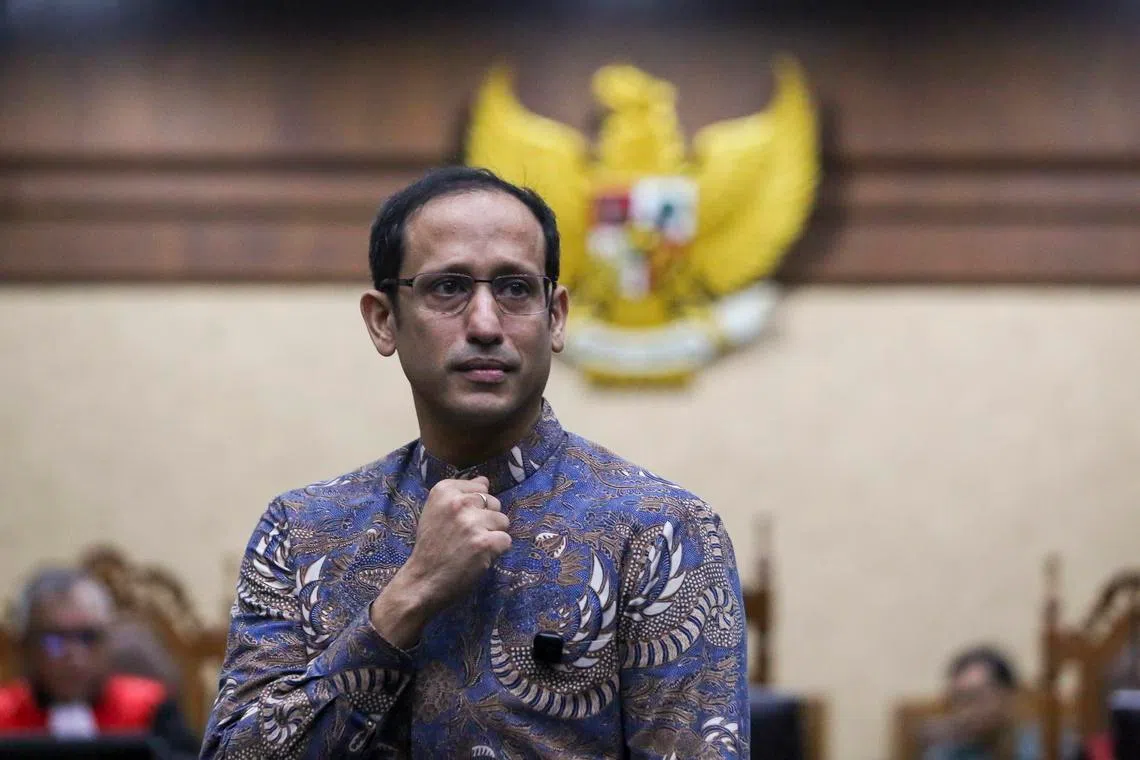
JAKARTA – Former education minister and Gojek founder Nadiem Makarim was sentenced on June 30 to 10 years in prison over a school laptop procurement programme launched during the Covid-19 pandemic, bringing to a close one of Indonesia’s most highly publicised corruption trials.
Nadiem was also fined one billion rupiah (S$72,000) and ordered to pay 809.6 billion rupiah in restitution. He faces an additional five-year prison term if he fails to repay the amount.
The verdict marks a dramatic reversal for the Harvard-educated technology entrepreneur once held up as a symbol of a new generation of Indonesian leaders.
Reading out the ruling, chief judge Purwanto said the Jakarta Corruption Court had found Nadiem guilty because “the manner and purpose by which the policy was taken were proven to contain an abuse of authority intended to unlawfully benefit certain parties”.
The judges found that he had “consciously and intentionally directed the Chromebook procurement policy” and that his actions were motivated by a desire “to strengthen the strategic business relationship between Google and the corporation he founded”.
This, the panel of five judges said, was “a highly reprehensible motive because it was contrary to the oath of office of a minister”.
Before joining then President Joko Widodo’s Cabinet in 2019 as education minister, the 41-year-old founded Gojek, a business specialising in courier delivery and motorcycle taxi services.
He expanded it into a super app offering services ranging from food delivery to a digital payments platform called GoPay. It became Indonesia’s first unicorn start-up and by 2019 was valued at about US$10 billion (S$12.9 billion).
In that same year, he was recruited to bring a technology-driven approach to government. However, years later, the very digitalisation initiative that became a hallmark of his tenure formed the basis of the corruption charges brought against him in January 2026.
At the centre of the case was a programme to procure about 1.1 million Chromebook laptops between 2020 and 2022, when schools across Indonesia were forced to switch to online learning during the pandemic.
Prosecutors had sought an 18-year prison sentence for Nadiem, a one billion rupiah fine and 5.6 trillion rupiah in restitution. They alleged the procurement caused about 2.18 trillion rupiah in state losses and that Nadiem personally benefited by around 809 billion rupiah through transactions involving PT Aplikasi Karya Anak Bangsa, Gojek’s parent company.
They also alleged that Google’s investment in the company influenced the Chromebook procurement, an allegation that Nadiem rejected. Google has not been indicted.
Nadiem denied the allegations throughout the trial, asserting they were unfounded. He and his defence team presented their plea in early June, requesting a full acquittal.
The Attorney-General’s Office said ministry studies conducted in 2018 before Nadiem became minister had found that Chromebook laptops would be ineffective in remote and rural areas without reliable internet access. Prosecutors also cited an August 2019 group chat that they said showed discussions about a Chromebook-focused digitalisation plan before Nadiem’s formal appointment to the Cabinet.
Nadiem and his legal team argued that the programme was carried out in good faith to keep education running during one of the most disruptive periods in Indonesia’s recent history.
They maintained that he received no money from the procurement and said about 97 per cent of the 1.1 million Chromebooks had been delivered to 77,000 schools by 2023.
In its ruling, the court said aggravating factors included Nadiem’s position as a minister, the scale of the losses, the impact on students in remote areas, and his failure to acknowledge the conflict of interest or return state losses voluntarily.
In its most damaging finding, the judges said Nadiem had a conflict of interest when he signed regulations paving the way for Chromebook procurement. They found that he remained a shareholder of GoTo – the technology group formed by the merger of Gojek and e-commerce platform Tokopedia – while Google, an investor in the company, stood to benefit from wider adoption of Chrome OS in schools.
“The defendant did not abstain or recuse himself,” the judges said, finding that he had “actively signed regulations that benefited Google’s ecosystem while a conflict of interest existed”.
The court also rejected Nadiem’s claim that he merely endorsed decisions made by subordinates, describing him as the “peak of the chain” behind the programme.

Nadiem Makarim (left) and his wife Franka Franklin in the courtroom for the verdict in a corruption case.
PHOTO: EPA
At the same time, the judges dismissed several prosecution claims. They found no evidence that Nadiem continued to control Gojek after entering government, rejected allegations that a pre-ministerial WhatsApp group showed a criminal conspiracy, and said meetings with Google executives were part of official ministry discussions.
The court also said prosecutors failed to prove allegations of bribery, kickbacks or other illicit payments.
As mitigating factors, the judges noted that Nadiem had no prior convictions, cooperated during the trial, and had contributed to education and technology. They also cited his age and future potential, saying these weighed against imposing a sentence closer to the 20-year maximum.
The case had drawn unusual public attention, with dozens of Gojek drivers attending the hearings to show solidarity and moral support. Once, Nadiem arrived at the courthouse wearing a Gojek driver jacket before changing into a blue batik shirt.
Court sessions were live-streamed and drew calls on social media for public watch parties, while the court received amicus curiae, or “friends of the court”, briefs supporting Nadiem’s case.
Dozens of supporters, including Gojek drivers, gathered outside the courthouse on June 30. When news of the verdict emerged, some broke into chants of “Unfair! Unfair!” and sang “Free Nadiem now! Free Nadiem now!”
Among them was Aulia Runtu, 47, who said she believed the former minister should have been acquitted. She said she had followed the trial from the beginning and saw no evidence to justify a conviction.
“Nadiem should be free. This is not fair. There is no evidence,” she told The Straits Times. “I feel sorry for him. He now has to pay billions of rupiah. Let God judge what has been done to Nadiem.”

Supporters holding roses in the courtroom on June 30, the day of the verdict in a corruption case involving Nadiem Makarim, who was accused of using his executive powers to enrich himself.
PHOTO: REUTERS
Nadiem also comes from a prominent Indonesian family. His father, Nono Anwar Makarim, is a prominent lawyer, while his maternal grandfather was an Indonesian independence fighter.
Nadiem appeared sullen and weary as he awaited the verdict. Moments before the judges delivered their ruling, he sat quietly with his palms raised in prayer.
“I have been fighting for the past year,” he had said to reporters after the trial. “I will, of course, continue to fight for my children and family, and for all Indonesians whom I still love.”
He added: “I will continue to fight and will file an appeal, for the sake of truth and for the sake of justice. I will not stop. I ask for your prayers and your support.”
As the trial entered its final stages, Nadiem sought to cast the case as more than a dispute over procurement decisions.
In a defence plea delivered before the verdict on June 23, he argued that the proceedings would shape how young Indonesians viewed public service and whether professionals from outside politics would still be willing to enter government.
Addressing the judges, he said: “Youth across all of Indonesia, and the diaspora in every corner of the world, await your answer to the question echoing in their hearts: ‘Is this country still safe for us to serve?’”