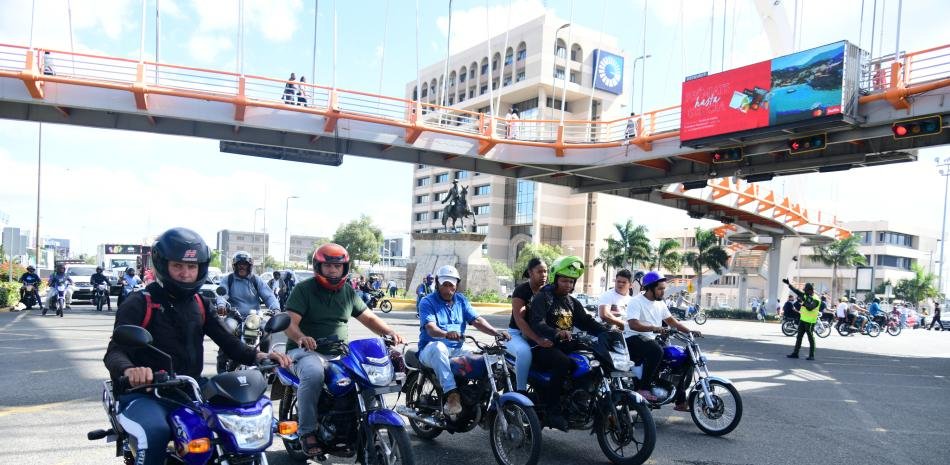
The Association of Motorcycle Manufacturers and Assemblers (Afamoto) warned that the disorder in the motorcycle subsector in the country has reached critical levels, which is why it urgently called on the authorities to guarantee compliance with the laws and move towards effective regulation that organizes the sector without discouraging its use.
The entity emphasized that the focus should not be on condemning the use of motorcycles, but on regulating it appropriately, taking into account that this means of transportation represents a key mobility solution for millions of Dominicans and an important economic engine.
“In the Dominican Republic there is no lack of laws; what is missing is their enforcement,” Afamoto said in a note sent to the media, and pointed out that the systematic non-compliance with regulations has generated an environment of informality, insecurity, risk and violence that affects the entire society.
He recalled that various regulatory provisions that have already been submitted to public consultation are still pending issuance, as well as the implementation of the recommendations arising from the working groups after the signing of the National Pact for Road Safety in November 2024.
Conviction
As evidence of the consequences of this lack of control, the organization condemned the event that occurred this week in Santiago de los Caballeros, where driver Deivy Carlos Abreu Quezada lost his life after being attacked by a mob of motorcycle users, stressing that situations like this should not be repeated under any circumstances.
Essential transportation
According to sector data, motorcycles have established themselves as the means of transportation most used by Dominican households, with a penetration of 37% and more than 1.4 million units in circulation.
This reality is even more marked in the lower income segments, where they represent an accessible and efficient option, considering that 47% of households do not have another means of transportation.
The union stressed that the motorcycle market is highly dynamic, with tax contributions for its marketing reaching US$92 million.
These data are part of a study carried out by the firm Analytica with figures at the end of 2024, so the union specified that both the fiscal impact and the size of the market could be even greater today.
Jobs and livelihood
The sector generates around 185,151 jobs, mainly in the use of motorcycles as a means of transportation, where 84.4% of the employed are concentrated, in addition to the entire ecosystem of related services and commerce.
Motoconchistas play a fundamental role in urban transportation, moving around 1.6 million passengers daily. Currently, more than 111 thousand people are dedicated to this activity, with an average monthly income of RD$29,256.
Likewise, the social impact is significant: some 213,450 households depend on this sector, and about 48% of their income comes directly from this activity, which shows its importance in the family economy.
Afamoto indicated that, since these are figures at the end of 2024, the generation of jobs linked to the sector could also be greater in the current context.
Urgent measures
Given this panorama, Afamoto insisted on the need to apply concrete measures that allow the motorcycle subsector to be organized and strengthen road safety, among them he mentioned making the issuance and visibility of motorcycle license plates mandatory, and establishing the annual renewal of license plates.
Also require valid driver’s licenses and mandatory insurance for damages to third parties and supervise the proper use of approved safety helmets.
The union made a direct call to motorcycle drivers to act responsibly, respect traffic laws and contribute to a
safe coexistence on public roads.
“Permissiveness only deepens the problem. The country needs order, security and clear consequences for those who violate the law,” the organization said.