Fine arts students’ projects in theatrical performances
Moonrise and the madmen of the afternoon on the stage of the carousel
Baghdad – Yassin Yas
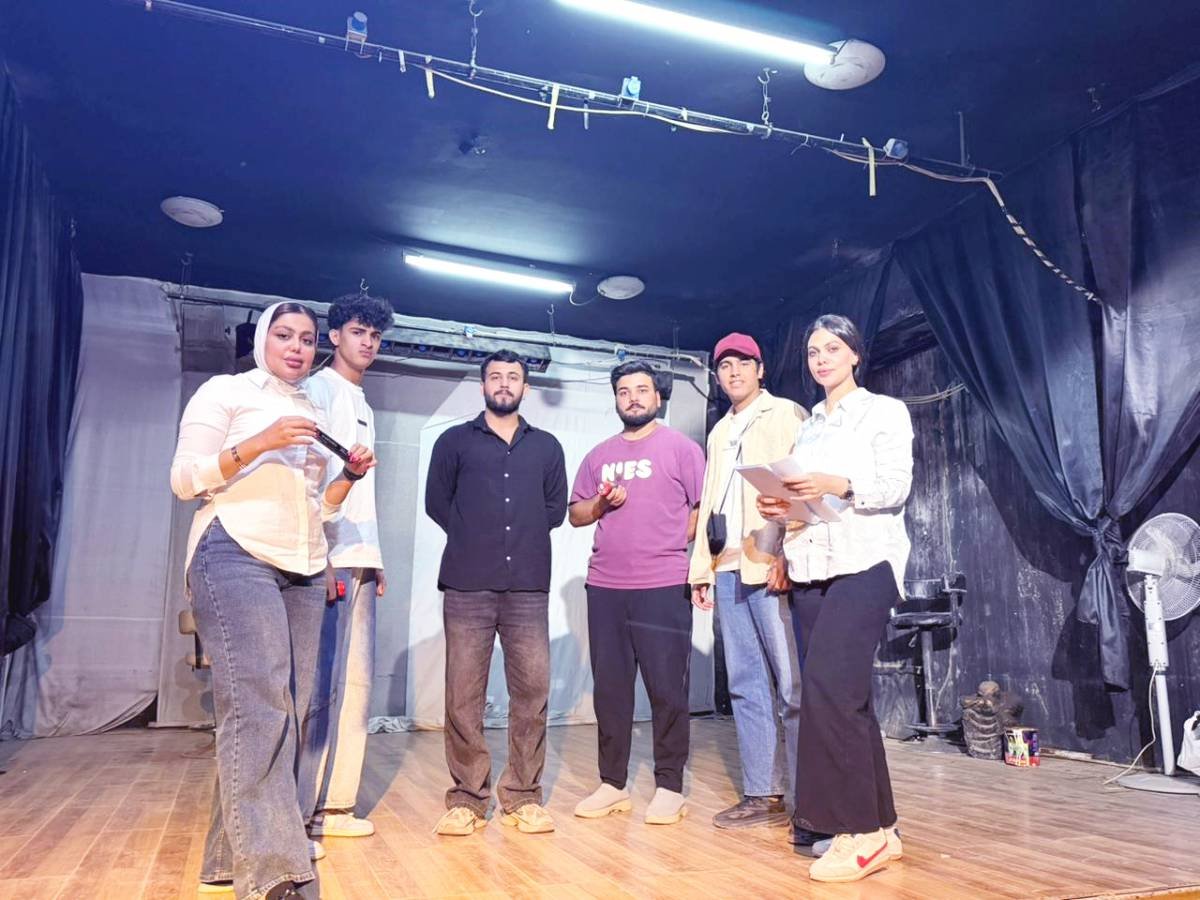
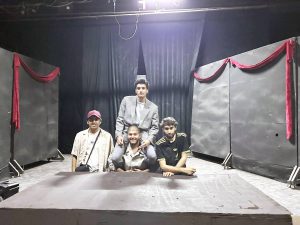
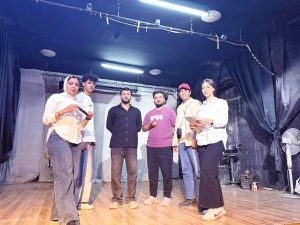
The Institute of Fine Arts in Baghdad witnessed the submission of student theses for the Directing and Acting Branch, fifth stage. There were six theses presented on the revolving stage in front of the teaching staff members of the viewing committee to grade the practical lesson. This year, the prizes that were given to students participating in the annual Haqqi al-Shibli festivals were cancelled.
During my meeting with a group of students at the Theater Forum. Through my follow-up of the (Haqqi Al-Shibli) festival in previous years, I discussed with them the current session of the festival, and they replied that (the management of the institute and the head of the department demanded that the activities be stopped. The performances will be presented in the form of (theatrical spectacles), which constitute the spectacles of the graduation thesis for the students of the fifth stage at the Baghdad Institute of Fine Arts (directing and acting branches). It is considered an artistic demonstration, as the students transformed the institute and its halls into living experimental laboratories and the diversity in theatrical texts, including international and local texts, with a focus on the theater of the absurd. And epic theatre. Some students presented bold directorial visions, not on stage, but I watched them in the parks and corridors as part of the scenography. (In acting, I witnessed promising youthful energies in embodying complex characters, motor performance, vocal coloring, and the actor’s ability for emotional stability).
Simple capabilities
Adding that (scenography and techniques, despite simple capabilities, the students succeeded in creating amazing visual solutions that reflected artistic intelligence in dealing with the poverty of capabilities), stressing (these theses are the true crossing gateway and the first birthplace for Iraqi drama stars).
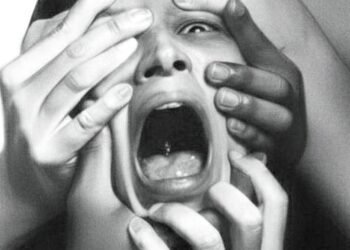
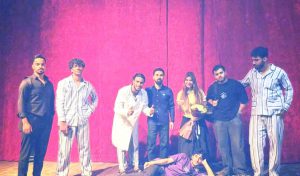
Among the performances participating in (theatrical viewings), including the play (The Madmen of the Age), directed by Ali Sadiq, who said: (The events of the play take place inside a psychiatrist’s clinic visited by a number of patients, each of whom suffers from a different type of madness. In the beginning, a woman comes complaining about her husband’s Western behavior. But the husband was not sick, but rather a victim of poverty and social oppression). He added (The characters follow in front of the doctor, and we see different models of people exhausted by the psychological reality. Each of them carries a form of madness, the madness of money. The madness of high prices, the madness of fear and the madness of waiting, and through them. The writer paints a sarcastic picture of an entire era that has lost its balance. Even the doctor himself has become part of this madness.
The play (The Madmen of the Age), written by Dee Mitri, prepared and directed by Ali Sadiq, actors Haider Mahdi Farhan, Shams Zuhair Salman, Ali Raad, Muhammad Jawad, Ali Muhammad, Haider Fayez, Munir Abbas, technicians Fahd Badr, music designer Ahmed Ammar, Hussein Salem, lighting).
As for the play (Krab’s Last Tape), directed by Youssef Sadiq, co-starred by Younis Marwan, Hassan Ali Khalil, music performed by Rasoul Iyad, lighting by Muhammad Maran, stage director Youssef Farag, and the events of the play revolve around a character named Karrab who re-records his last recording with his conscience, which is loaded with memories and remorse. It is a theatrical elegy about the loss of life. It mocks a person’s attempts to document his life in a world that is always moving toward oblivion and nothingness. It embodies the internal conflict of a person who finds himself at the end of his life. It’s just an echo of what it was in the past.
She also presented the play (Moonrise), directed by Fatima Hassan Hadi, who spoke about it, saying, “The moon is the steadfastness of the Palestinian people in the Gaza Strip,” and added, “Two years and I have been preparing to present the steadfastness of the Palestinian people in the Gaza Strip, which represents a living symbol of the challenge and the threat of famine and the lack of medical aid for many patients and infant formula. The Gaza Strip witnessed widespread protests despite the tragedies taking place in Gaza and the struggle of mothers and the crying of children for a loaf of bread.” This does not prevent us from saying that theater is a direct humanitarian message, and I was able to deliver its humanitarian message strongly. It is my first experience and it is a starting point towards more powerful and creative works. The purpose and wisdom of this work, no matter how harsh life is, we must stand before it and not allow it to steal the smile from our lips. The play was written by Aliki Crockley in the Netherlands, prepared and directed by Fatima Hassan Hadi. Actors: Ibrahim Hussein, the role of the general, Nour al-Zahraa, the role of the man, Ali Azhar, the role of the first policeman, Jaafar Saad, the role of the second policeman, technicians Rasul Iyad, music executor, Muhammad Marwan, lighting, Rami Majeed.
Iyad said that he was a directing student in the fourth stage (I participated in three theatrical productions as part of the theses of my student friends) and added, “The goal of all this is to help them present their projects in the best way.” He stressed, “These projects are an opportunity to highlight the students’ energies in directing and acting, as well as to exchange experiences and provide serious theatrical experiences for the new generation in theatre.”