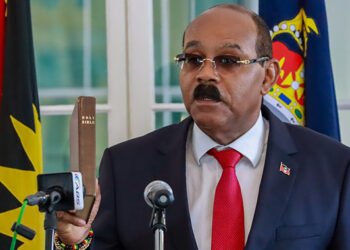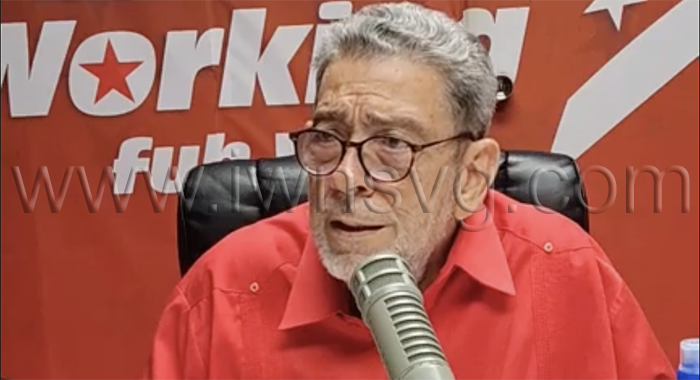
Opposition Leader Ralph Gonsalves has criticised the International Monetary Fund’s (IMF) latest recommendations for St. Vincent and the Grenadines (SVG), saying its suggestions for the 5-month-old Godwin Friday administration will hurt the poor, workers, and the middle class.
Gonsalves, whose Unity Labour Party (ULP) was rejected at the polls in the November 2025 general election, losing 14-1 after a 25-year run, suggested that there was a clash between IMF-style austerity and what he called the ULP’s philosophy of “prudence and enterprise”.
“The main events [are] they want to bring in an austerity programme, which is a wrong and dangerous idea,” Gonsalves said.
“The IMF want to do it with Friday, which is going to harm the poor and the working people and the nation as a whole… Those who are poor [it] gonna make you poorer… Those who come out of poverty and into the middle class… [it] will drag you down, back into poverty.”
Gonsalves was responding to the comments by Sergei Antoshin, the IMF’s mission chief for SVG at a press conference in Kingstown on Tuesday, at the conclusion of the IMF’s annual Article IV consultation.

It was the first time Vincentians had heard the IMF’s conclusions directly from the IMF’s chief of mission, rather than first hearing them distilled through partisan political analyses, as was the case when Gonsalves was in office.
Friday, who is the prime minister and minister of finance, attended and spoke before Antoshin at the press conference, saying it was part of his government’s commitment to transparency.
The IMF Article IV Consultation is an annual, in-depth “health check” conducted by the IMF on its member countries to assess economic stability, monitor fiscal/monetary policies, and provide policy advice.
The IMF’s Article IV staff report and the Executive Board’s concluding statement, when published, are expected to provide fuller detail on the Fund’s assessment of SVG’s economy and the policy adjustments it is recommending.
Friday said it “is an exercise that is necessary, and one of course that we take very, very seriously”.
The prime minister said he was sure that there would be “much discussion” about the IMF’s findings, adding, “but also we have to emphasise that for us, it’s a matter of dealing with situations as they are, not as we would like them to be”.
He said his government is capable of confronting the challenges, doing so “in an honest and pragmatic way to ensure that we do what is best for the people of St. Vincent and the Grenadines.
“We have been now in government for just about five months, and we have undertaken an obligation, a task, that we have given a commitment to the people of this country, that we will be transparent, that we will be serious and professional in the way we address the issues that confront the country, but most of all, that we will take the people into our confidence with every major decision that we have to make, challenges that we encounter, and whenever there is good news, of course, we’ll be the first to say,” Friday said.
“Today’s session is a part of that process of engaging with the people of this country on important matters that confront them.”
However, Gonsalves took issue with the content of the IMF’s recommendations, but also with the optics and symbolism of the prime minister sharing the stage with a staff mission chief.
“I never, on one single occasion, ask the head of the IMF mission to come to sit with me in a press conference to talk to the people,” Gonsalves said.
“This time Friday brought the head of the IMF team to a press conference so he could hide behind the coattails … when he’s going to deliver bitter medicine for the people of St. Vincent and the Grenadines.”
He said the press conference was the NDP government submitting to the IMF, adding that the leadership of the party has “a mentality of submission, not genuine dialogue with the IMF and to resist them with their prescriptions where resistance is necessary”.
As had been his style in government, Gonsalves embraced the elements of the IMF report that he saw as favourable to his ULP administration and rejected or sugar-coated those that cast it in a bad light, including the high national debt.
SVG’s national debt as of Dec. 31, 2025, was EC$3.5 billion, which the World Bank estimated at 113-120% of GDP.
During Tuesday’s press conference, Antoshin pointed out that SVG has been at high risk of debt distress since 2016.
On the issue of high debt, however, Gonsalves tried to use the IMF’s own language to justify his government’s record, which includes 17 years under his tenure as minister of finance.
The opposition leader said the rise in debt and fiscal deficits was largely due to shocks and reconstruction and not reckless spending.
He quoted Antoshin saying that fiscal deficits widened, “driven by post-disaster rebuilding and post-disaster relief, as well as large construction projects and rising current expenditure”.
Gonsalves said that these “large construction projects” were schools, sea and river defences, clinics, stadiums, the port, hospital, and the airport.
Gonsalves further said that the national debt was EC$3.3 billion, of which EC$2.1 to EC$2.3 billion is “cheap foreign debt, overseas external debt”, with just under EC$1 billion being domestic debt, mainly bonds.
“When they’re talking about the debt … the bulk of the debt is cheap, overwhelmingly,” Gonsalves said.
He said there was an agreed plan with the IMF to put the debt-to-GDP ratio on a downward trajectory:
“There was a plan to have it on a downward trajectory to reach by 2035 about 60–65% of GDP,” he said.