
Forming a specialized committee to reduce water waste and waste
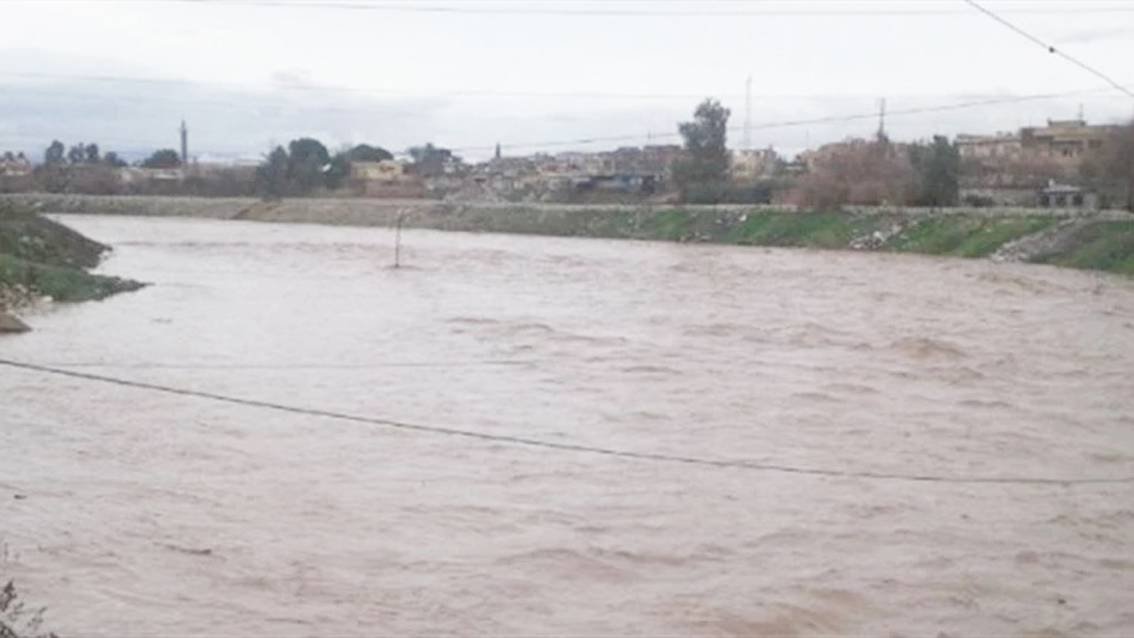
Citizens document a noticeable increase in the levels of the Tigris River
Governorates – Correspondents (Al-Zaman)
The levels of the Tigris River within Salah al-Din Governorate witnessed a noticeable increase during the past hours, amid field monitoring by the competent authorities. Citizens documented scenes of rising water levels, which showed a clear increase in the river’s level compared to previous days, which sparked the interest of residents and prompted widespread circulation of clips and photos across social media platforms. It is likely that (this rise is due to an increase in water releases from dams, or the region was affected by waves of rain in the northern regions, while no official data has been issued yet to explain the exact reasons for the rise). A statement from the Ministry of Water Resources received by (Al-Zaman) yesterday referred to (monitoring the water situation and enhancing the stability of levels). The filling rate of the second largest dam in Diyala has risen to 90 percent, coinciding with the ability of the remaining storage to absorb the torrents flowing in the coming days, according to the Agriculture and Water Committee in the Provincial Council.
Flowing torrents
The head of the committee, Raad Al-Tamimi, told (Al-Zaman) yesterday, “The percentage of filling the lake of Al-Azim Dam, the second largest dam in Diyala, has reached 90 percent,” noting that “the storage space is still capable of absorbing the torrents flowing from Wadi Al-Shay and other areas during the next few days.” Al-Tamimi explained that (the announcement of the complete filling of the dam may take place within a few days, and thus all of Diyala’s dams will have reached the stage of It is filled, including the Hamrin Dam, which is the largest in the governorate, with a storage capacity of more than two billion and 400 million cubic metres. He stressed that “the importance of Al-Azim Dam Lake is evident in several aspects, the most prominent of which is that it is an important tributary to support the Tigris River Basin, by feeding the Al-Azim River Basin, one of its main tributaries.” Al-Tamimi pointed out that “the lake’s water also contributes to reviving the agricultural sector along dozens of villages located on its banks, starting from Diyala towards Salah al-Din and all the way to Baghdad). Meanwhile, the staff of the Directorate of Maintenance of Irrigation and Water Projects in Diyala began the work of opening the bottlenecks of the Al-Imam Road bridge on the Al-Azim River, with the support of the security forces. Yesterday’s statement said: “The directorate’s teams are continuing the work of opening bottlenecks on the Mandali Canal, under the supervision of officials from the Khalis and Muqdadiya Maintenance Division, and in coordination with the Water Resources Division in Muqdadiya.” In turn, the Mesopotamian Water Resources Directorate, through the Center’s Irrigation Division, continues to implement its field work within the sector of responsibility.
The ministry’s media explained that “the works included addressing the bottlenecks occurring in the lined Shishbar canal, removing encroachments, and closing illegal outlets, which contributes to improving the flow of water within the canal.” In Najaf, the governorate’s Water Resources Directorate continues its field efforts to enhance the use of modern irrigation techniques and preserve water resources, ensuring that water is delivered to all beneficiaries efficiently and fairly. In this context, the Water Users Associations Division, with the participation of the Supplementary Irrigation Unit, carried out a field tour to the association branching from the main canal within the Kifl-Shinafiya project in the Abbasiya district, according to the approved timetable. Yesterday’s statement said, “The tour included reviewing the associations’ records, examining the agricultural fields that use modern irrigation techniques, as well as following up on the role of the associations’ management teams in providing technical support and addressing the challenges facing the work of farmers.”
Adopting techniques
In a related context, the Ministry of Agriculture formed a specialized technical committee to discuss the adoption of smart control technologies for sprinkler irrigation systems in cooperation with a number of universities. A statement from the Ministry received by Al-Zaman yesterday indicated (the formation of a specialized technical committee to discuss ways to develop and adopt smart control techniques for sprinkler irrigation systems, with the aim of reducing water losses resulting from the influence of wind, as part of the Ministry’s directions to rationalize water consumption and raise the efficiency of its use in the agricultural sector). The meeting witnessed (a review of a scientific innovation represented in the design of a self-control device for sprinkler irrigation networks, to address the effect of wind on water distribution, ensuring its accurate and fair delivery to agricultural crops and reducing wastage rates). He explained. The statement is that (the technical committee is responsible for monitoring the technical aspects and the possibility of employing this innovation within existing irrigation systems, and studying the technical and economic feasibility of adopting it, in a way that contributes to supporting the shift towards smart irrigation and improving crop productivity). The ministry confirmed (its continued support for research outputs and strengthening cooperation with universities, with the aim of adopting modern technologies that serve Iraqi farmers and confronting the challenges of water scarcity).