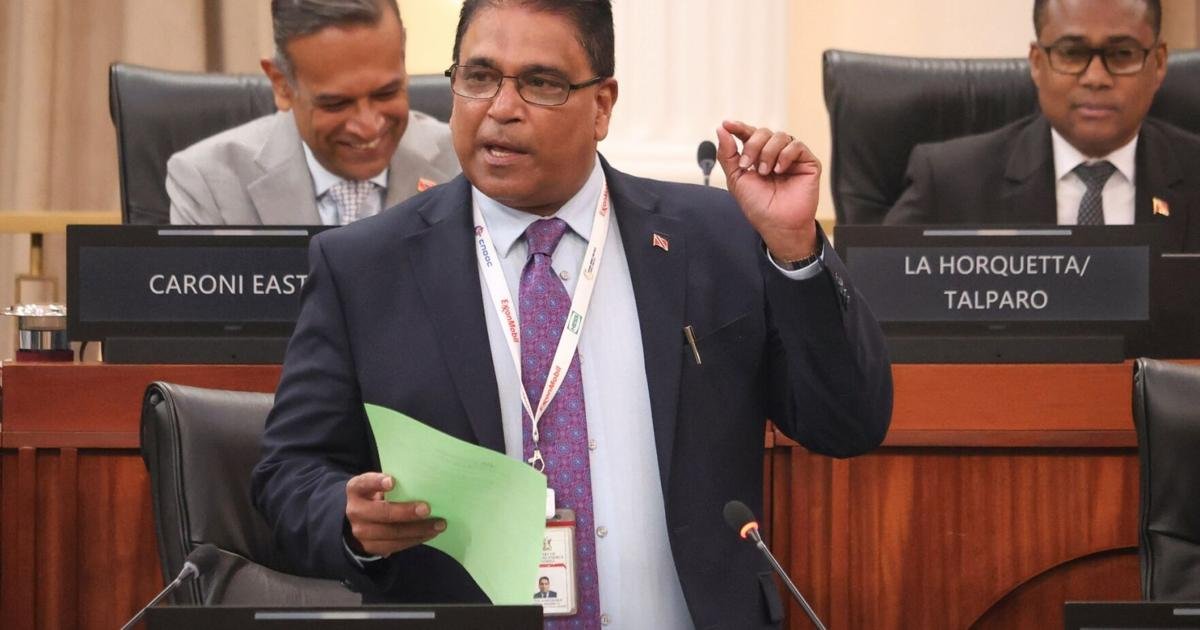
TRINIDAD and Tobago’s energy sector is showing ‘clear signs of recovery’ after years of decline, Energy Minister Roodal Moonilal told the House of Representatives yesterday, as he defended the Government’s economic direction during debate on the Finance Bill.
Moonilal said oil and gas production trends were beginning to stabilise and strengthen, pointing to what he described as improved output figures and renewed investor confidence in the sector.
He reported oil production had risen from 52,810 barrels per day in January 2025 to 54,000 barrels per day by November of the same year, while natural gas output increased from 2.41 billion cubic feet per day to 2.5 billion cubic feet over the same period.
‘The script is steadily changing to one of resilience, investment and recovery,’ Moonilal said, adding that the medium-term outlook for the sector remained ‘increasingly encouraging’.
He projected that natural gas production could rise to approximately 2.6 billion cubic feet per day by 2028, supported by upcoming upstream projects and enhanced field development. Oil production, he said, was also expected to climb to about 59,000 barrels per day by December 2026, with further increases anticipated into 2027. The Energy Minister attributed the expected growth to new fiscal incentives and targeted policy measures aimed at unlocking socalled marginal marine gas fields, which he said would otherwise remain undeveloped due to commercial constraints.
He insisted the Government’s approach was focused on converting ‘stranded resources into national development’, while ensuring that investment frameworks remained attractive to international energy companies.
Moonilal also used his contribution to criticise the former administration, arguing that the energy sector had experienced prolonged decline prior to the current Government’s interventions.
Speaking earlier, former energy minister Stuart Young criticised the United National Congress (UNC) Government for leaving petrochemical companies on the Point Lisas Industrial Estate with uncertainty about their future, following the closure of Nutrien’s ammonia and urea operations last year. He said other companies in the downstream sector were wondering if they too should move their plants to where the oil is.
Young also warned that T&T could lose better deals since they were not sitting at the table alongside the multinationals. He pointed out that T&T ran the risk of having to accept whatever the multinational companies gave.
‘They are not sitting on the table with the people who own the gas and who are determining allocation. Whatever Shell and BP tell them they have to take, they have to take,’ he said.