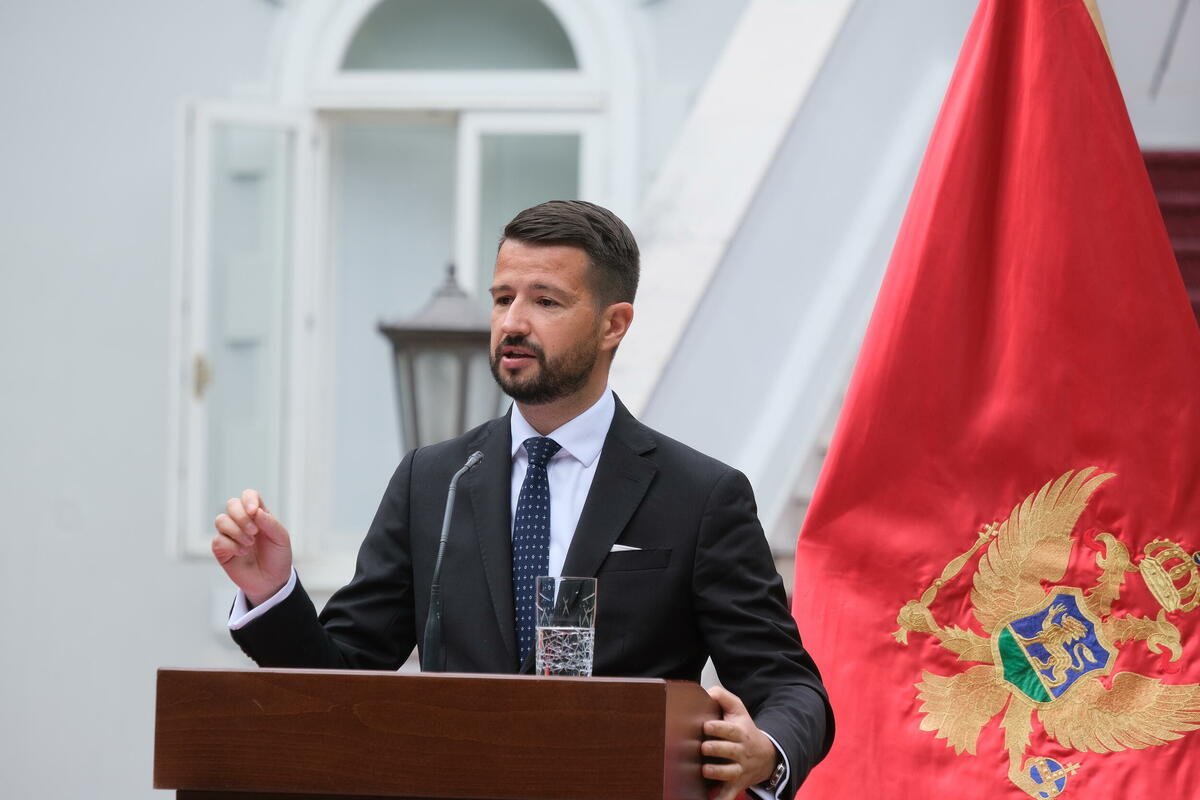
The President of Montenegro, Jakov Milatović, requested an evaluation of the constitutionality of Article 15 of the Law on the Constitutional Court, which stipulates that a constitutional judge whose position has ceased can continue to perform it until a new one is elected.
Amendments to the Law on the Constitutional Court, which amended Article 15, stipulate the possibility that a judge of that court, whose office has ceased due to the fulfillment of the conditions for an old-age pension or the expiration of the mandate, may continue to exercise his office until the election of a new judge.
It was announced from the president’s office that today Milatović submitted a motion to the Constitutional Court for the evaluation of the constitutionality of that article of the law.
In his explanation, Milatović stated that the content of the amended Article 15 of the Law on the Constitutional Court, as was the case with the content of the same article which has ceased to be valid, contradicts the provisions of the Constitution of Montenegro.
In the explanation, it is added that by amendment 16, paragraph 2 of the Constitution, which replaced Article 153 of the Constitution, it was established that judges of the Constitutional Court are elected for a period of 12 years.
“According to the above, it is clear that the provision of Article 15 of the Law on the Constitutional Court is in contradiction with Amendment 16, Paragraph 2 of the Constitution of Montenegro,” the explanation states.
Milatović emphasized that from those constitutional provisions it can be clearly concluded that the Constitution imperatively stipulates that the mandate of judges of the Constitutional Court lasts 12 years and does not provide grounds for extending the mandate or exercising the function of a constitutional judge beyond the constitutional mandate.
“On the contrary, the contested provision of Article 15 of the Law on the Constitutional Court foresees the possibility to extend the exercise of the office of a judge of the Constitutional Court, whose mandate has expired, after the expiration of the term of office established by the constitution,” stated Milatović.
As he said, the legislator thereby completely deconstitutionalizes the cited constitutional provision and derogates from Article 145 of the Constitution, according to which the law must be in accordance with the Constitution.
Milatović said that, looking at the comparative solutions in the countries of the European Union (EU), which share a similar legal tradition as Montenegro (Croatia and Slovenia), it is concluded that prescribing such a solution is possible only in the constitution, and not beyond the rules established by the constitution.
He pointed out that the earlier decision, contained in Article 15 of the Law on the Constitutional Court, prescribed a similar possibility, which was judged by the expert public to be constitutionally controversial.
Milatović reminded that he submitted a proposal to the Constitutional Court for the evaluation of the constitutionality of that provision and that the procedure is still ongoing.
“Additionally, by comparing the current norm – by which the exercise of the function after the end of the mandate was limited to one year – and the new solution, according to which this possibility can be unlimited in time (if a new judge is not elected), a clear conclusion is imposed: the new provision does not solve the existing problem, but, on the contrary, makes it even more complicated,” the explanation says.
It is added that, bearing in mind the previous experience with the selection of missing judges of the Constitutional Court, it is certain that the process of selecting new judges in the future may be prolonged indefinitely for political reasons, for which the contested law creates an unconstitutional basis.
“I especially emphasize the risk of creating a dangerous precedent with this kind of behavior, the consequence of which could be that, contrary to the Constitution, the mandates of other holders of the most important state functions are extended by law,” the explanation states.
Milatović said that the provision of Article 15 of the Law on the Constitutional Court contains both linguistic and logical contradictions that question its applicability.
As he stated, the question arises: how can a judge “whose position has ceased” “continue to perform his function” and how can there be a “vacant position” if it is still filled by a person who, according to the same article, continues to work despite the termination of his position.
“It is clear that by allowing a person who, by force of the Constitution, is no longer a constitutional judge, to perform his duties, the legal order is violated, the work of the Constitutional Court is delegitimized and the integrity of the judicial function itself is encroached upon,” said Milatović.
He added that the adopted provision, in addition, puts in a more favorable position judges who continue to perform their duties beyond the constitutional mandate compared to those whose mandate lasts exactly as long as the Constitution prescribes – 12 years.
“For the reasons stated, I propose that the Constitutional Court make a decision that will establish that the provision of Article 15 of the Law on the Constitutional Court is not in accordance with the Constitution and that it ceases to be valid on the day of publication of the Decision of the Constitutional Court in the Official Gazette,” stated Milatović.
In the explanation, it is recalled that when submitting the proposal for the review of the constitutionality of the earlier provisions of Article 15 of the Law on the Constitutional Court, Milatović requested that the Constitutional Court issue a decision ordering that, until the final decision on the proposal is made, the execution of the act of the Assembly of December 28 last year, which established that Desanka Lopičić continues to perform the function of a judge of the Constitutional Court until a new judge is elected, is suspended.
It is emphasized that solving this issue is extremely important for the legitimacy of the work of the Constitutional Court, the preservation of constitutionality and legality, but also the realization of the rule of law in Montenegro.
“Without getting into the nature of the decision that will be made by the Constitutional Court, we call on that institution to determine as soon as possible according to the submitted proposal, in the manner required by the Constitution and the Law on the Constitutional Court of Montenegro,” the explanation states.
It is concluded that the Montenegrin public must finally receive a clear answer from the Constitutional Court on the question of whether, beyond the constitutionally established length of the mandate of public office holders, that mandate can be extended by law.
Download the application and follow the news


FOLLOW US ON

News