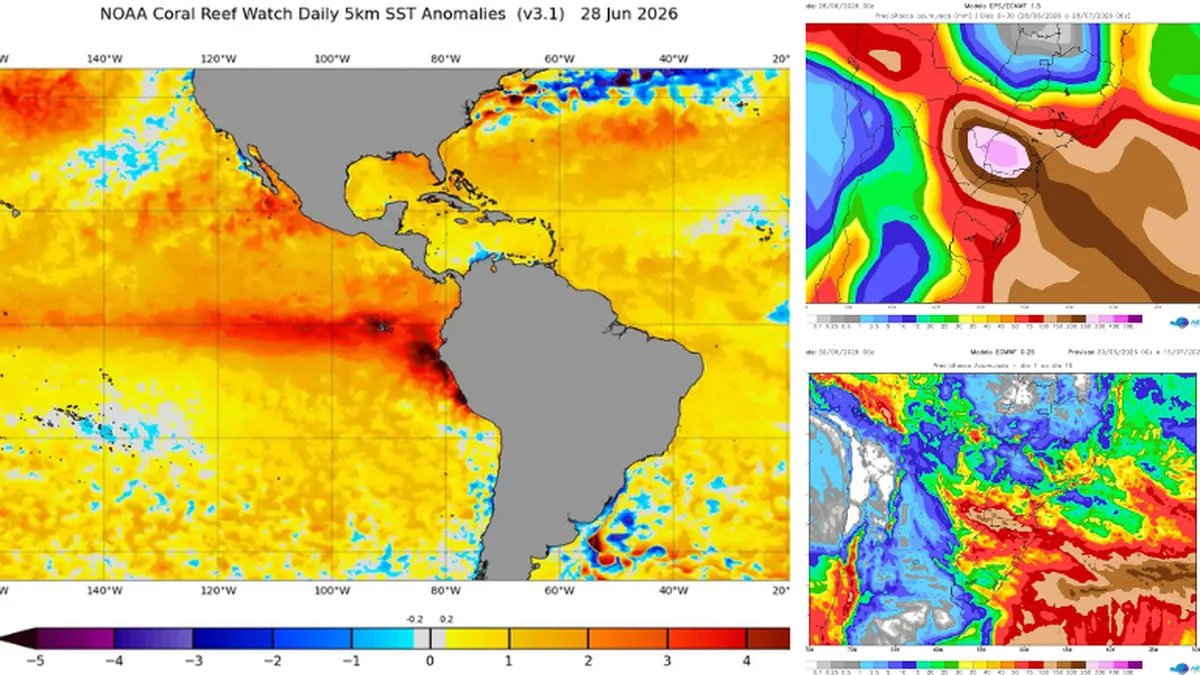
The month of July will be marked by strengthening of El Niñoa phenomenon that will continue to intensify over the coming weeks and that will favor a scenario of greater rains and new arrivals of cold air in a good part of the Southern Cone, according to the latest analysis of Metsul.
The Brazilian meteorological organization predicts that the second month of climatic winter will combine Above-normal rainfall events with new eruptions of polar air, a pattern that could also influence Uruguay.
El Niño continues to gain strength
According to the report of Metsulthe sea surface temperature in the equatorial Pacific continues to increase and confirms the intensification of the phenomenon.
According to the latest update of the United States National Oceanic and Atmospheric Administration (NOAA)El Niño already presents an intensity moderate or strongdepending on the measurement method used.
Metsul meteorologists consider that during July the positive anomalies will continue to increase and that the phenomenon could reach an intensity very strong in the coming months.

More rain for Uruguay and the region
The main impact expected for the Southern Cone will be an increase in precipitation.
Metsul points out that climate models show a broad consensus that July will have above average rainfall in southern Brazil, especially in Paraná, Santa Catarina and the northern half of Rio Grande do Sul.
According to the consultancy, during the winter the dry season over central Brazil favors the transport of humidity towards central Argentina, Uruguay and Rio Grande do Sula process that usually intensifies when there is an El Niño event.
For this reason, the organization understands that Uruguay could go through several episodes of instability during Julywith more frequent rains than usual.

New arrivals of polar air are also expected
Despite the higher humidity expected for the month, the cold will continue to be the protagonist.
Metsul projects that July will have normal or below average temperatures in much of southern Brazil and anticipates new incursions of polar air capable of causing widespread frosts, subzero temperatures and even snowfall in some areas.
Although the report does not make a specific forecast for Uruguay, this type of cold outbreaks usually reach Uruguayan territory, so the country could register new episodes of low temperatures during the month.

The consultant remembers that July corresponds to second month of climatic winter and, historically, it usually concentrates some of the most important cold waves of the year.
As an example, he mentions the heavy snowfalls recorded in southern Brazil in 2013 and 2021, in addition to polar irruptions that left temperatures below zero in much of the Southern Cone.
With a Increasingly intense childMetsul considers that July will combine cold, above normal rain and frequent weather changesa characteristic behavior of this climatic phenomenon in southern South America.