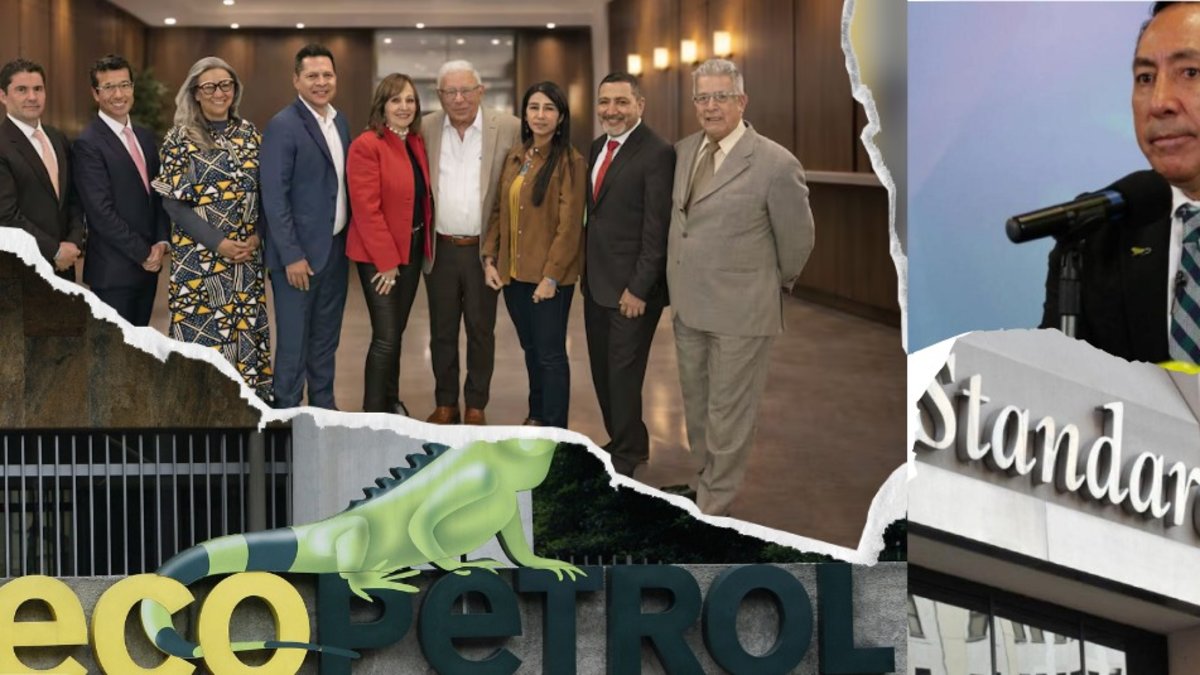
Around midnight last Wednesday, Ecopetrol sent relevant information to the Financial Superintendency regarding the reduction in its global credit rating of BB. to BB- by the renowned risk rating agency Standard & Poor’s.
READ ALSO

In a brief four-paragraph statement, the state company attributed the financial setback and reputational to the poor rating that the country also received.
READ ALSO

But Hours later, EL TIEMPO revealed that the report on the state company’s performance raises serious questions about its board of directors and talks about pressure from the Government. and the magnifying glass is even placed on the formation of that collegiate body, through which, for the most part, Petrism tokens have paraded.
The data was so devastating that the following Thursday, in his debut before the media, Juan Carlos Hurtado, The new head of Ecopetrol had to respond to the agency’s report.
READ ALSO

And, by the way, took the opportunity to distance himself from Ricardo Roa, who obtained unpaid leave and vacation, in the face of the two criminal charges he faces: for influence peddling —related to his connection with former police officer Juan Mancera and the purchase of apartment 901, revealed by this newspaper— and for violation of limits of the Petro Presidente campaign, of which he was manager.
Tail blow for the iguana
Juan Carlos Hurtado, president (e) of Ecopetrol. Photo:Ecopetrol
“It calls us to carry out actions and reviews to advance the sustainability of the company,” Hurtado said in a first approximation to S&P’s observations, after several questions from the specialized press.
Nevertheless, EL TIEMPO established that at the meeting on April 21, the report from the S&P agency will be addressed on a mandatory basis. which some described as worrying.
READ ALSO
For experts consulted by EL TIEMPO, The agency made clear what different sectors had been warning about for at least three years: the pressures from the Petro government to the board of the state company, putting at risk the corporate governance that governs it, and the formation of that collegiate body.
The brief communication to the Superfinanciera. Photo:THE TIME
The first figure that the risk rating agency highlighted is that Ecopetrol consumed almost 9 billion pesos more than expected. This means that, applied to the company’s total debt – which exceeds 118 billion pesos -, instead of generating nearly 2.95 billion pesos of free cash, it consumed an additional 5.9 billion.
And the pressure that the Government exerts on the company through the people it has been placing on the board is immediately addressed. It is even recommended that there be more independent board members (there are only 2 out of 9) and much greater turnover.
‘The Scary Ones’
Gustavo Petro, president of Colombia. Photo:Presidency
In fact, The governance of the state company was described as negative, a factor that ended up affecting the company’s rating.
In this regard, it is noted that the Government, the controlling shareholder, is a source of financial pressure for the oil company, which is exerted through the board. The outgoing president even described them as scared for not supporting Roa despite the accusations.
READ ALSO
“I said that I have never felt an attitude from the United States against Ecopetrol (…) Here I have representatives of mine on the boards of directors of public companies who are scared, not by the screams of the gringos but of the Uribistas. Oh God! “How can they think of offering the president of the largest company in the country and the President of the Republic himself to the extreme right on a platter just to scare them,” wrote President Petro.
Opaque future
The company seeks to compete with giants like Wall Street Photo:Bloomberg
Another pressure point identified by S&P is the distribution of dividends. After warning that these represent between 40 percent and 60 percent of the company’s net income, the rating agency says verbatim: “The Government’s continued trend towards maximizing dividend payments, together with its ongoing fiscal challenges, raises the possibility of constraints on Ecopetrol’s future financial flexibility.”
In this regard, in 2024, Ecopetrol distributed dividends of 15.6 billion pesos compared to a net profit close to 14.9 billion: that is, it paid more dividends than generated profits. What is striking is that, in March 2026, The shareholders’ meeting, at the initiative of the Ministry of Finance, raised the dividend proposed by the board of directors from 110 to 121 pesos per share.
The focus of the report, however, is that Ecopetrol loses investment grade and that corporate governance influenced this. that appears with a negative rating.
The fear of some board members is that what was reflected in the S&P report will become administrative and judicial investigations. by authorities in the United States – where the oil company is listed on the stock market – if it is proven that they did not protect Ecopetrol financially and reputationally.
INVESTIGATIVE UNIT
u.investigativa@eltiempo.com
@UinvestigativaET
Follow us now on Facebook