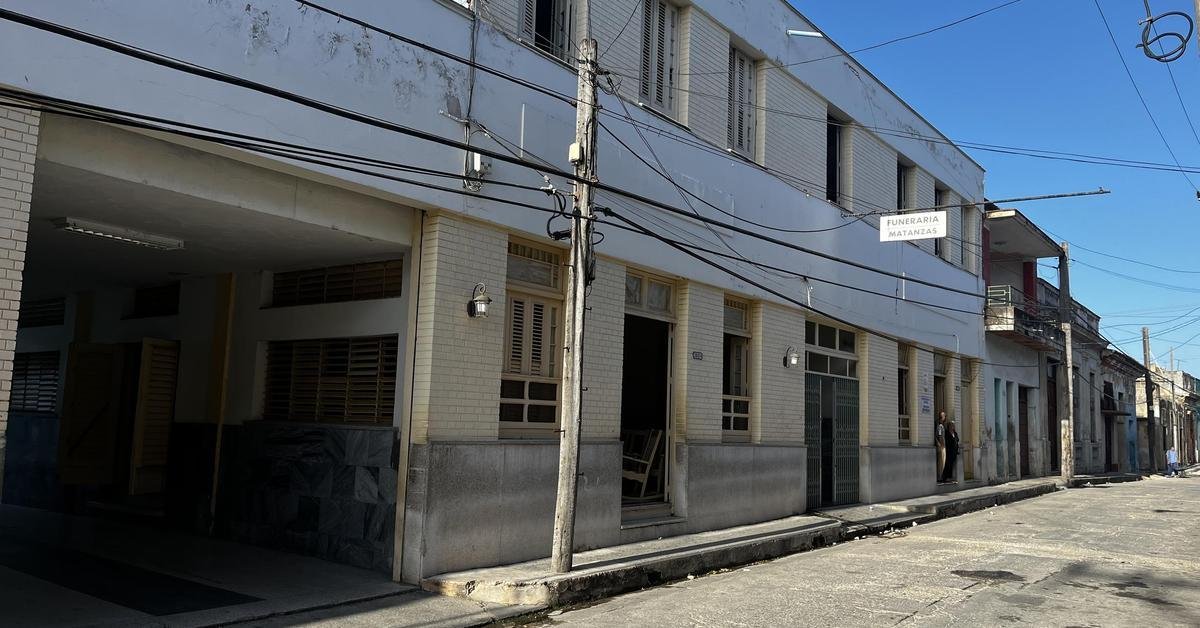
Matanzas/“The dead of each family are sacred. You cannot accept a chain of problems that ends with the corpse of your relative leaking liquids into a poor quality coffin.” With that harsh image stuck in her memory, Claudia summarizes the collapse of the obituary services in Matanzas. What should have been his grandmother’s farewell ended up becoming a scene of helplessness, putrefaction and abandonment.
In the province, as in the rest of the country, dying does not put an end to the hardships, but rather transfers them to another scenario. The family’s pain then collides with the lack of fuel, blackouts, damaged hearses and a chain of informality and corruption that feeds on the desperation of others.
Claudia still talks about her grandmother’s death with a mixture of pain and anger. “We decided to cremate her because we believed it was the quickest and most viable option,” he says. It was not the first time he had gone to the crematorium and, until then, the experience had been acceptable. This time, however, reality erased any remaining confidence in state service.
“We were naïve,” Claudia admits. “The camera also failed. In the end we had to bury it in a cemetery, with visible signs of decomposition”
After hours of waiting with her grandmother’s body, the response was dry: there was no backup liquefied gas or diesel to start the ovens. The family thought that leaving the body in the cold room could be a temporary solution, but it was another mistake forced by desperation. “We were naïve,” Claudia admits. “The camera also failed. In the end we had to bury it in a cemetery, with visible signs of decomposition.”
Claudia’s case is no exception. In Matanzas, the debacle of obituary services brings together shortages, blackouts and corruption. The crematorium oven, inaugurated in 2015, needs to reach temperatures between 850 and 1,000 degrees Celsius. For this it depends on the supply of liquefied petroleum gas or diesel. But even having fuel is not enough. The ventilation systems and the mechanical arm that introduces the bodies into the oven also require a stable electrical supply, something increasingly rare on the Island. And when fuel and electricity are lacking, the system reveals its most effective mechanism: bribery.
Jorge confirmed this after the death of his mother-in-law. The first response he received was blatantly frank: “There is only one car for 16 deaths in the city. It’s 3,000 pesos to get ahead on the list.” The message was obvious. There was no capacity to respond to normal demand, but there were mechanisms to disrupt order in exchange for cash.

/ 14ymedio
Although they officially told him that the crematorium was not working, that inactivity had a solution and also a fee. “For 15,000 pesos the lady will be cremated,” they told him. Jorge ended up paying 18,000 pesos between one thing and another to avoid further suffering for his wife. After that, the system, until then paralyzed, began to move with sudden efficiency. In a few minutes the car arrived and in less than three hours the body had been cremated.
What he saw there ended up revealing the extent to which money can unlock what precariousness keeps paralyzed. “They even removed the battery from the hearse to operate the mechanical arm of the oven,” he says. “He who has money, welcome; he who doesn’t, let him invent.”
In March 2026, the newspaper Giron He presented the incorporation of a single hearse as a reinforcement for the province. The news, conceived as a sign of good management, ended up showing the magnitude of the disaster. In an entire province, with dozens of deaths a day, the official remedy was summed up in a single new vehicle.
At street level, skepticism is total. A worker in the obituary sector, consulted by 14ymedio Regarding the arrival of the new vehicle, he responded with a mixture of tiredness and sarcasm: “Do you think that a hearse, no matter how modern it may be, is going to make a difference in a province of almost a million people?” The employee, who asked not to be identified, explained that precariousness forces everything to be improvised, from spare parts to fuel. “If it weren’t for that, we would already be going to bury people in horse-drawn carriages.”
What emerges from these testimonies and from the official admissions themselves is not a conjunctural failure, but a structural crisis. The material deterioration of obituary services shows that the country’s collapse is also measured by the way it treats its dead.