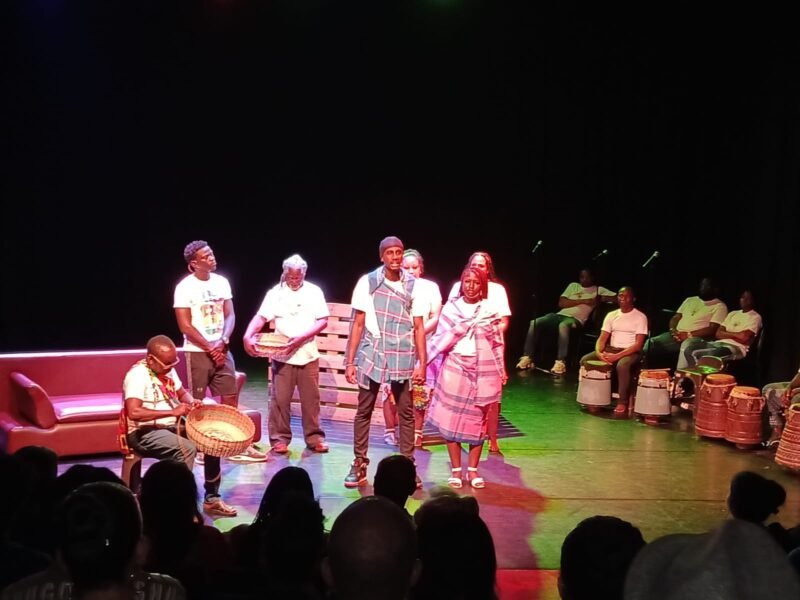
The theater performance ‘Manenge’ In On Stage Theater it starts at exactly seven o’clock in the evening with dazzling apintie drumming. The eight leading actors come on stage! ‘Manenge’a production by the Dutch foundation ‘Wi Mato’ begins with that deeply penetrating question that will haunt the entire story: ‘Who am I anyway?’ Rapper and singer Scrappy W, stage name for Claude Dinge, wrote the story for this play after a conversation with theater maker and director José Tojo.
Text and image Tascha Aveloo
‘Manenge’ is more than a theater performance. It is a mirror, a confrontation and a search for what it means to be a man in a world that is rapidly changing,” Tojo previously told the True Time. Guus Pengel edited the text and the dramaturgy was in the hands of Rehana Ganga.
Life in the village
“Who am I? I am a man, but not just any man… I am a descendant of brave men and proud women,” Scrappy states at the beginning of the story in which Lante, from the village of Semoisi, is central. That’s where the story begins, by the way. Lante is known as a man who knows the values, norms and requirements of the life of a Maroon. He is a dignified man who works hard, just as his ancestors had done. The piece is infused with vocals from four members of the singing group ‘Krin A’kra’ and an Apintie drum line-up of six men. We hear about the death of one kabiten in the village and the traditions surrounding the funeral rituals, for example that women do not go to the cemetery. The transfer of kia (training/discipline) to the young men by their grandfather is central, as is the lack of the baakumi(grave diggers) in the village.
Lante, in his naive youthful worldview, then promises his grandfather that he will never leave the village. Yet we see him years later in the city, where he had to go to continue his studies.
When someone dies, the oldest and strongest boys have to dig the grave. The influence of young people on these rituals is noticeable. Grandfather says that there are fewer and fewer young men in the village, which means that digging graves is taking longer and longer. Lante, in his naive youthful worldview, then promises his grandfather that he will never leave the village. Yet we see him years later in the city, where he had to go to continue his studies. There he notices the contrast between the stress of the city and the convenience of the village. In the city he has no space to live freely: he has to work and study and lives in a small house with many relatives. The economic pressure is heavy. There is great joy when Lante can study in the Netherlands Bush Pilot. Then the questions arise: What will it be like there? Will it be as busy as the city? He thinks back with nostalgia to the purity and connection with nature inland and tells his friends that he actually doesn’t want to leave. But driven by the economic situation, he starts looking for a ‘better life’.
Culture shock in the NetherlandsOnce in the Netherlands, Lante is picked up by friends from the past who wonder whether he has changed. When you return home, your shoes must be taken off immediately. Lante quickly notices that the gender models and expectations are different here. The social pressure may be heavier and everything is different – if only because of the cold and the scarce free hours. He is confused, he misses Suriname, his village and the way he could be a Maroon man there. The central question arises: do we preserve our culture or do we follow Western culture? He calls friends in Suriname who eventually tell him that he just has to adapt. In a group of friends of Surinamese men who play the drum, there in the Netherlands, conversations arise about being a man and culinary choices (no afingi but fries). There are questions about control in relationships (“What time are you home?”) and the blurring of the fairly strict traditional Maroon lines when it comes to gender roles and the tasks involved.
Lante cannot understand that in the Netherlands women take drum lessons, something that is traditionally reserved for men. He vents to his friends; he wants to hunt and build a boat, but that is not possible in the Netherlands. He also finds it unheard of to interact with menstruating women who simply cook. His friends try to encourage him to keep doing his best and, above all, to adapt. The discussion about what a ‘real’ Maroon man is becomes heated when it comes to the acceptance of kombosahaving a second wife, known to the first wife and completely normal in the traditional sense. A Maroon man who can take care of two or three women – because that is the requirement – is respected. Such a woman is not an outdoorsy woman, because all women are treated equally.
The Western mindset of the Surinamese women in the room was clearly audible: they resolutely rejected this. Is monogamy the only way? Is culture static or should we look at gender roles differently?
The return and the balance
Ultimately it’s all about balance. The masculine and feminine energies should not see each other as opponents, but as equal people. Lante experiences stress due to the pressure and sees how his friends struggle to find themselves between two cultures and believes that they have lost their identity. Money and progress are important, but not every choice feels like progress. Lante is about to graduate when bush pilot. Despite everything he has learned in Dutch society, he chooses Suriname. He does not like the strict agreements, the focus on time and punctuality, and the demanding changing gender roles in the Netherlands. In Suriname he can breathe and build something with someone who sees him as a Maroon man.
Finally back in his village, Lante is a grown man. Ready to have a wife. His uncle is happy to see him as one of the few ‘manenge’ who has really come back.
Finally back in his village, Lante is a grown man. Ready to have a wife. His uncle is happy to see him as one of the few ‘manenge’who really came back. He urges Lante to build up patience in order to live with a woman, because that is not easy. He must have the kia possess the skills to deal with a woman correctly, even in times of scarcity. His uncle tells him that westernization is also noticeable in the villages. There are women who now captain could be or those to the gold fields (gowtubusi) to go. The lespeki (respect) and the kia seem to disappear among young people.
But Lante wants to keep that promise to his grandfather for a real one manenge to be the one kia has received and who will do everything he can to continue to hold on to the traditions, and will also pass them on to the coming generation. The play is not a traditional play, which we are actually used to from Tojo. The story is a reality for every ethnic group: How do I maintain my cultural identity in the midst of my Western life.
Visitors to the performance who arrived late – some even for 45 minutes – missed important lessons from the performance.-.