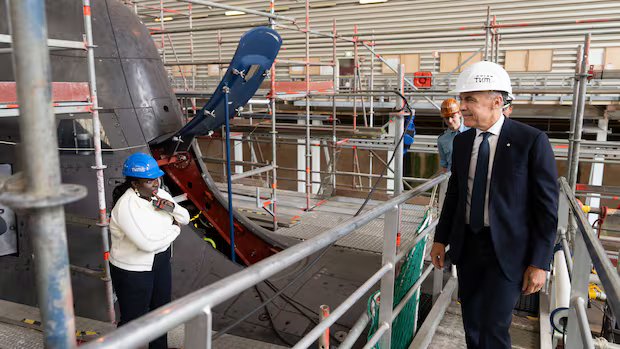
“Canada’s next submarine fleet will secure our coastlines and waters,” Prime Minister Mark Carney said early last month in announcing the choice of Germany’s ThyssenKrupp Marine Systems as the preferred bidder for the country’s new underwater fleet.
Patrolling Canada’s three coasts will be part of the job for the fleet of up to a dozen state-of-the-art diesel-electric 212CD submarines, says retired vice-admiral Darren Hawco, who commanded Canada’s Atlantic Fleet and served as the nation’s military representative to NATO until 2020.
“With three oceans, the Arctic responsibilities, they’re one of those strategic assets that we want to have.”
But Hawco says the subs — which are intended to replace the navy’s aging Victoria Class fleet and could be ready by 2034 — will also travel the world.
He expects to see them used in global hot spots from the Taiwan Strait and the nine-dash line in the South China Sea to the Mediterranean and the Baltic.
Protecting the seabed and everything on it
Nearer to home, the subs’ job will include protecting underwater infrastructure and resources that many Canadians are only dimly aware of, like the fibre-optic cables that carry trans-oceanic communications.
“Most people do not appreciate that 90 per cent of global telecommunications actually runs across the seabed,” said retired vice-admiral Mark Norman, former commander of the navy. “Everybody thinks it’s satellite based.”
“In the early days of the [current] Ukrainian conflict, we saw the vulnerability of underwater infrastructure.”
Even for these more domestic tasks, the submarines’ range of 7,000 nautical miles (13,000 kilometres) will be needed “because the distances are so vast,” said Norman.
The new subs “have lots of endurance. They are not designed to go anywhere particularly quickly, but they are designed to stay at sea for relatively long periods of time, get into a patrol area, and basically stay there.”
Their air-independent propulsion lets them remain submerged for about three weeks, allowing them to operate invisibly in areas such as the eastern and western approaches to Canada’s Arctic coast and archipelago.

Riches under the sea
Hawco says the immediate threat in the North is the fact that Canada and Russia have overlapping undersea claims.
There would be little return for Russia to invade Canada’s Arctic archipelago, much less its mainland, he said. But the ocean floor is a different matter.
“I think the return for them is to say, ‘I own the entire Lomonosov Ridge and all the resources that are there, and there’s nothing you can do,'” he said, referring to the 1,800-kilometre-long ridge under the Arctic Ocean that’s the subject of a territorial dispute.
The answer to that kind of threat, Hawco said, is “having a submarine that can operate at that kind of distance, that’s covert, super-quiet and can sink anything that comes close.”

As part of a bi-annual exercise, Canada’s HMCS Corner Brook torpedoed and sank a decommissioned American vessel, a former guided missile cruiser called the USS Mobile Bay, on July 12.
As undersea mining becomes more important, said Hawco, the subs will be called on to make sure resources on Canada’s continental shelf aren’t pilfered.
He cites reports on the amount of rare earth minerals Japan has found by surfacing mud offshore. “That’s just an indication of how much unexplored, unidentified and unarguably unexploited critical minerals there are in seabeds,” he said.
Protecting those resources in the future will involve submarines and a major investment in undersea technology, including “a whole bunch of sensors, whether sitting on the bottom or mobile,” Norman said.
A needle in a haystack
A major role for the submarines in NATO’s new Cold War with Russia and other adversaries will be intelligence-gathering and surveillance, including the covert insertion of special forces troops.
“They could be trailing other platforms, be they surface ships or submarines. They could just be doing general surveillance, including surveillance of land-based targets,” said Norman.
Norman says he sees the subs working in concert with a fleet of underwater drones, and doesn’t believe drones will render the submarines obsolete. Instead, their stealth will keep them relevant.
“Technology is not going to solve this problem in our lifetimes. It still will continue to be like finding a needle in a haystack, and nobody’s figured out how to do that yet,” Norman said.

Fear of what lurks in the deep
That stealth is the key difference between the new submarines and the current Canadian fleet.
“It’s hard to hide on this globe today with space surveillance being what it is,” said Hawco. But the new submarines “are able to operate in a very dead zone of water where sound doesn’t propagate well.”
The goal is to create a mystery about where they’re deployed.
“One of the greatest challenges in naval operations for an adversary is the knowledge that a submarine is out there somewhere, but you don’t know where,” said Norman.
When a Canadian frigate begins a deployment, there is typically a sendoff with fanfare. Pictures of the mission are posted to a Facebook page or the DND website and the frigate can be followed through online ship trackers.
Canada’s new underwater fleet will be much more secretive.
A submarine “could be just sitting on the seabed off its own home port,” said Norman, “but it doesn’t matter because it’s the fact that it’s at sea,” and therefore invisible. “It becomes an asymmetric consumer of resources to try to find a submarine.
“When you have a larger fleet, which we’re hoping to get, it has a multiplication effect on an adversary. If they know that Canada has six submarines deployed at a particular moment, in a crisis, then where the hell are the submarines?”
Canada skips chance to get strategic weapon
Canada’s choice of the German 212CD submarine over the larger South Korean Hanwha KSS-III wasn’t a purely technical decision, but also took into account economic and strategic factors, including the Carney government’s desire to integrate into European supply chains.
In an active war, the classic role of the submarine is to hunt and sink enemy shipping. The 212CD can accomplish that either with torpedoes or by launching cruise missiles through its torpedo tubes, which break the water’s surface to strike a ship or a target on land. The subs will likely use a yet-to-be-developed supersonic cruise missile with a range of about 800 kilometres.
But in rejecting the Hanwha option, Canada also turned down what would have been its first real strategic weapon — one powerful enough to change the whole war calculus for a potential adversary.
One difference between the two subs is the South Korean one’s ability to vertically launch ballistic missiles — in its case, the Hyunmoo-4 — a capability normally seen in nuclear-powered submarines.

Prime Minister Mark Carney says Canada is negotiating to procure ‘up to 12’ submarines from German shipbuilder Thyssenkrupp Marine Systems. Speaking to reporters in Halifax on Monday, Carney called the reported $24-billion procurement the ‘largest in Canadian history.’
While the Hyunmoo-4 may not ultimately exceed the 212CD’s cruise missile in range, it is a true ballistic missile that reaches into the exosphere and comes down at 10 times the speed of sound, making it very difficult to stop.
Moreover, its warhead weighs two tons, or about 15 times as much as the cruise missiles proposed for the TKMS submarine, and a sub in the Gulf of Finland could strike Moscow.
In fact, the KSS-III and Hyunmoo-4 package looks very much like a submarine designed in a country that’s thinking about nuclear weapons.
In Canada’s current strategic situation, Hawco said, it expects to fight as part of the NATO alliance, and “the military expectations of NATO for Canada don’t today include such a capability.”
“It would have been transformational in some respects from a war-fighting perspective,” said Norman about the South Korean option. “But that doesn’t mean the absence of that capability is in and of itself a vulnerability or a problem.”
In a different future, though, in which NATO and NORAD might continue to fray and Canada finds itself more alone, the choice to forego a strategic weapon might come to be regretted.
“There’s no denying that we won’t have that capability,” said Norman. “And I can’t sit here and tell you categorically that not having it is not a problem. But we didn’t specify it as a mandatory requirement.”