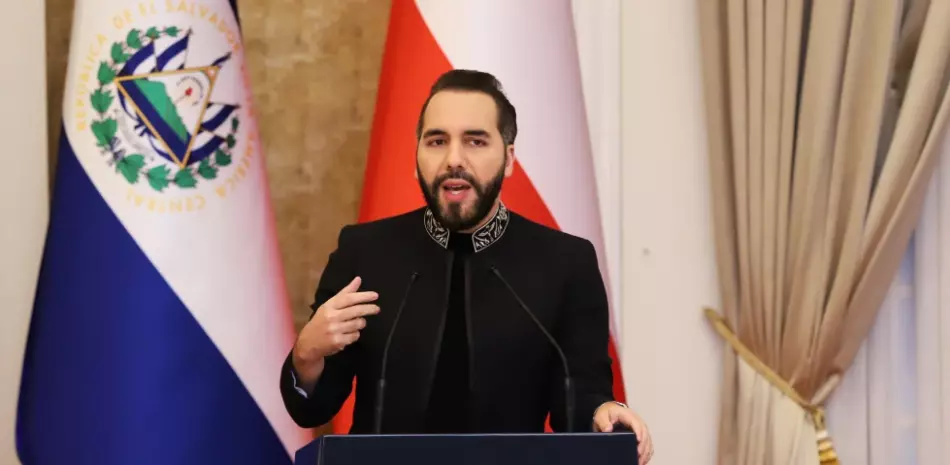
Salvadoran President Nayib Bukele sanctioned constitutional reforms on Wednesday to apply life sentences to minors and adults for crimes of homicide, feminicide, rape and gang membership.
The penal reforms, approved last month by the Legislative Assembly controlled by Bukele’s party, establish that this punishment will be imposed on perpetrators or accomplices – from 12 years of age – who have committed these crimes. They also stipulate the mandatory review of said measure depending on whether they are minors who have committed one or more crimes or if it is an aggravated offense.
The reforms also include the validity of the new criminal courts created with the amendments as of April 26. These criminal judges, formerly juvenile judges, must carry out a mandatory review of the life sentence to evaluate a possible regime of controlled freedom under certain rules.
This review should be mandatory for all prisoners sentenced to life every five years starting from 25 years in prison for minors, 30 years for adults, 35 for adults convicted of various crimes and starting from 40 years in prison for aggravated crimes, according to the new rules.
The Juvenile Penal Law that was reformed established that when the crimes were committed by gang members, the maximum penalty was up to 20 years in prison for minors who had turned 16 and up to 10 years when a minor had turned 12.
several rounds of negotiations
This occurs after several rounds of constitutional reforms promoted by Bukele, which have been harshly criticized by those who consider that they weaken the system of checks and balances and undermine the fragile democracy of the Central American country.
In July 2025, the government pushed another reform that would eliminate presidential term limits, paving the way for Bukele to remain in power indefinitely.
The reforms build on other measures Bukele has taken in his war against Salvadoran gangs, which began when he declared a state of emergency in March 2022 following a wave of gang violence.
This measure, initially temporary and extended for almost four years, suspends fundamental constitutional rights and has led to the arrest of around 91,650 people in El Salvador. Bukele has claimed that 8,000 innocent people have been freed.
Human rights organizations have documented cases of arbitrary detentions for years, and one of them even reported before the Inter-American Commission on Human Rights (IACHR) that the vast majority of those imprisoned under the state of emergency were arbitrarily detained. Bukele harshly criticized this accusation.