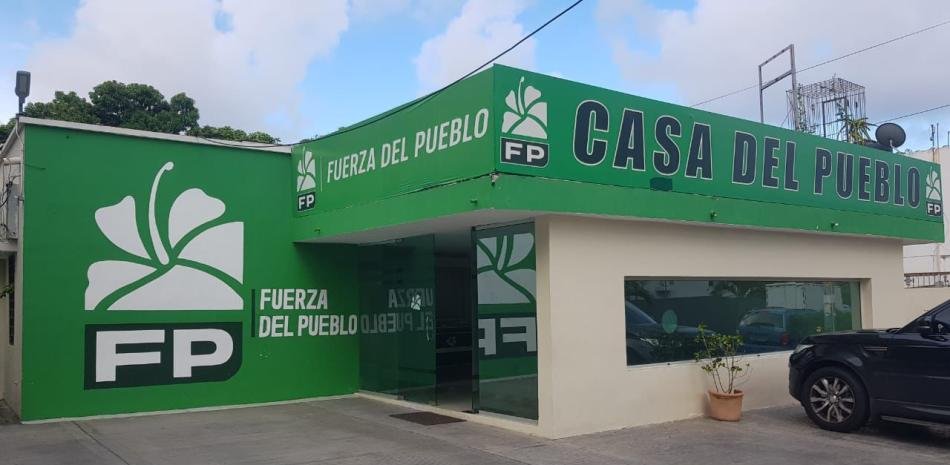
The People’s Force party (FP) warned this Thursday that the events caused by the rains of April 8 do not respond to an extraordinary event, but rather show structural failures both in the country’s critical infrastructure and in the risk management system, reflecting accumulated weaknesses in the planning, execution and response of the State.
During a press conference, the organization’s Secretary of Public Works, engineer Mariano Germán, stated that the end of operation of the line 2C of the Santo Domingo Metro constitutes a warning sign about the quality of a recently inaugurated work, by presenting leaks in stations, accumulation of water in the viaduct with potential electrical risk, collapsed drains in its immediate surroundings and uncertainty in the underground section.
He explained that these elements cannot be considered isolated events or a consequence of unpredictable rain, but rather manifestations of a systemic failure in a new infrastructure, which forces us to evaluate with technical rigor aspects such as project design, execution and supervision. In that sense, he warned that the highest level of concern is concentrated in the underground tunnel of more than 900 meters, whose real condition has not been publicly reported.
Germán also questioned that the system continues to operate under the “blank run” mode, transporting users without having completed its comprehensive validation, in a context where failures have already been evident in the interaction between water and electrical components, which he described as a high-risk decision in a massively used infrastructure.
For his part, the Secretary of Risk Management and Emergency Response of the People’s Force, Wilkin Moreno, maintained that the event that occurred in Greater Santo Domingo was previously warned through the official alert system, which had progressively escalated between 48 and 72 hours before, so it cannot be presented as an unexpected phenomenon.
He indicated that what happened responds to structural failures in prevention, institutional coordination and the system’s response capacity, evidenced by citizens trapped in flooded roads, interruptions of public transportation and the repetition of floods in historically identified pointswhich confirms the persistence of weaknesses in risk management.
Moreno pointed out that the country continues to operate under an outdated institutional scheme, with a National Risk Management Plan whose basis dates back to 2011, without evidence of structural review, and with key organizations that do not show sustained active functioning or transparent accountability to citizens.
Likewise, he questioned the lack of correspondence between the financial resources received by the State in terms of climate change and risk management, which exceed 700 million dollars in recent years, and the visible results in resilient infrastructure, urban drainage and preventive capacity, which raises questions about the effectiveness of said investments.
In that sense, Wilkin Moreno warned that what happened is not an isolated event, but rather the repetition of a pattern that has been manifesting continuously since the current administration came to power, recalling that since 2022 episodes of collapse due to rain have been recorded, with high intensity events in 2023, persistence of failures in 2024, new emergencies in 2025 and the same situation in 2026, which shows that the system has not been corrected despite to be foreseeable risks.
Both leaders agreed that the official narrative that attributes the effects of the event to the unpredictability of the weather contradicts the technical reality, since the rains were warned, the points of vulnerability were known and the impact was foreseeable from an operational point of view, which is why they insisted that the problem is not the rain, but the lack of preparation of the State.
In this context, the People’s Force warned that the country faces a repetitive pattern of crises associated with rain in recent years, without evidence of sustained structural solutions, which reflects the absence of institutional learning and the persistence of a reactive approach in public management.
The organization demanded an independent audit of the Santo Domingo Metro system, including the underground section of line 2C, as well as a comprehensive evaluation of the drainage system and urban infrastructure in the affected areas.
Likewise, he raised the need to effectively activate the coordination bodies of the risk management system, update the current National Plan, make transparent the use of resources allocated to these areas and establish clear protocols that guarantee a timely response to foreseeable events.
La Fuerza del Pueblo maintained that when a warned phenomenon becomes a crisis, it is not an extraordinary natural event, but rather an institutional failure that compromises the safety of the population, and warned that ignoring the signals that the infrastructure is already emitting could lead to greater consequences if corrective measures are not adopted in time.
In this context, the leaders of the People’s Force warned that the country faces a repetitive pattern of crises associated with rain in recent years, without evidence of sustained structural solutions, which reflects the absence of institutional learning and the persistence of a reactive approach in public management.
On behalf of the organization, they raised the need to carry out an independent audit of the Santo Domingo Metro system, including the underground section of line 2C, as well as a comprehensive evaluation of the drainage system and urban infrastructure in the affected areas.
Likewise, they indicated that the coordination bodies of the risk management system must be effectively activated, update the current National Plan, make the use of resources allocated to these areas transparent and establish clear protocols that guarantee a timely response to foreseeable events.
The leaders also maintained that when a warned phenomenon becomes a crisis, it is not an extraordinary natural event, but rather an institutional failure that compromises the safety of the population, and they warned that ignoring the signals that the infrastructure is already emitting could lead to greater consequences if corrective measures are not adopted in time.