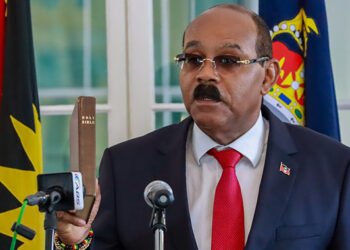
Deputy Prime Minister and Minister of National Security, St. Clair Leacock, says he was surprised by some of the items that came across his desk regarding information the Unity Labour Party administration was collecting on Vincentians.
“When I see the things that come across my desk in the responsible position that I have as Minister of National Security … sometimes I hold my head and I ask, ‘Is this the kind of intelligence and information that the then Honourable Prime Minister had of me, my political party, and private citizens… during his sojourn?’” Leacock said.
Leacock made the disclosure as he defended the Advanced Passenger Information and Passenger Name Record Bill in Parliament on Tuesday, which passed without a clearly defined position from the three-member opposition.
Leacock rejected criticisms by Opposition Leader Ralph Gonsalves and accused him of trying to sow doubt about regional and national security institutions, a claim that Gonsalves rejected.
Gonsalves was the prime minister and minister of national security when the ULP was voted out of office in November after 25 years at the reins of governance in St. Vincent and the Grenadines.

Leacock responded to Gonsalves’ questions about whether the legislation had been properly refined and vetted.
Gonsalves, a lawyer, said that the law “reads like a draft” and warned about data protection, appointment processes, and timelines for information submission.
However, Leacock cast Gonsalves’ contribution as part of a long-running pattern of needing to control every major policy initiative.
“If it is not under the suzerainty of the Honourable Ralph Everett Gonsalves, it ain’t good,” Leacock told Parliament, referring to Gonsalves.
“Anyone who is listening to this conversation [or] has seen this debate, there’s one conclusion you can come to in St.Vincent [and] the Grenadines: ‘If it is not under the suzerainty of the Honourable Ralph Everad Gonsalves, it ain’t good.’ That’s my conclusion,” the Central Kingstown MP said.
“Nobody is good enough for him unless he presides over it.”
Leacock argued that Gonsalves, as a former prime minister and long-serving minister of national security, should be more careful in how he speaks about institutions and officials who now administer security and data-related systems.
“I said to remind him that he has responsibilities to this country far bigger than himself.”
Leacock said he was “extremely disappointed” with Gonsalves’ presentation, which he said focused on “semantics” and “nitpicking”, including references to punctuation and drafting details.
“I mean the kind of nitpicking that you took us through this evening, the kind of semantics exercise … and this [is] what you have done for this country over so many years, and this is who you are.”
He suggested that Gonsalves’ critique was an attack on the integrity of public servants and regional security bodies.
“What I want the people to understand is that the essential feature of his presentation is to create doubt into the integrity and the credibility of regional and local public servants. Nobody is good enough for him unless he presides over it. That’s what he is about.”
Gonsalves, however, rejected Leacock’s assertions, saying he never badmouthed the regional bodies.
However, Leacock said Gonsalves wanted “to parade here as a colossus… that all things are beautiful, but without you, St. Vincent will fall apart. Not so, and the people have proclaimed on that.”
He said Gonsalves left SVG “with a ramshackle security apparatus”.
Leacock used port security and police operations to argue that the country inherited a poorly integrated security system and now faces threats that may exceed local capacity.
He said that Gonsalves’ government installed screening equipment at the port.
“You don’t want to talk about that the police, over what you have been in control of for many years, complain bitterly about inability to get information through that same mechanism,” he said.
“What are the instruments you left to mandate them or the port to automatically provide to the police information that comes as a way of the screening process?” Leacock said, adding that he was not imputing improper motives.
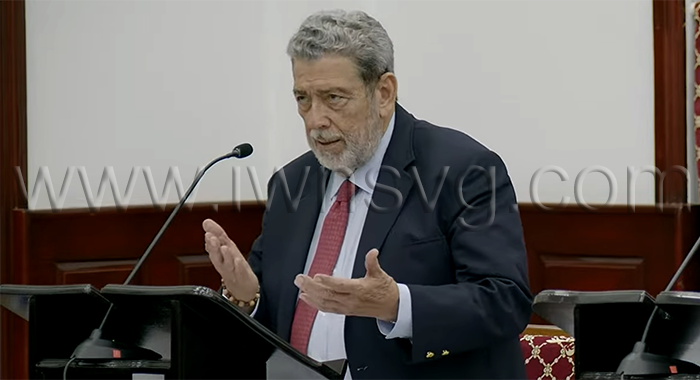
Gonsalves had argued that the bill appeared not to have gone through the full CARICOM Legal Affairs Committee (LAC) process, saying, “I read this bill and it reads like a draft. It doesn’t read like a final product.”
He expressed the view that lawmakers would return to Parliament to amend the bill, adding that he had “an uneasy feeling” about whether the regional legal processes had been followed.
Leacock responded that the legislation had, in fact, passed through the regional machinery, including under Gonsalves’ own tenure:
“This legislation … came before your administration by the same LAC that you speak about, since 2024 and has gone to your scrutiny. And you, Honourable Ralph Everett Gonsalves, have presided over the same CARICOM IMPACS…”
Leacock responded to Gonsalves’ comment about wanting to see the New Democratic Party administration serve only one term.
“It points… to a poison that in order for this country to go forward, we must not underestimate the hurdles that remain for us to climb… Your single purpose is to ensure that we become a one-term government.”
Leacock, however, said his own focus was on citizen security and institutional strengthening:
“This advanced passenger information bill… is for the single purpose of securing people who must travel in and out of our state… and be satisfied… that coming to St. Vincent [and] the Grenadines, there’s not only safety, but a sufficiency of ease of access.”
Leacock argued that any imperfections in the law could be addressed through active governance and regulation rather than delaying or undermining the framework.