The Liechtenstein Employees’ Association held its May 1st celebration on April 30th – with a topic that is currently very important to the working world in the country: mass layoffs.
Association president Sigi Langenbahn was pleased about the large number of participants despite the beautiful weather and the long weekend ahead. Among the guests were Minister of Society Emanuel Schädler, several members of the state parliament and deputies as well as representatives of the social partners from the Chamber of Commerce and the Liechtenstein Chamber of Commerce and Industry.
In his greeting, Langenbahn recalled the history of the holiday: May 1st goes back to the labor movement of 1890, when workers in the USA fought for the eight-hour day and the strike in Chicago was bloodily suppressed. The fact that Liechtenstein introduced the holiday comparatively late also explains why the celebration traditionally takes place on the evening of April 30th.
The pocket knife as a symbol
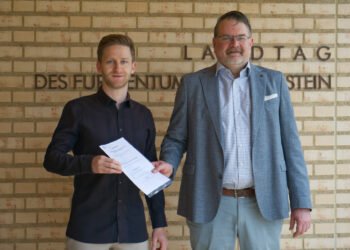
The strongest impression of the evening was made by lawyer Peter Beck, who appeared as a surprise guest. Beck, whose father and grandfather were both LANV members, spoke about what has defined the association since its founding in 1920. His image: a red pocket knife – versatile, reliable, always with you.
Beck recalled that the LANV was created in the same uncertain 1920s as the State Court, which is celebrating its centenary this year. Both grew out of the desire for justice and security. The association has changed significantly since then – from a combative representative of interests to a recognized social partner – and is now just as much a part of Liechtenstein’s reality as the companies themselves. In view of digitalization and artificial intelligence, it is needed more than ever: “In the end, it’s not about technology, but about people – and people need a strong voice when they are alone.”
Legal and political classification
The focus of the event was the question of what applies legally to mass layoffs and what is required politically. A lawyer explained the legal definition: Mass layoffs occur when a large number of employment relationships are terminated for operational reasons within a certain period of time – a definition that goes back to an EU directive from 1975 and also applies in Liechtenstein.
Employers are obliged to inform the Office of Economic Affairs in advance. Confirmation of the ad triggers a 30-day blocking period. The office does not carry out a substantive examination of whether the dismissals are justified – it is only a matter of whether the report was filed on time.
Politically, it was clearly emphasized that mass layoffs are much more than a business decision. They affect people existentially, put a strain on the health of those affected and affect social cohesion. The demand for politicians: create framework conditions at an early stage that enable socially acceptable processing – and not react until the terminations have already been announced.