SPLIT OPINION:
KMT legislators support different figures of the defense budget, ranging from the party’s proposed ‘NT$380 billion plus N’ to NT$810 billion
-
By Lo Kuo-chia / Staff reporter
The Chinese Nationalist Party (KMT) is slated to hold a meeting on Tuesday next week as party lawmakers debate the special defense budget.
The Cabinet in November last year proposed a special budget of NT$1.25 trillion (US$39.46 billion) to fund domestic weapons systems and US arms packages.
It covers eight US weapons systems costing US$11.1 billion announced by Washington in December last year, undisclosed items and domestically manufactured weapons, notably drones and the “T-Dome” air defense system.
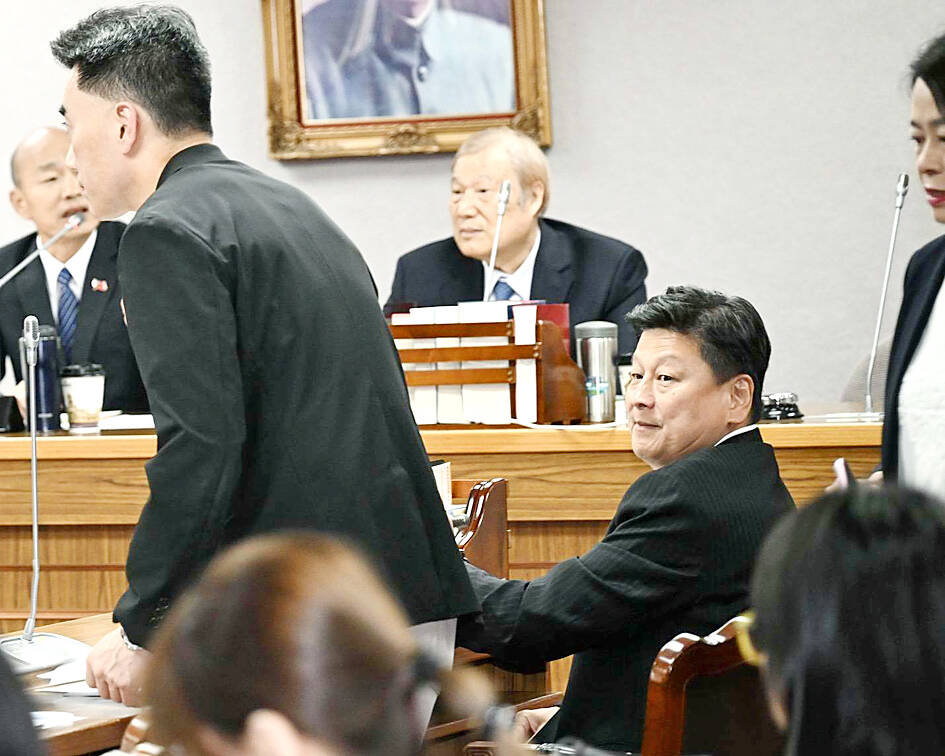
Photo: Lo Pei-de, Taipei Times
The KMT proposed a “NT$380 billion plus N” budget, with N referring to funds that could be allocated after receiving letters of acceptance for arms sales from the US.
The Taiwan People’s Party’s (TPP) version of the budget set a ceiling of NT$400 billion.
Legislative Speaker Han Kuo-yu (韓國瑜) is scheduled to lead another cross-caucus negotiation on the budget on Wednesday next week.
Taichung Mayor Lu Shiow-yen (盧秀燕) said in an interview with the Liberty Times (sister paper of the Taipei Times) in late March that it would be reasonable to set the amount at between NT$800 billion and NT$1 trillion.
Senior KMT member and former Broadcasting Corp of China chairman Jaw Shaw-kong (趙少康) said he supports an NT$810 billion special defense budget, but proposed first approving NT$350 billion tied to existing US arms sale offers and freezing the remaining NT$460 billion until new US offers are issued.
KMT Legislator Hsu Chiao-hsin (徐巧芯) has previously proposed a budget of NT$800 billion.
The KMT party headquarters, meanwhile, insisted on the “NT$380 billion plus N” proposal.
At a gathering of the KMT’s Central Standing Committee on Wednesday, Chi Lin-lien (季麟連), a 78-year-old retired ROC Marine Corps general and one of the KMT’s four deputy chairs, reiterated his support for the “NT$380 billion plus N” plan and said Han should be expelled from the party for his alleged support for a larger special budget.
Local media reports suggested that, before a KMT caucus meeting that took place on the same day, party officials had mobilized contacts to lobby KMT legislators. However, during the meeting, opinions were split between those supporting the NT$800 billion proposal and those backing the party’s proposed “NT$380 billion plus N” version.
According to sources, among the attending KMT lawmakers, around 20 supported the NT$800 billion figure, seven backed the “NT$380 billion plus N” version, and five remained undecided. Most legislators planning to run for mayor in the year-end elections said that they could not support the “NT$380 billion plus N” plan, sources added.
At one point, a lawmaker suggested a recorded vote, but party leaders adjourned the meeting without reaching a conclusion, leaving the matter to be discussed at a later date, they said.
KMT caucus whip Fu Kun-chi (傅?萁) told reporters after the meeting that the next Legislative Yuan session would be held on Friday next week, which leaves time for further discussions.
“The caucus is committed to conducting the most democratic communication possible and, once a consensus is reached, will report to the public as quickly as possible,” he said.
With the KMT divided and some voices arguing that anyone who supports a budget exceeding NT$380 billion aligns with pro-US factions and acts as a “CIA stooge,” Lu said in response to media queries yesterday that “harmony at home brings prosperity to all.”
“Whether it’s a city, a family, a nation, or any organization, only with harmony can everything thrive,” she said.
New Taipei City Mayor Hou You-yi (侯友宜) of the KMT yesterday said that people might disagree on the budget, but defending Taiwan must come first.
“Without that capability, discussions of peace are meaningless,” he said.
When asked which version he supports, Taipei Mayor Chiang Wan-an (蔣萬安) of the KMT yesterday said he backs bolstering Taiwan’s defense while calling for open discussion.
“The most important thing is for the party caucus to fully exchange views and reach a consensus before making a decision,” he said.
Additional reporting by Tsai Shu-yuan, Wong Yu-huang, Kan Meng-lin and CNA