Melissa Lavigne has done a lot of kayaking on the St. John River in Fredericton.
But recently, as she explored the shoreline on the city’s south side, she came across a couple of grave discoveries, one with a possible link to a passenger on the Mayflower.
Lavigne found a headstone and a grave marker for two different men, buried 67 years apart in different cemeteries, kilometres away from each other.
“It’s very weird,” Lavigne said. “I hope this river isn’t trying to tell me something.”

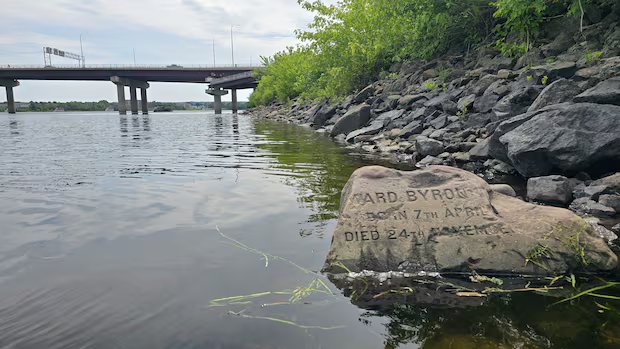
A kayaker out for a paddle discovered a headstone and a grave marker in the St. John River in Fredericton.
The headstone was visible during the summer’s low water, partially submerged against the rocky shore.
Some lettering is worn away on each side, but what’s visible on the stone reads:
WARD BYRON
BORN 7th APRIL
DIED 24th NOVEMBER 04.
The stone rests about 100 metres upriver from the Westmorland Street Bridge.
Other than the text, the headstone is not unlike other stones along the riverbank.

“It looked like just another rock on the side of the river,” Lavigne said.
But those few letters and dates on the stone can tell a lot.
A man buried a little more than three kilometres away shares the same name and dates.

Records from the Provincial Archives of New Brunswick list an Edward Byron Winslow as being born April 7, 1842, and dying on Nov. 24, 1904.
Winslow’s obituary calls him “a prominent lawyer and citizen of Fredericton,” and says he died “after a long illness of brain trouble.”
Winslow was associated with J.J. Fraser, a former lieutenant-governor of New Brunswick, the obituary says, and he was a direct descendant of “Edward Winslow, who came to America in the Mayflower in 1620.”
Despite the headstone poking out of the river, Winslow is now buried at the Forest Hill Cemetery under a headstone complete with his full name and dates for his birth and death.

Josh Green, manager at the provincial archives who helped track down Winslow’s details, said he has no idea how the headstone wound up in the river.
But his theory is that the stone in the river may have been discarded after a spelling error or design flaw during the engraving.

“There was a stonecutter at the west end of Queen Street that we found that was around in 1900, which is around the same time that this fella passed away,” Green said. “That’s rank speculation, but it did exist. Baxter’s Stone Works.”
“I’ve never heard of that before,” said Kathryn Murphy, a manager at Wolastoq Adventures, a rental service for canoes and kayaks that operates about a half-kilometre away from the grave stone.
“That’s awesome, a really neat discovery.”
She said she’ll direct customers to check it out now that she knows it’s there.

As for Lavigne’s second grim discovery, she said she fished a small grave marker out of the river later on her same trip.
The small silver and gold-coloured placard reads: ‘Walter F. Blair 1892-1971.”

According to New Brunswick’s vital statistics records, Blair was born at the Victoria Public Hospital, now the Victoria Health Centre, which sits by the riverbank where Lavigne found his grave marker.
According to records from the provincial archives, he was a major in the military and an accountant when he became a civilian.
“Walter Blair served with the 104th Regiment, and he served in both world wars,” Green said. “We actually have a photograph of him in his military uniform.”

Blair is buried in the extension of the Fredericton Rural Cemetery just upriver from where Lavigne found the marker.
Lavigne and her husband made arrangements to have the marker returned to Blair’s surviving family members.
Stuart Blair said he was a child when Walter died, so he didn’t know him personally, but he was pleased to receive the marker. He plans to give it to a Blair relative who keeps track of family history and related mementos.
Lavigne, meanwhile, is hoping future kayak trips will be less eventful.
“Well, that’s a lot of death in this river.”