by Steven Seedo
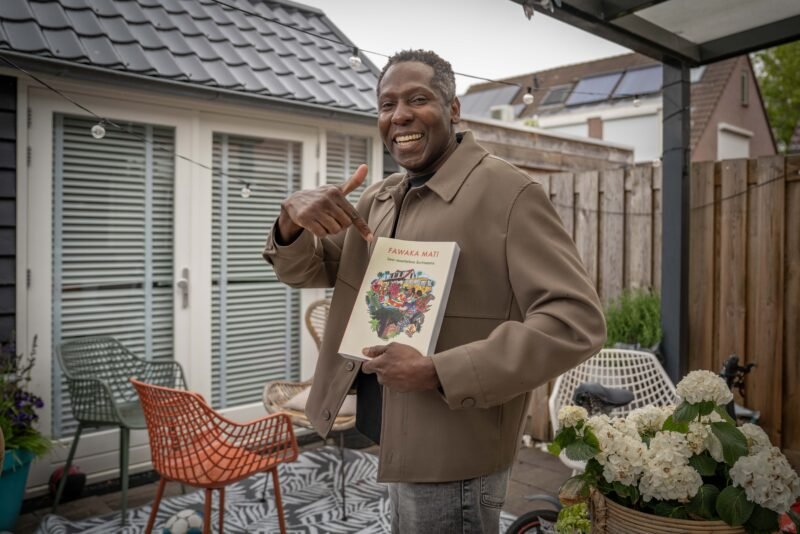
PARAMARIBO — “My dream is that ‘Fawaka Mati’ finds its way to Suriname and inspires people to record their own stories and pass them on to future generations. Because when stories disappear, a part of our history also disappears. And language only really lives when we speak it, share it and pass it on.” With these words, author, teacher and musician Benito Kaarsbaan (52) hopes that his recently published (language) book ‘Fawaka Mati – Learn Surinamese effortlessly’ will be popular in both the Netherlands and Suriname. From his 26 years of experience in education, he knows how important language is. “Language gives people self-confidence and ensures that you can participate in society. But above all, language tells who you are and where you come from.”
He wants to consult with the Surinamese Ministry of Education, Science and Culture about cooperation. “Even as a child, I dreamed that Surinamese would one day have a visible and valued place in education. I still carry that dream with me today.”
“I once wanted to mean something to my country of birth. With this book I am taking a first step in that direction“
Kaarsbaan says that he has lived in the Netherlands since he was eighteen, but that his bond with Suriname has always remained strong, “bika na ini Sranan mi kumbat’tei beri“, or my umbilical cord is buried in Suriname. “Family, friends and acquaintances still live there. But above all, Suriname lives in my heart.” His father passed away in 2020. “I promised him just before his death that I would one day give something back to Suriname. Actually, I had already made that promise to myself when I left for the Netherlands when I was eighteen. I once wanted to mean something to my country of birth. With this book I am taking a first step in that direction.”
Inspiration from daughter
The idea for the book arose three years ago when Kaarsbaan was lying in a hammock on the veranda. “I enjoyed the peace, music in the background and the memories of Suriname. Suddenly I heard my daughter say: ‘Dad, you always read books. Why don’t you write one yourself? A Surinamese book with which I can learn the language.’ I looked at her. It was quiet for a moment. “That’s actually a very good idea,” I replied. But deep down I already knew. This book had to happen.”
The idea grew into much more than a book to learn Sranantongo. “What started as a question from a daughter who wanted to learn the language of her roots grew into a journey that changed my life. While writing I discovered that it was not just about words, grammar or sentences. It was about identity, origins and the question of who I really am.”
More than learning the language
During the writing process he realized: “I gave my children the music, the food, the culture. But not the language. That realization hit me hard.” In the book, Kaarsbaan combines language education with personal stories from his youth. Divided into twenty-seven daily themes, readers learn Sranantongo step by step, with pronunciation and Dutch translations offered side by side.
He says that not only Surinamese recognize themselves in his story, but also people with roots in Aruba, Curaçao, Indonesia, Sri Lanka and Spain. “They tell me that they too have not fully received a language or culture and want to reconnect with their origins. That makes this mission bigger than myself.” With Fawaka Mati – Learn Surinamese Effortlessly, he hopes not only to teach people the Surinamese language, but also to contribute to the preservation of Surinamese culture, history and identity for future generations.