On May 30, one of the most flagrant acts of homophobia in the last year was recorded in Barquisimeto, Lara state. It was carried out by members of the Bolivarian National Police (PNB), many of whom have evaded justice and those who have not, do not face the absolute consequences of a direct attack and stigmatization against members of the LGBTIQ+ community who are clamoring for heavier sentences against their perpetrators.
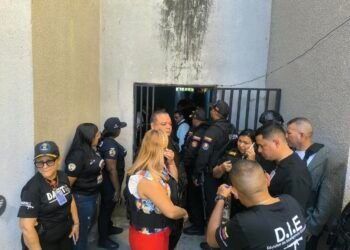
The events occurred in the afternoon, when after 4:00 pm approximately 20 members of the PNB canine brigade entered a sauna in Barquisimeto – some dressed in civilian clothes – to carry out an alleged police procedure.
It all turned out to be a farce; The objective was another: to kidnap and extort the 33 men from the LGBTIQ+ community who were at the site. They were threatened with firearms, insulted for their sexual orientation and isolated from the outside world when their belongings, including their cell phones, were taken away.
Under the threat of prosecuting them for their homosexuality—falsely arguing that it was a crime—and of planting drugs on them to imprison them, the uniformed officers separated each of the 33 men throughout the afternoon. One by one, they were forced to call their relatives to demand money in exchange for their freedom.
In some cases, they were even threatened with revealing their identity and sexual orientation if they did not comply with contacting their relatives or if, failing that, they did not have the money to pay.
The 33 men who were in Lara’s sauna remained in that situation until the early hours of the morning, when finally, after paying, they were all “released.”
The complaint and the lack of justice
Lawyer Henderson Maldonado assumed the legal representation of the 33 victims. On May 31, the formal complaint was filed against the officials. Although the investigation progressed quickly and several people involved were identified, the jurist maintains that the judicial action was limited both in scope and in the penalties imposed. .
“After the complaint, six officials identified by the victims were arrested, including some who managed to be identified by name. Now, the leaders of the canine brigade have not gone through the process nor have they been charged; they fled, they are evaded. The raid was carried out by between 15 and 20 officials, but only six are detained and charged,” Maldonado said.
Despite the obvious homophobic nature of the procedure, this was not the only motive of the police group. The lawyer pointed out that said commission had already operated under similar schemes against other premises in Barquisimeto.
Although the six detainees admitted the facts and pleaded guilty on June 2, the sentence handed down is insufficient for the seriousness of the crimes. They were sentenced to 5 years in prison for constriction, violation of home, unlawful deprivation of liberty and inhuman and degrading treatment.
“The crime of the Law against hatedespite providing for discrimination based on sex or sexual orientation in its article 121, neither extortion, nor brief kidnapping, nor association to commit a crime. As representation of the victims, we presented a complaint and a private accusation of our own with these crimes, but the control court did not admit it, arguing that the conclusive act was close and that they could not be accused of different crimes, even though the factual fact was the same and the law empowers the victim to present a private accusation,” questioned the victims’ lawyer.
Both Maldonado and the Public Ministry appealed the 5-year sentence against the officials due to the dosimetry of the sentence. For the lawyer, the seriousness of the crime of extortion – left out by the prosecution – as well as the aggravating circumstance of homophobia typified in the Law against hatewould mean that officials could face up to 23 years in prison.
“There was clear institutional homophobia as the correct formal and material controls were not exercised. In addition, the victims were granted a measure of protection and security because the relatives of the detained officials persecuted and threatened both me and three of the victims on the day of the presentation hearing,” added the lawyer.
This is not a unique case
Lara’s case is not an isolated event. It has deep similarities with other police actions registered in the country, according to Andreína Colmenares, legal advisor of the Venezuelan Observatory of LGBTIQ+ Violence. “Despite being a very emblematic case, this is neither unique nor is it an isolated event, but rather a something that happens frequently despite the fact that some cases have more visibility than others.”
Colmenares maintains that systematic discrimination based on sexual orientation or gender identity persists in the country: “There is no clear position on the part of the Venezuelan State. The argument is frequently used that homosexuality is a crime or that demonstrating freely in public spaces violates morality and good customs. Even the Law against hatewhich contemplates the sanction of discrimination based on gender, identity, race or creed, is not applied correctly; On the contrary, it is distorted to question people who walk freely hand in hand.”
Precisely the existence of the Law against hate It should be a mitigating factor to prevent attacks against people’s dignity from being carried out. Unfortunately, as Colmenares explains, this law has been used as an instrument of repression or persecution and not as one of defense for communities at risk such as LGBTIQ+.
“Basically this law has been part of a process that allows the community to be attacked. The Law against hate “It speaks of peaceful coexistence, tolerance, fraternity, justice, equality and recognition, but all these principles are distorted and used by the officials who guarantee peace to attack, extort, segregate and discriminate against people from the LGBTIQ+ community,” he explained.
Given this reality, the observatory insists on the urgency of establishing multidisciplinary working groups to address the vulnerability of the group in the country. “The call is to open the channels to regulate and carry out an awareness-raising process, because it is useless to have a document or law if it is not applied correctly. The Public Ministry, the Ombudsman’s Office, the Public Defense, the courts and the security agencies should be at these tables. Also the Labor Inspectorate, since we have registered cases of employment discrimination. If these officials are not trained to attend to, process and understand the level of protection required by the LGBTIQ+ community as a vulnerable group, the measures will be of little use. laws.”